
Payout Rails vs Payout Calculation Software: Why Teams Need Both
A practical comparison article explaining why Allocora complements payout rails rather than replacing them.
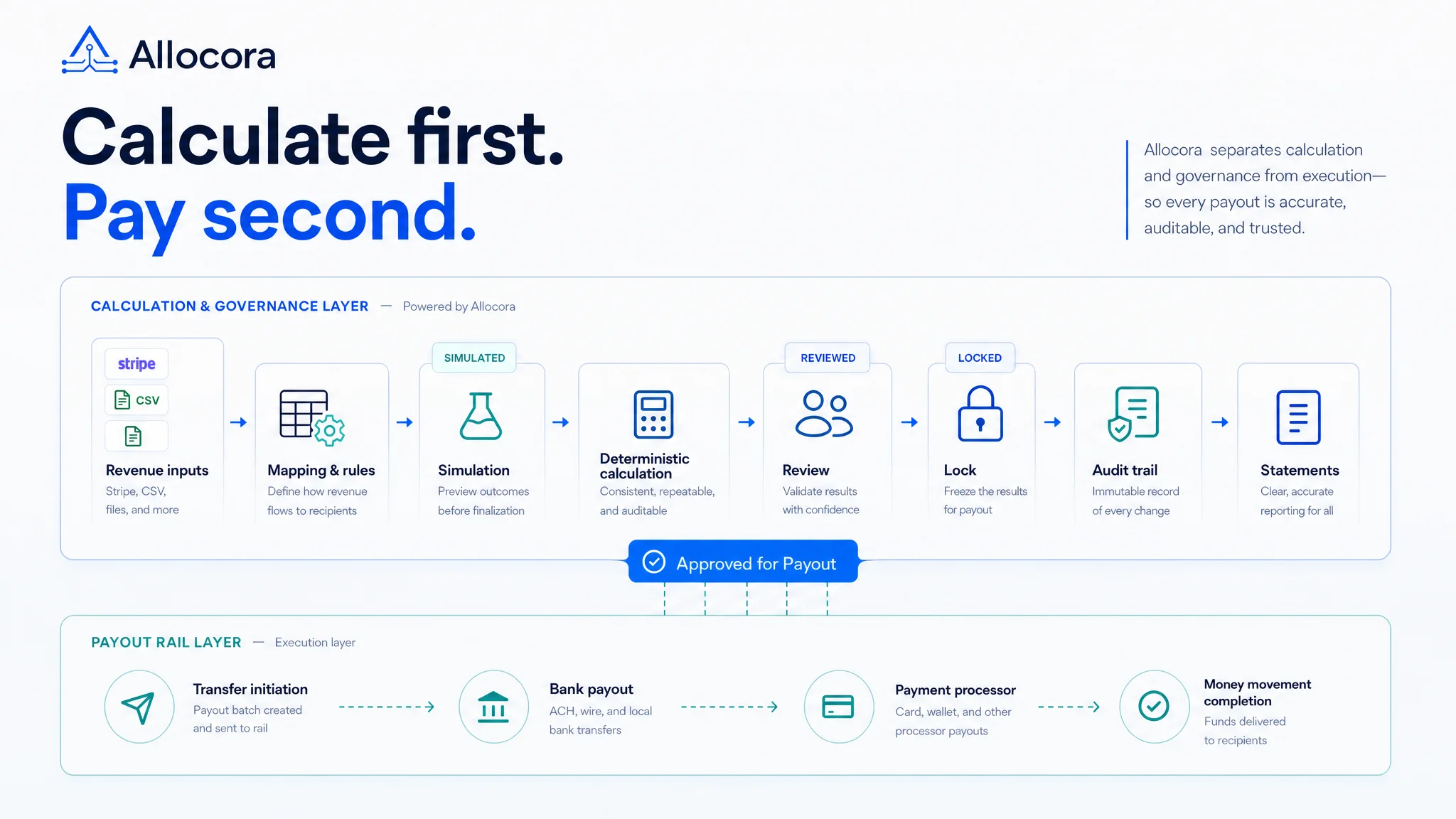
Payout rails and payout calculation software solve different problems. A payout rail moves money. Payout calculation software determines what should be paid, why it should be paid, and what evidence supports the amount before any transfer happens.
Confusing those jobs creates risk. If a team expects a payout rail to handle complex allocation logic, it may lose the review step that finance needs. If a team expects a spreadsheet to prepare payout amounts for a rail, it may lack deterministic runs, audit trails, and structured statements.
Allocora is payout calculation software. It calculates and governs payouts from revenue data, creates deterministic runs, preserves immutable snapshots, and generates statements and exports. It does not move funds, perform recipient onboarding, or replace compliance workflows. It complements payout rails by preparing reviewed payout evidence before money moves.
This article explains the difference.
What payout rails do
A payout rail handles execution. Depending on the provider, a rail may support:
- Bank transfers.
- Card payouts.
- Wallets.
- Recipient onboarding.
- Identity verification.
- Compliance workflows.
- Payment scheduling.
- Retry logic.
- Reporting on transferred funds.
Allocora's comparison content describes this category clearly: payout rails handle the parts of payout operations that Allocora intentionally does not touch. Stripe Connect is one example of a payout rail. Bank transfer platforms, payroll providers, and other payment systems can play the same downstream role.
If your payout logic is straightforward and the rail owns the full workflow end-to-end, a payout rail alone may be enough.
What payout calculation software does
Payout calculation software handles the logic before execution:
- Importing revenue data.
- Mapping products and payees.
- Defining allocation rules.
- Simulating rule outcomes.
- Detecting conflicts.
- Running deterministic calculations.
- Preserving immutable snapshots.
- Producing statements.
- Exporting payout-ready files.
- Creating audit evidence.
Allocora is focused on this layer. It is the calculation, governance, evidence, export, and reconciliation layer before payout execution.
That distinction matters because calculation errors become payment errors if they are not caught before the rail receives a file or transfer instruction.
Why payout rails are not enough for complex payout logic
Payout rails are strong at money movement. They are not designed to replace every company's allocation model. A marketplace might need seller-specific fees. A SaaS company might need recurring affiliate commissions. An agency might need partner revenue share rules. A creator or reseller workflow might need product-specific splits and adjustment handling.
Those rules often depend on:
- Revenue source.
- Product.
- Partner or seller.
- Territory.
- Metadata.
- Effective dates.
- Priority.
- Tiers.
- Refunds.
- Adjustments.
A payout rail can execute a transfer amount, but the team still needs to determine that amount. If that determination happens in a spreadsheet, the organization may have no durable proof of how the amount was calculated.
Allocora fills this gap with versioned rules, simulation, deterministic calculation runs, statements, exports, and audit logs.
Why spreadsheets are not enough before a payout rail
Many teams use spreadsheets as the calculation layer before a payout rail. This is common because spreadsheets are flexible and easy to start with. The problem appears when payout calculations become recurring or disputed.
Spreadsheet risks include:
- Formula drift.
- Manual edits.
- No immutable history.
- Copy-paste payout files.
- Inconsistent statements.
- Difficult prior-period reconstruction.
- Limited audit context.
Allocora's spreadsheet comparison page makes a useful distinction: spreadsheets are good for quick, one-off analysis and free-form modeling. They are not a payout system for recurring, auditable workflows.
When the output of a spreadsheet becomes the input to a payout rail, every hidden formula becomes a payment risk.
How Allocora and payout rails work together
The combined workflow is straightforward:
- Revenue data enters Allocora from Stripe or CSV/XLS/XLSX.
- Products and payees are mapped.
- Allocation rules are configured and simulated.
- Allocora runs deterministic calculations.
- Finance reviews the run, exceptions, and outputs.
- The run is approved or locked as appropriate.
- Allocora generates statements and structured exports.
- The payout rail executes payment using reviewed amounts.
The division of responsibility is simple: Allocora prepares the math, and the payout rail moves the money.
The benefit is governance before execution. Teams can catch unmapped products, rule conflicts, refund treatment issues, and statement inconsistencies before a transfer is sent.
The handoff should be an artifact, not a conversation
The best handoff from payout calculation software to a payout rail is a reviewed artifact. It should not be a verbal confirmation that "the sheet looks right." A reviewed artifact can include a locked run, statement PDFs, payee totals, calculation item exports, and a payout-ready file.
Allocora's export workflow supports structured outputs and audit logging. Its statement workflow generates payee-facing PDFs from locked runs. That gives teams a concrete package to hand downstream to finance or a payout rail.
That separation becomes important during payout review. The rail should receive reviewed amounts and supporting context. It should not be responsible for discovering whether a product was unmapped or a rule conflicted.
Examples by workflow
SaaS affiliate payouts
A SaaS team uses Stripe as the revenue source. Affiliate terms include recurring commissions, product-specific rates, and clawback treatment. Allocora imports Stripe revenue, maps products, applies rules, creates a deterministic run, and generates partner statements. The payout rail handles payment after review.
Marketplace seller payouts
A marketplace calculates seller payouts after platform fees, refunds, and adjustments. Allocora models seller fee logic, detects unmapped products, generates seller statements, and exports payout-ready files. The marketplace's payout rail executes transfers.
Agency revenue share
An agency splits revenue with partners, white-label clients, or internal teams. Allocora models the share rules, preserves historical versions, runs calculations, and generates close packages. The agency's accounting or payment workflow handles the downstream action.
Different workflows, same sequence: calculate first, pay second.
When a payout rail alone may fit
Use a payout rail alone when:
- Payout logic is simple.
- A fixed percentage or direct transfer covers the workflow.
- There are few payees.
- There is a single revenue source.
- The rail provides all required records.
- The team does not need to prove complex calculation logic later.
For many teams, this is the right approach. The workflow simply does not require an additional calculation layer yet.
When to add payout calculation software
Add payout calculation software when:
- Logic involves tiers, conditions, or multiple revenue sources.
- Payees need statements.
- Finance needs close artifacts.
- There are refunds or adjustments.
- Rules change over time.
- Someone needs to answer "how did we calculate this?"
- Governance controls matter before funds move.
- You run recurring calculations and need period-over-period reproducibility.
These are the conditions Allocora is built for.
What "governance before payout" means
Governance before payout means the team has a reviewable calculation layer before execution. It includes:
- Controlled source data.
- Mapped products and payees.
- Versioned rules.
- Conflict checks.
- Simulation.
- Deterministic runs.
- Immutable snapshots.
- Approval or lock controls where applicable.
- Statements and exports from the reviewed run.
- Audit logs for key changes.
Errors are much easier to fix before a payout rail receives the final amounts.
What to document internally
Teams adding payout calculation software should document where each responsibility lives. Keep a short operating note that says which system imports revenue, which system owns payout rules, where calculation runs are reviewed, which artifact is considered final, and which payout rail executes payment.
Clear ownership reduces confusion later. It also helps new finance and operations teammates understand why Allocora exists in the workflow even when the payout rail is already in place.
Questions to ask before adding a rail export
Before sending any file downstream, ask whether the calculation is actually ready. Have all products been mapped? Are all payees active and correctly versioned? Did rule simulation produce the expected matches? Were conflicts resolved? Was refund and adjustment treatment reviewed? Is the run locked or otherwise marked as reviewed? Do the statements and export totals match?
These questions belong before payout execution. If the team answers them after the rail receives the file, the workflow is reacting too late.
Pricing should match the calculation layer
Allocora pricing is based on operational volume: payees, rows, runs, and sources. The public pricing page states that Allocora does not charge transaction fees and does not move money. That pricing model matches the product boundary. Allocora is not monetizing money movement. It is providing the calculation workflow.
This also supports self-serve adoption. Teams can start free, then choose a plan based on the scale of their payout calculations.
Launch takeaway
Payout rails and payout calculation software are complementary. A payout rail moves money. Allocora calculates and governs the amounts before money moves.
Teams with simple payout logic may only need a rail. Teams with recurring, multi-party, rule-driven payout obligations need a calculation layer that produces evidence. That is where Allocora fits.
Teams evaluating Stripe Connect, marketplace seller payouts, or other payout approaches often end up comparing money movement and calculation governance at the same time. The distinction is straightforward: keep the rail, add a calculation layer when payout logic becomes difficult to manage.
Read Allocora vs payout rails, compare Allocora vs Stripe Connect, review Partner Settlements, review the product overview, or check the self-serve pricing.
Related Articles
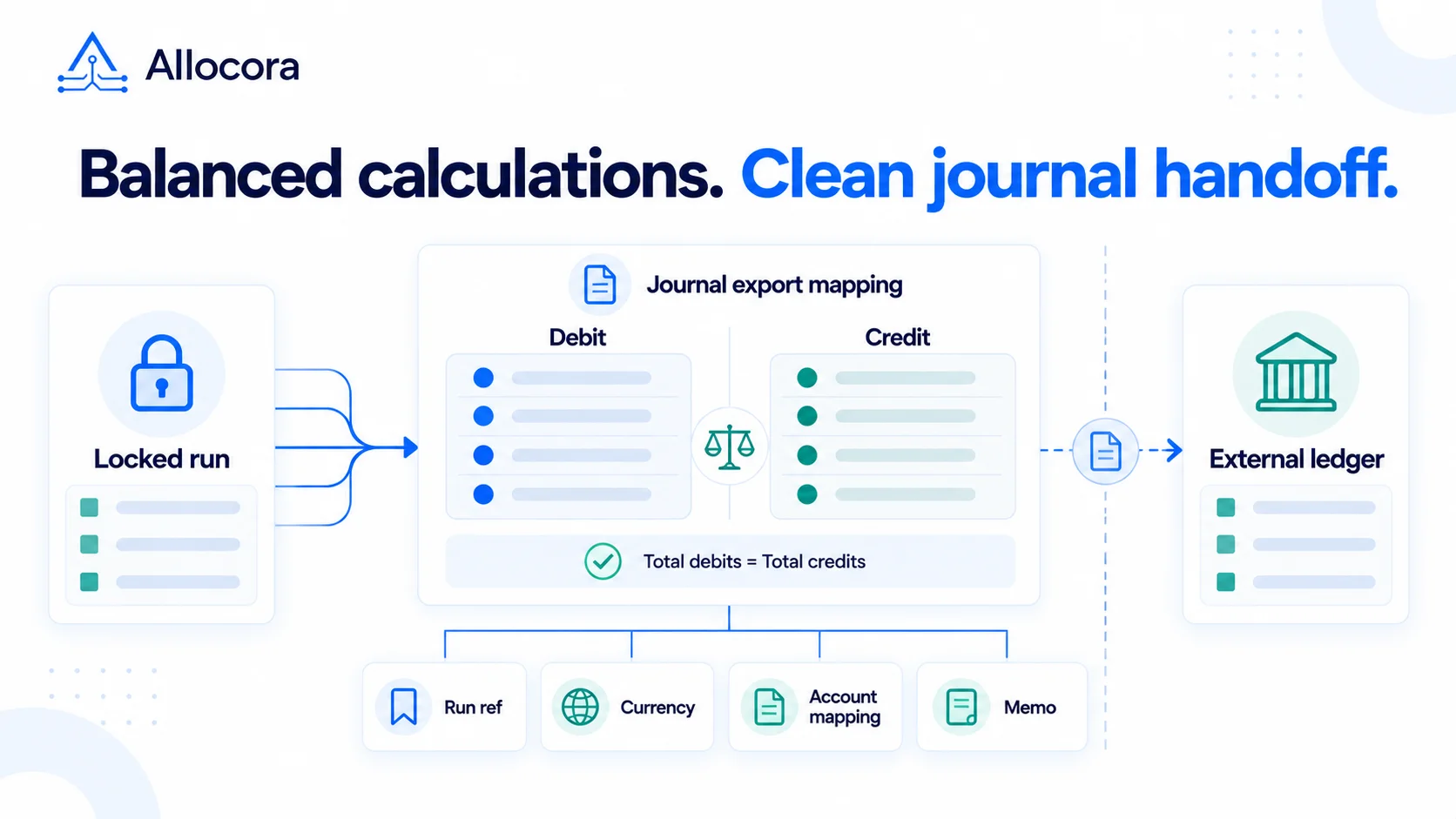 Journal Export Planning for Revenue Share, Royalties, and Partner Payouts
Plan a reviewed accounting handoff for revenue share, royalties, and partner payouts, with journal-basis choices, account mapping, and vendor-specific import checks.
Oct 15, 2026 - 8 min read
Journal Export Planning for Revenue Share, Royalties, and Partner Payouts
Plan a reviewed accounting handoff for revenue share, royalties, and partner payouts, with journal-basis choices, account mapping, and vendor-specific import checks.
Oct 15, 2026 - 8 min read
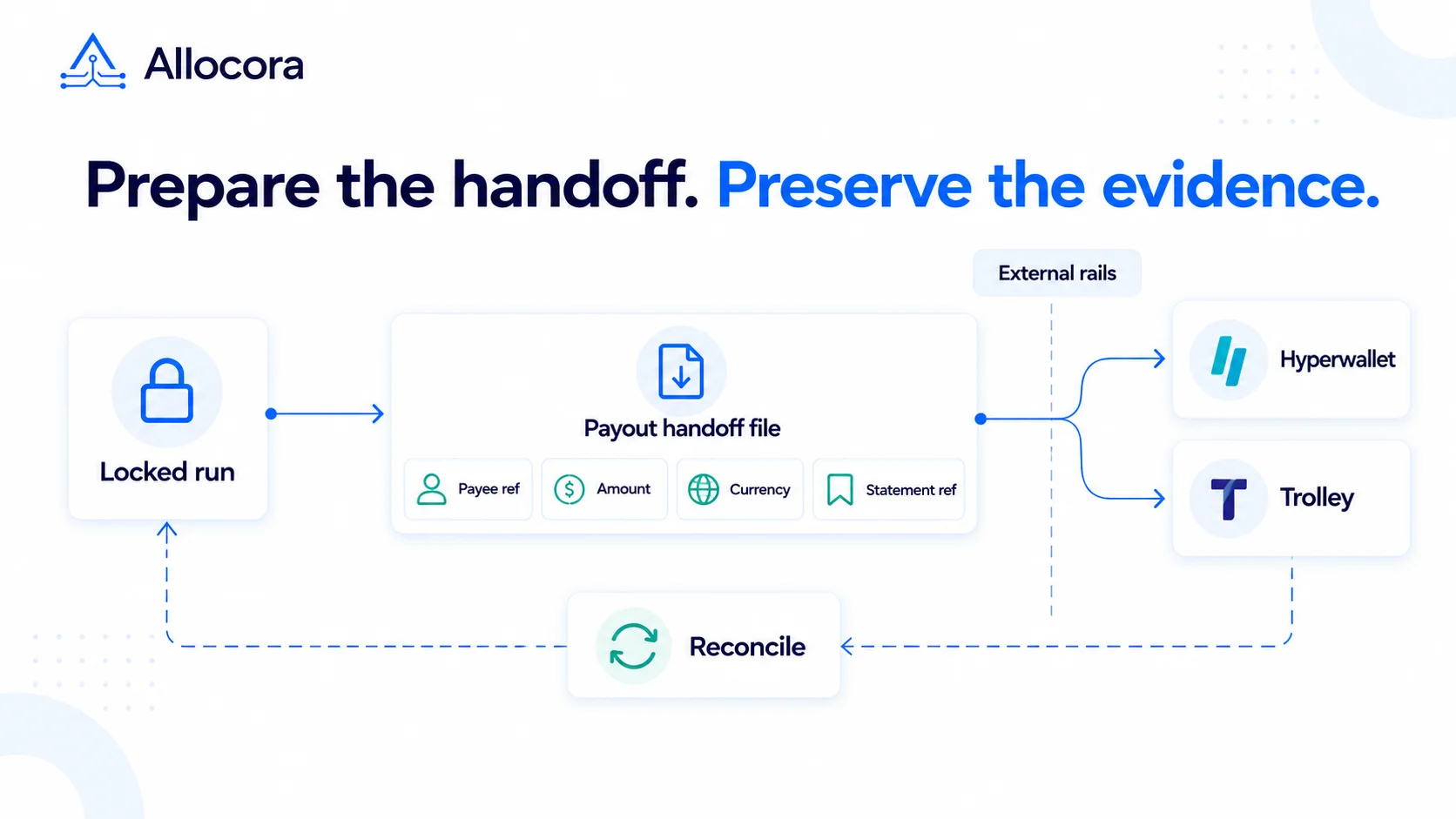 Hyperwallet and Trolley Payout Handoff Planning: Evidence and Fields to Prepare
Plan a Hyperwallet or Trolley payment handoff by separating locked obligations, export mapping, provider checks, and reconciliation evidence. This is not a provider-ready upload template.
Oct 05, 2026 - 5 min read
Hyperwallet and Trolley Payout Handoff Planning: Evidence and Fields to Prepare
Plan a Hyperwallet or Trolley payment handoff by separating locked obligations, export mapping, provider checks, and reconciliation evidence. This is not a provider-ready upload template.
Oct 05, 2026 - 5 min read
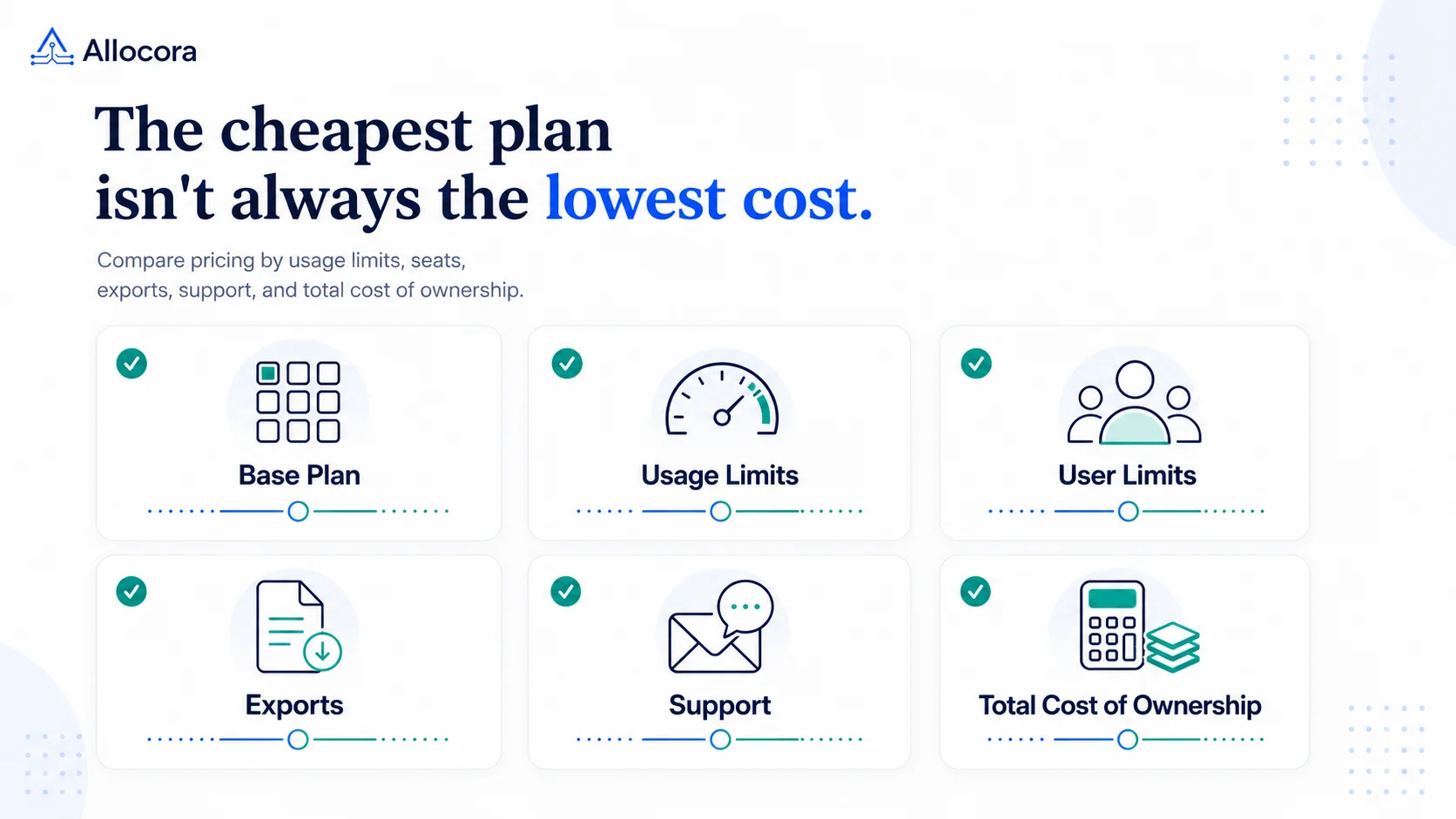 Payout Software Pricing Models: Usage Limits, Fees, and a TCO Checklist
A practical checklist for comparing payout software pricing models, usage limits, add-ons, implementation effort, and total cost before choosing a plan.
Aug 05, 2026 - 9 min read
Payout Software Pricing Models: Usage Limits, Fees, and a TCO Checklist
A practical checklist for comparing payout software pricing models, usage limits, add-ons, implementation effort, and total cost before choosing a plan.
Aug 05, 2026 - 9 min read