
Affiliate Payout Software for SaaS: What to Look For Before Launch
A practical launch guide for SaaS teams moving affiliate payout calculations out of spreadsheets and into governed, repeatable workflows.
Most affiliate payout systems look fine until recurring revenue starts changing underneath them. A SaaS affiliate program usually has recurring revenue, upgrades, downgrades, refunds, cancellations, product-specific terms, tiered rates, and partner questions after the month closes. If those details live in a spreadsheet, the payout number may be fast to calculate once, but hard to defend later.
The difficult part usually starts after the payout is calculated.
Finance still needs to explain where every number came from, rerun the same period later, and export something reviewable before money moves.
Before launching an affiliate program, it is worth understanding where payout operations usually break down.
Start with the real workflow, not the final payout number
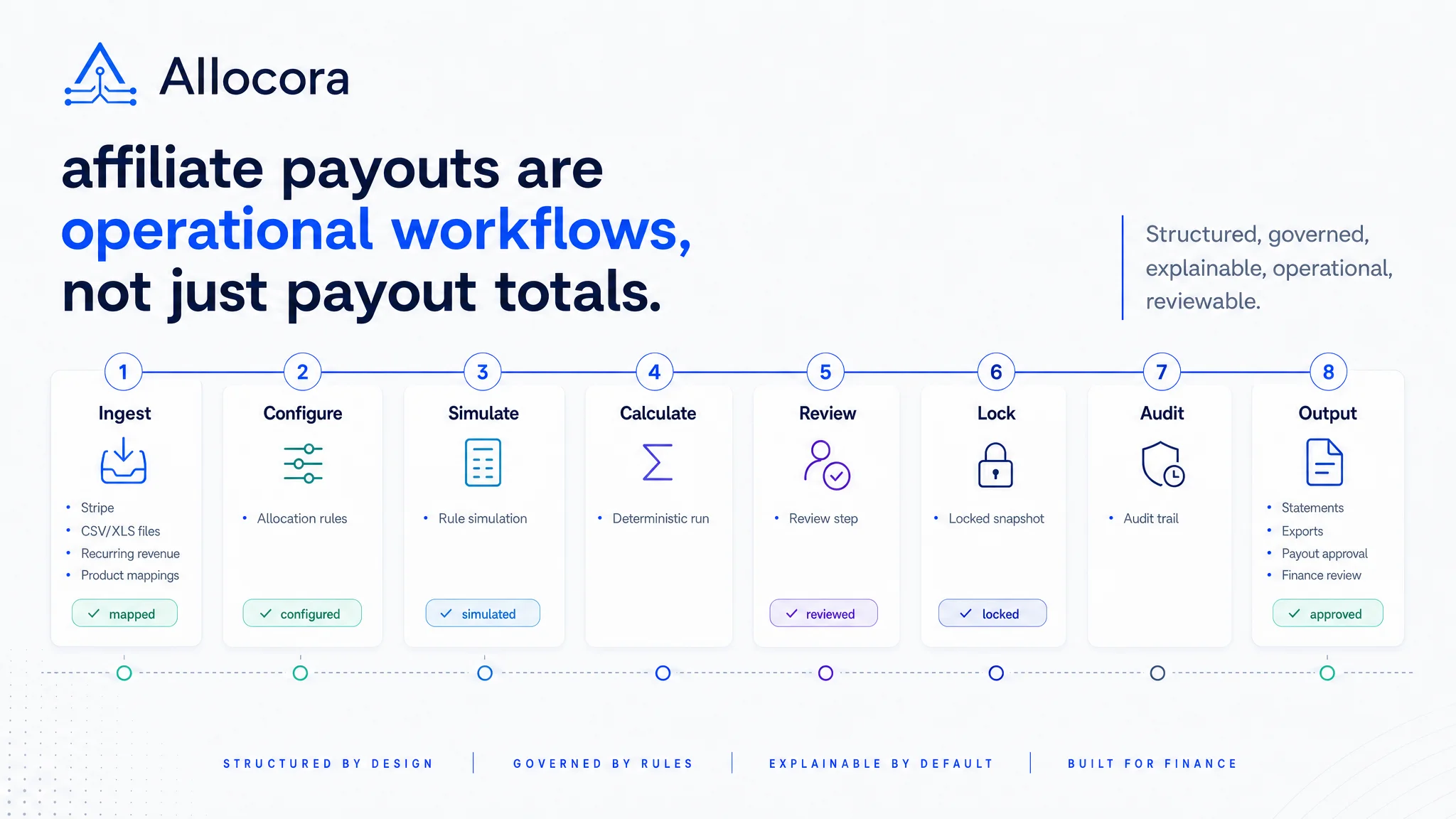
Many teams evaluate affiliate payout tools by looking at the final amount owed to each partner. That is necessary, but it is too narrow. In practice, affiliate payouts usually break down into something closer to this:
- Import revenue from Stripe or CSV.
- Normalize revenue rows into a canonical record.
- Map external product identifiers to internal products.
- Create payees for affiliates or partners.
- Define commission rules with flat or tiered allocation logic.
- Simulate the expected outcome before close.
- Run a deterministic calculation.
- Review exceptions, unmapped products, and rule conflicts.
- Lock or approve the completed run.
- Generate statements and exports for finance review and payout execution.
If the system only stores the final payout number, most of the operational context is gone.
Allocora follows this workflow directly. The product supports Stripe and CSV/XLS/XLSX revenue ingestion, product mapping, payees, rules, rule simulation, calculation runs, statements, exports, and audit logs. That makes the payout result a traceable artifact instead of an isolated number.
Recurring revenue makes affiliate payouts harder
SaaS affiliate payouts differ from one-time referral payments because the revenue changes over time. A customer may start on one plan, upgrade later, cancel mid-period, receive a refund, or buy multiple products under one account. Each event can affect commission eligibility.
This is usually where spreadsheets start falling apart. The workbook has to know which rows are in scope, which partner owns the account, which product was sold, which rate applies, whether a refund should claw back commission, and whether a prior-period adjustment belongs in the current close. At some point, nobody is completely sure which formula produced which payout line anymore.
A payout system should keep enough context to explain how each payout line was produced:
- Source revenue row.
- Product or external identifier mapping.
- Payee or affiliate.
- Matching rule version.
- Allocation amount.
- Explanation details.
- Export or statement output.
Allocora's calculation items include explanation payloads, and its rule simulation uses the same rule evaluation service as the calculation engine. That matters because the simulation and the final calculation follow the same logic.
Versioned rules are essential for partner trust
Affiliate programs change. You may introduce a new product category, adjust a tier, apply a different rate after a contract update, or pause a partner. Those changes should not rewrite the past.
A spreadsheet can keep separate copies, but copies are not the same as controlled version history. When someone asks why an affiliate received a certain amount for March, the answer should reference the rules that were active for March. It should not depend on whether someone saved the correct workbook version.
Allocora models payees and rules with immutable versions. Rule updates create new rule versions rather than mutating prior logic. Rules can support flat and tiered allocations, metadata conditions, priority ordering, and effective windows. That makes it much easier to change current rules without rewriting historical payouts.
This is especially important for teams searching for affiliate payout software for SaaS because recurring commissions are not just one formula. They need governance around changing terms, not another place to store an unreviewed rate.
Deterministic calculation runs prevent formula drift
One of Allocora's core product claims is deterministic runs: the same inputs and rules produce the same results. This affects how finance teams review and defend payouts later.
In a spreadsheet, rerunning the same period after formulas have changed can produce a different result. Sometimes that is intentional. Often it is accidental. Either way, it becomes difficult to prove what the team knew at close.
In a governed payout workflow, the run itself should become the record. Allocora creates calculation runs with snapshots, status transitions, persisted line-item outputs, and audit coverage. Completed runs can be locked, and locked runs support statement generation. This gives the finance team a stable point in time to review and export from.
For affiliate payout operations, deterministic runs help with:
- Partner disputes.
- Month-end review.
- Prior-period comparison.
- Rule change analysis.
- Export consistency.
- Internal approval workflows.
The payout number is no longer a moving target.
The best affiliate payout workflow separates calculation from money movement
Allocora's public positioning is clear: it does not send payouts or move money. That boundary is useful. Payout rails such as Stripe Connect, bank transfers, payroll providers, or other payment systems handle money movement. Allocora handles the calculation, governance, and evidence before that movement happens.
That separation matters during payout review. Before any transfer is executed, finance can review:
- Which revenue rows were included.
- Which payees were eligible.
- Which rules matched.
- Which rows were blocked by unmapped product identifiers.
- Which conflicts or exceptions need attention.
- Which statements and exports will be shared.
Affiliate payout software should not blur this step. It should make the pre-payout review more reliable.
Statements and exports are part of the product, not an afterthought
SaaS affiliate programs need partner-facing outputs. A partner may not care about the internal run ID or snapshot hash, but they do care about the statement that explains their payout.
Allocora supports per-payee statement generation from locked calculation runs. The implemented statement workflow includes summary statements, product-level statement modes, PDF artifacts, batch ZIP bundles, share URLs, and email delivery. Statement content uses snapshot-safe names and product data from the calculation items so historical statements do not drift after a later rename.
Operationally, this reduces a few common problems:
- Statements reduce manual copy-paste.
- Structured exports reduce file reshaping.
- Close packages give finance a repeatable artifact.
- Payee-level detail helps answer payout questions.
Statements and exports only matter if they can be traced back to the exact calculation run that produced them.
What to ask before choosing affiliate payout software
Use this checklist before choosing a tool or launching with a spreadsheet:
- Can the system import Stripe and file-based revenue data?
- Can it preserve revenue rows as append-only facts?
- Can it handle refunds and adjustments as explicit rows?
- Can products and external identifiers be mapped safely?
- Can every affiliate or payee have versioned terms?
- Can rules be simulated before close?
- Can the calculation run be reproduced from the same inputs?
- Can a completed run be locked before statements are generated?
- Can payee statements and exports be generated from the same run?
- Can the team prove which rules and source rows produced a payout?
If the answer is "no" to several of these, the team is probably still using a payout calculator rather than a payout governance workflow.
Where Allocora fits
Allocora is a self-serve revenue allocation product for teams that need governed payout calculations. It is strongest when a SaaS team already has revenue data and payout obligations, but the calculation layer is becoming too important to leave in spreadsheets.
Allocora currently supports:
- Stripe and CSV/XLS/XLSX revenue ingestion.
- Append-only revenue handling.
- Product mapping.
- Payees.
- Flat and tiered allocation rules.
- Metadata conditions.
- Rule simulation.
- Deterministic calculation runs.
- Immutable snapshots.
- Audit logs.
- Payee statements.
- Structured exports.
- Pricing based on operational volume, not transaction fees.
That makes Allocora a practical launch choice for SaaS affiliate teams that want to keep their payout rail while improving the calculation layer before funds move.
Launch takeaway
Affiliate payout software for SaaS should make the monthly close easier to explain. The key features are not only commission rates and partner totals. They are source-data control, rule versioning, deterministic runs, locked evidence, statements, and exports.
If your affiliate workflow is still a spreadsheet with hidden formulas, start by mapping the workflow from revenue import to final statement. Then decide where governance is missing. Allocora is designed for the gap between raw revenue and payout execution: calculating who gets paid, with proof.
Most teams do not think about payout governance at the beginning.
The real problems appear later, when recurring commissions, adjustments, and partner questions stop fitting cleanly into spreadsheets.
Teams that outgrow spreadsheet payout workflows usually need three things:
reproducible calculations, explainable statements, and a safer review process before money moves.
That is the workflow Allocora is designed around.
Related Articles
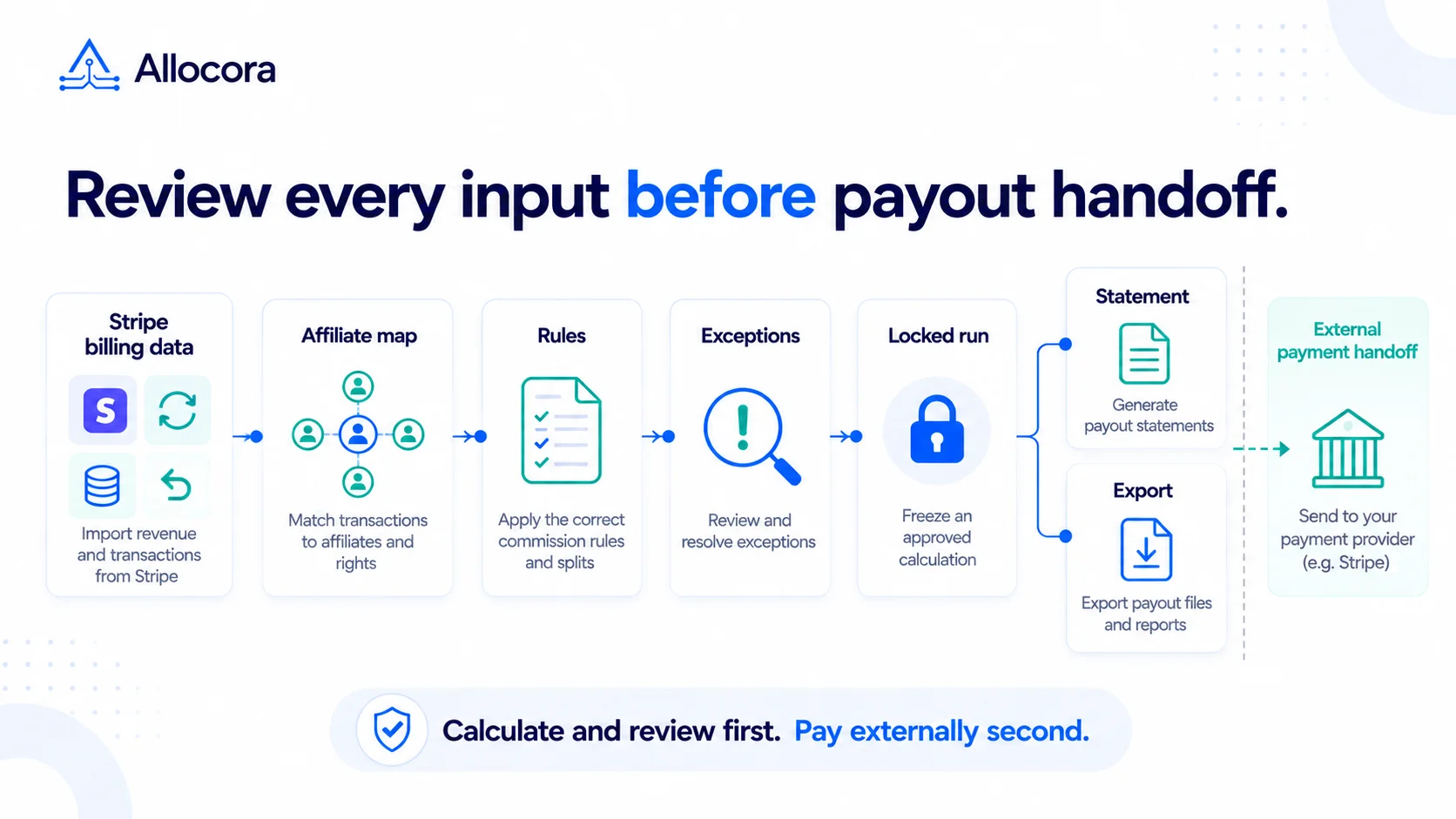 Stripe Revenue-to-Affiliate Payout Close Checklist
Review Stripe revenue for affiliate commission close: choose the ingestion path and date policy, verify mappings and corrections, lock the calculation, and prepare the external payment handoff.
Sep 24, 2026 - 6 min read
Stripe Revenue-to-Affiliate Payout Close Checklist
Review Stripe revenue for affiliate commission close: choose the ingestion path and date policy, verify mappings and corrections, lock the calculation, and prepare the external payment handoff.
Sep 24, 2026 - 6 min read
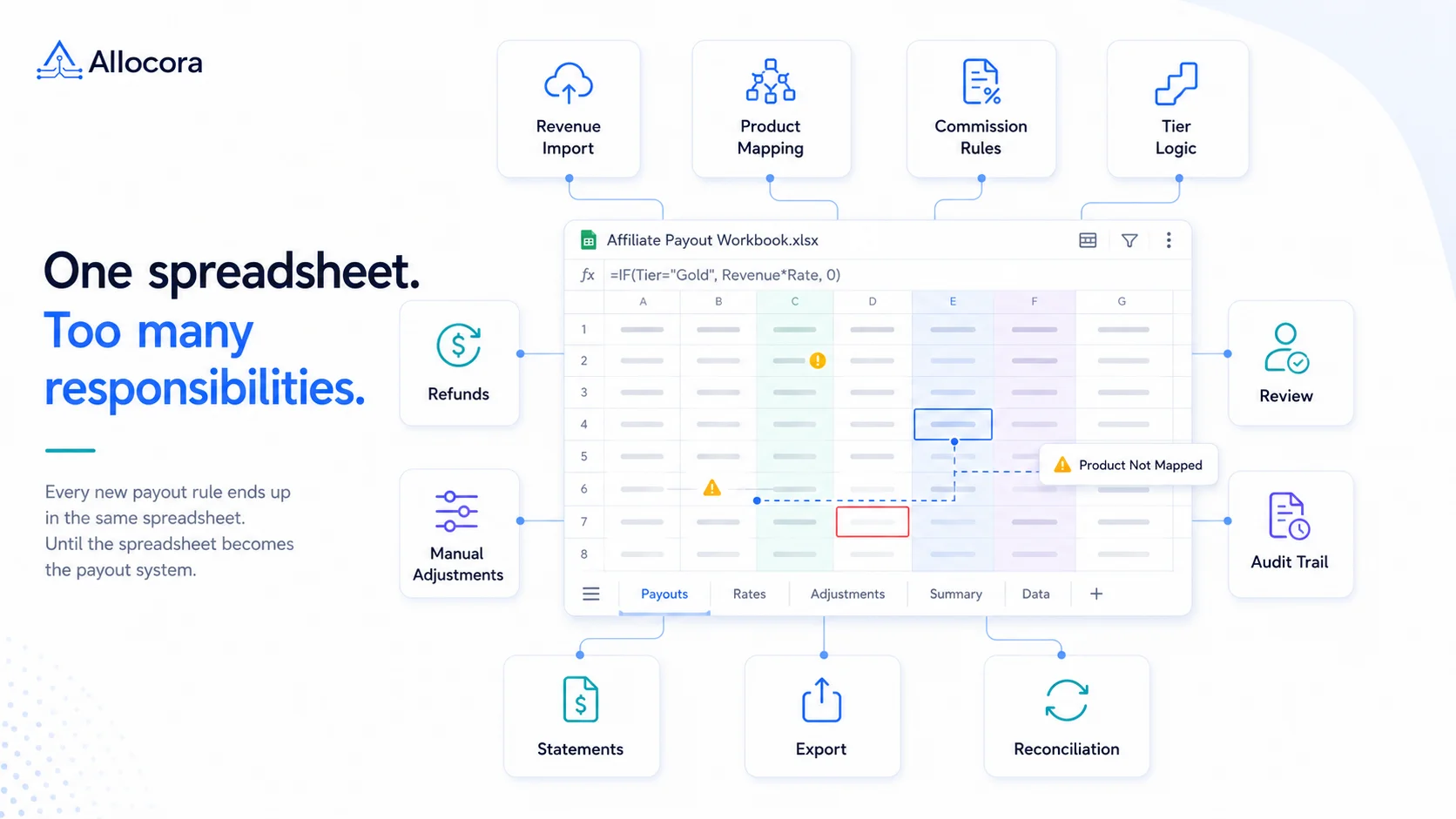 Monthly Affiliate Payout Spreadsheet: Required Fields, Controls, and Review Flow
Structure a monthly affiliate payout spreadsheet with source fields, refund adjustments, review controls, export checks, and a clear path to governed payout runs.
Jul 22, 2026 - 5 min read
Monthly Affiliate Payout Spreadsheet: Required Fields, Controls, and Review Flow
Structure a monthly affiliate payout spreadsheet with source fields, refund adjustments, review controls, export checks, and a clear path to governed payout runs.
Jul 22, 2026 - 5 min read
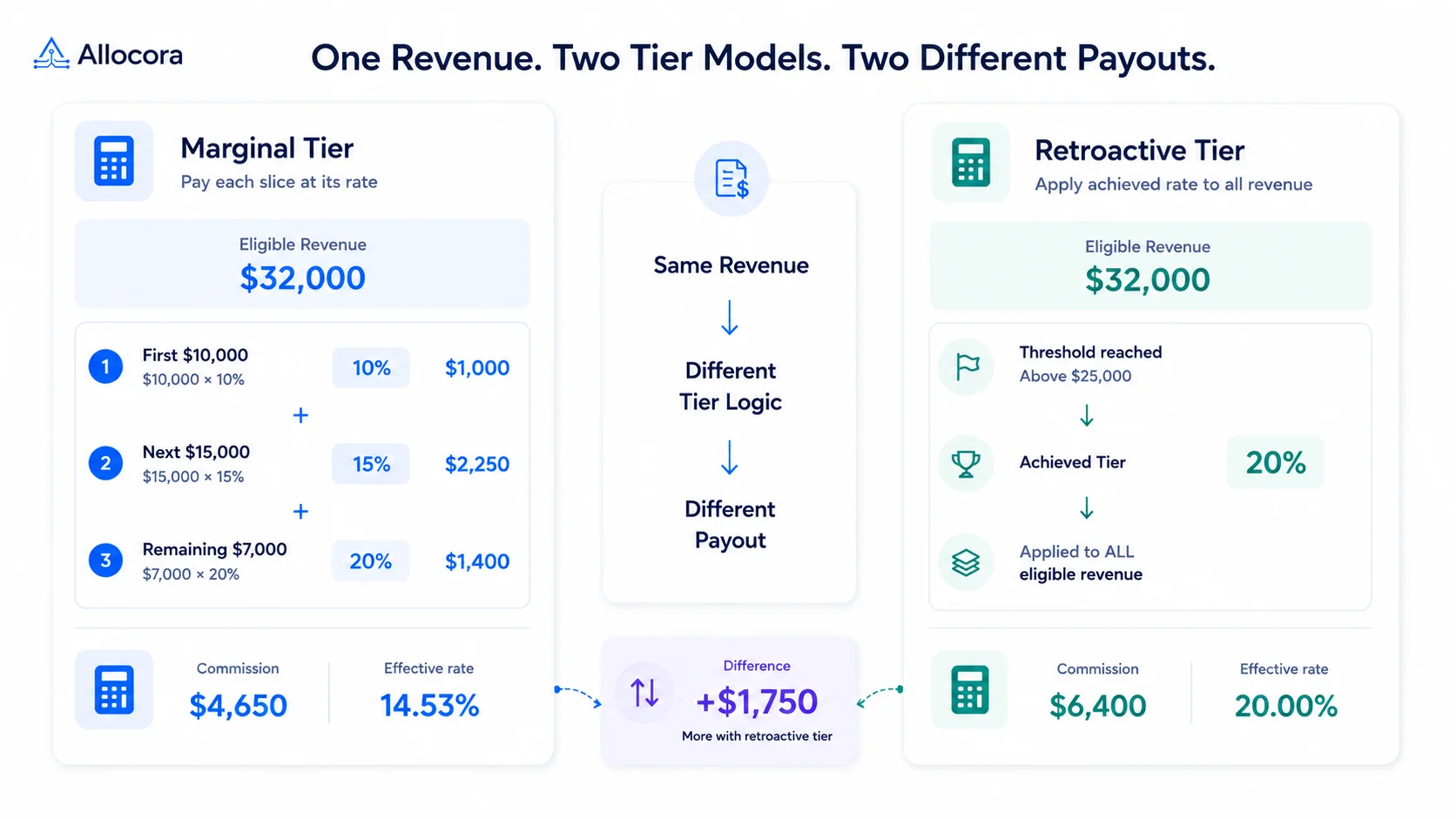 How to Calculate Tiered Affiliate Commissions Without Spreadsheet Errors
A practical guide to tiered affiliate commission math, including marginal tiers, retroactive tiers, refund holds, examples, and review controls.
Jul 16, 2026 - 6 min read
How to Calculate Tiered Affiliate Commissions Without Spreadsheet Errors
A practical guide to tiered affiliate commission math, including marginal tiers, retroactive tiers, refund holds, examples, and review controls.
Jul 16, 2026 - 6 min read