
Agency Revenue Share Calculations That Survive Partner Review
A launch article for agencies and service businesses replacing partner revenue-share spreadsheets with governed calculation runs.
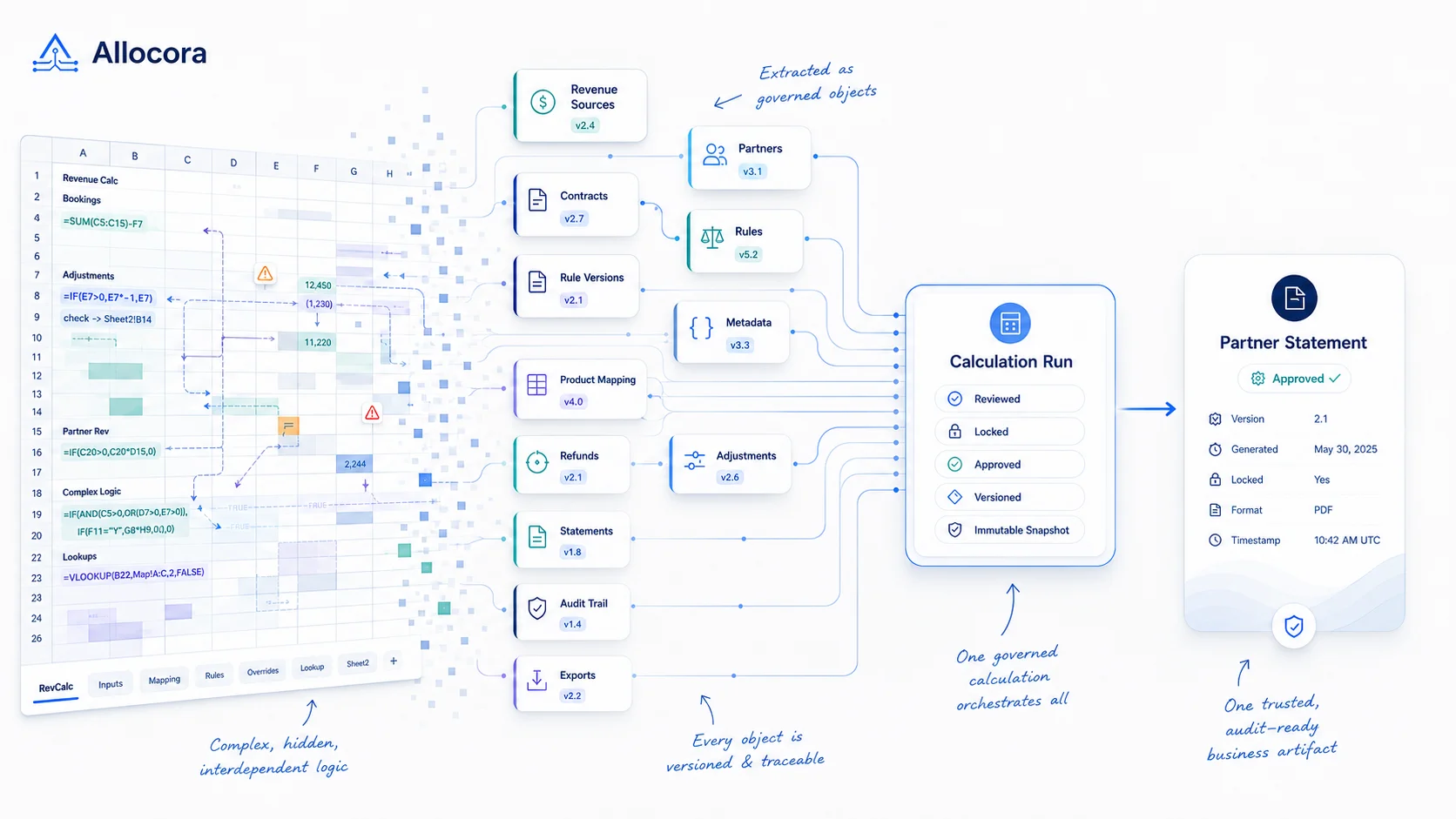
Agency revenue share calculations become difficult when each partner has different terms. One partner may receive a fixed percentage. Another may have a weighted split. A white-label client may be tied to a specific product or project. An internal team may receive a share only for certain revenue categories. When all of that lives in a spreadsheet, month-end close becomes a handoff problem.
Allocora's agency revenue share solution is built around deterministic revenue-share calculations, versioned rules, partner statements, and close-ready exports. Allocora does not replace invoicing, accounting, or payment execution. It calculates who gets what and preserves the evidence before the team's existing finance workflow takes over.
As partner relationships grow, revenue share software needs to preserve more than percentages.
Revenue share is more than a split percentage
At the simplest level, revenue share looks like a percentage. But operationally, an agency revenue share workflow has more moving parts:
- Source revenue.
- Client, project, product, or service category.
- Partner or internal team.
- Contract terms.
- Date windows.
- Split percentages.
- Adjustments.
- Refunds.
- Statement requirements.
- Finance exports.
A spreadsheet can calculate a percentage, but it does not automatically preserve the rule history, source data, run output, or statement artifact. That becomes a problem when partners ask for an explanation or when terms change mid-quarter.
Allocora moves the core logic into versioned payees, versioned rules, deterministic calculation runs, and structured exports.
Why agency spreadsheets drift
Agency revenue share spreadsheets often grow one partner at a time. The first version is manageable. Then another tab is added for a white-label partner. A new client has different terms. A refund is handled manually. Someone copies last month's workbook and edits formulas. By the end of a few periods, no one wants to touch the master file.
Common failure modes include:
- Custom formulas copied between partner tabs.
- No version history when terms change.
- Manual rebuilding of calculations each month.
- Inconsistent partner statements.
- Unclear treatment of refunds or adjustments.
- No stable audit trail for historical runs.
Allocora's agency solution describes this problem directly: revenue-share spreadsheets do not scale with partnerships. The practical issue is not only spreadsheet size. It is the lack of governance.
Rules should represent agreements
Revenue-share terms should be represented as rules, not hidden formulas. Allocora supports flat and tiered allocation rules, metadata conditions, priority handling, effective dates, and immutable rule versions. Rule versions can also include contract reference fields for governance traceability.
For an agency, that means a partner agreement can map to a structured rule:
- Partner A receives 30 percent of revenue from a defined product group.
- Partner B receives a tiered share after a threshold.
- A white-label client receives a share only for specific metadata conditions.
- A rule becomes active on a specific date.
- A new rule version applies after terms change.
This makes the agreement visible to operators and reviewable by finance. It also prevents current terms from rewriting historical calculations.
Teams can also validate rule behavior before close using Rule Simulation for Payout Calculations Before Close.
Deterministic runs make close repeatable
Every close needs a reliable record. Allocora's calculation runs provide that record. A run validates inputs, checks product mapping gates, checks scoped rule conflicts, snapshots rule and mapping context, executes calculation jobs, and persists calculation items.
The value is reproducibility. Given the same inputs and rules, the result should be the same. That is difficult to guarantee in a spreadsheet that can change after close.
For agency revenue share, deterministic runs help with:
- Partner review.
- Month-end close.
- Prior-period comparison.
- Internal finance handoff.
- Adjustment tracking.
- Export consistency.
The run becomes the artifact that the team can approve, lock, export, and reference later.
Partner statements should be generated from the run
Agencies often send partner statements manually. A team member copies totals into a document, adds context, exports a PDF, and emails it. That process works until a partner questions a number and the statement cannot be tied cleanly back to source data.
Allocora supports payee statement generation from locked calculation runs. Statements can be generated as summary or product-level outputs, with PDF artifacts, batch ZIP bundles, share URLs, and email delivery records. Statement content is snapshot-safe, so historical names and product labels do not drift after later edits.
For agency revenue share, statements should communicate:
- The period.
- The agreement or rule context.
- Attributed revenue.
- Share amount.
- Adjustments.
- Product or line-level detail where needed.
Because the statements come from the locked run, partner communication matches the calculation evidence.
The same review process becomes much easier when statements are generated from immutable calculation runs, as described in How Immutable Calculation Runs Create a Payout Audit Trail.
Close packages reduce finance handoff friction
These workflows often cross teams. Operations manages client and partner context. Finance reviews the close. Leadership may approve totals. Accounting may need exports for invoices or payment workflows.
Allocora's structured exports help keep that handoff consistent. Teams can generate queued exports, statements, summaries, and finance-ready artifacts from reviewed calculation runs.
For agencies, useful close package contents may include:
- Partner totals.
- Partner statements.
- Calculation item detail.
- Revenue summaries.
- Rule references.
- Audit excerpts.
- Prior-period comparison context.
The goal is not more documentation. It is a close process that produces the same outputs every time.
Adjustments should be visible, not buried
Agency payout workflows often include exceptions. A refund may reduce a partner's share. A manual correction may be needed after a client invoice changes. A prior-period adjustment may belong in the current close. If those adjustments are entered as side notes in a spreadsheet, the partner statement and the finance export can drift apart.
Allocora treats revenue rows as immutable facts and supports explicit revenue types such as sales, refunds, and adjustments in ingestion workflows. That allows adjustment treatment to remain visible to the calculation run. It also keeps the team from silently editing prior revenue rows to make the current period work.
For agency teams, this is useful because revenue-share relationships depend on trust. Partners do not only want the net number. They want to know whether a deduction was a refund, a correction, or a rule-driven allocation. A governed workflow should keep those categories clear enough to review before a statement is sent.
Use metadata deliberately
Agencies often need to split revenue by client, project, campaign, product, territory, or custom operational labels. Allocora supports metadata conditions on rules, and the rule evaluator can consider merged product and revenue metadata. That gives teams a structured way to scope rules without creating a new spreadsheet tab for every exception.
Metadata should still be used carefully. Keep field names consistent, document which values drive payout logic, and simulate representative rows before close. If metadata affects payout decisions, it deserves the same review discipline as a rate table.
Revenue share software should not become a payout rail
Allocora's product boundary is important for agencies. It calculates and governs payout obligations. It does not send payments or replace the payment process.
That keeps the workflow clean:
- Revenue data enters Allocora.
- Rules calculate partner shares.
- Finance reviews the run.
- Statements and exports are generated.
- The agency uses its existing invoicing, accounting, bank, or payment process.
This is useful because agencies may already use QuickBooks, Xero, bank transfers, or other tools. Allocora is the calculation and evidence layer before those tools.
What to migrate from the spreadsheet
When moving agency revenue share into Allocora, start by identifying the objects hidden inside the workbook:
- Source tabs become revenue sources.
- Partner tabs become payees.
- Rate tables become rules.
- Client or product columns become product mappings or metadata.
- Monthly output tabs become calculation runs.
- Statement PDFs become generated payee statements.
- Export tabs become structured exports.
This mapping helps teams avoid recreating spreadsheet complexity inside a new tool. The goal is to turn implicit spreadsheet structure into explicit workflow objects.
We covered the limits of spreadsheet-based payout workflows in Replace Spreadsheet Commission Tracking Before Month-End Breaks.
Questions agencies should ask before launch
Before launching a revenue share workflow, ask:
- Can we import source revenue without manual copy-paste?
- Can we map products, clients, projects, or categories consistently?
- Can each partner have versioned terms?
- Can we simulate rule changes before close?
- Can we detect rule conflicts?
- Can we lock a reviewed run?
- Can statements be generated from the locked run?
- Can exports be regenerated consistently?
- Can finance see the audit trail?
- Can we keep payment execution in our existing process?
If the answer is yes, the revenue share workflow is ready to become more repeatable.
Start with one close period before migrating every agreement. A small reviewed run is enough to prove whether the rule model, statements, and exports match how the agency already closes revenue share.
Launch takeaway
Agency revenue share calculations must survive partner review. That means the team needs more than a percentage formula. It needs source data, product mapping, partner records, versioned rules, deterministic runs, statements, close packages, and audit evidence.
Allocora gives agencies a self-serve way to build that workflow while keeping existing invoicing and payment tools in place.
Agencies often start with a workbook and then ask whether their accounting or payment tool should solve the rest. Allocora's answer is narrower and clearer: keep the downstream tools, but make the calculation layer reviewable.
Related Articles
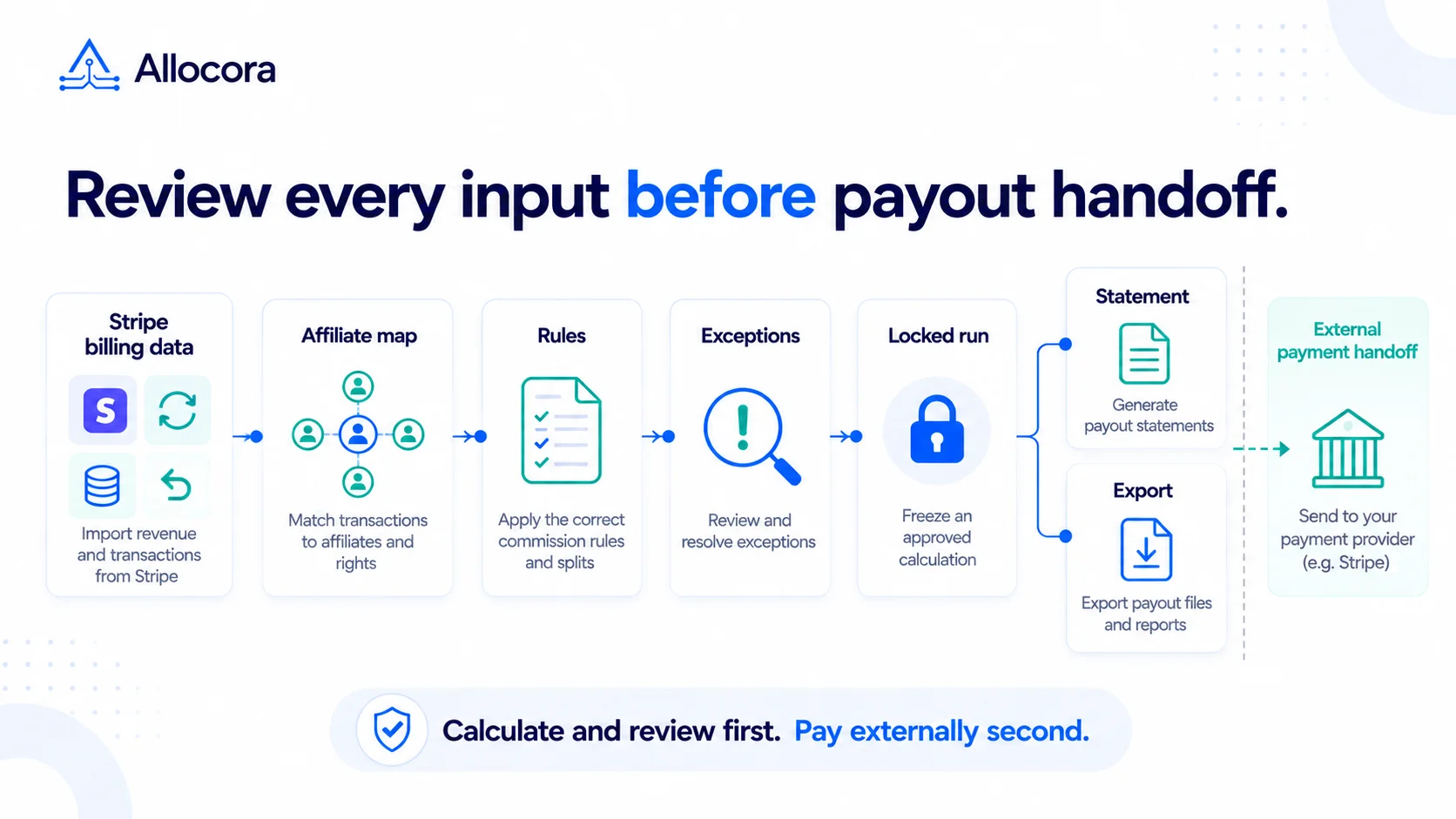 Stripe Revenue-to-Affiliate Payout Close Checklist
Review Stripe revenue for affiliate commission close: choose the ingestion path and date policy, verify mappings and corrections, lock the calculation, and prepare the external payment handoff.
Sep 24, 2026 - 6 min read
Stripe Revenue-to-Affiliate Payout Close Checklist
Review Stripe revenue for affiliate commission close: choose the ingestion path and date policy, verify mappings and corrections, lock the calculation, and prepare the external payment handoff.
Sep 24, 2026 - 6 min read
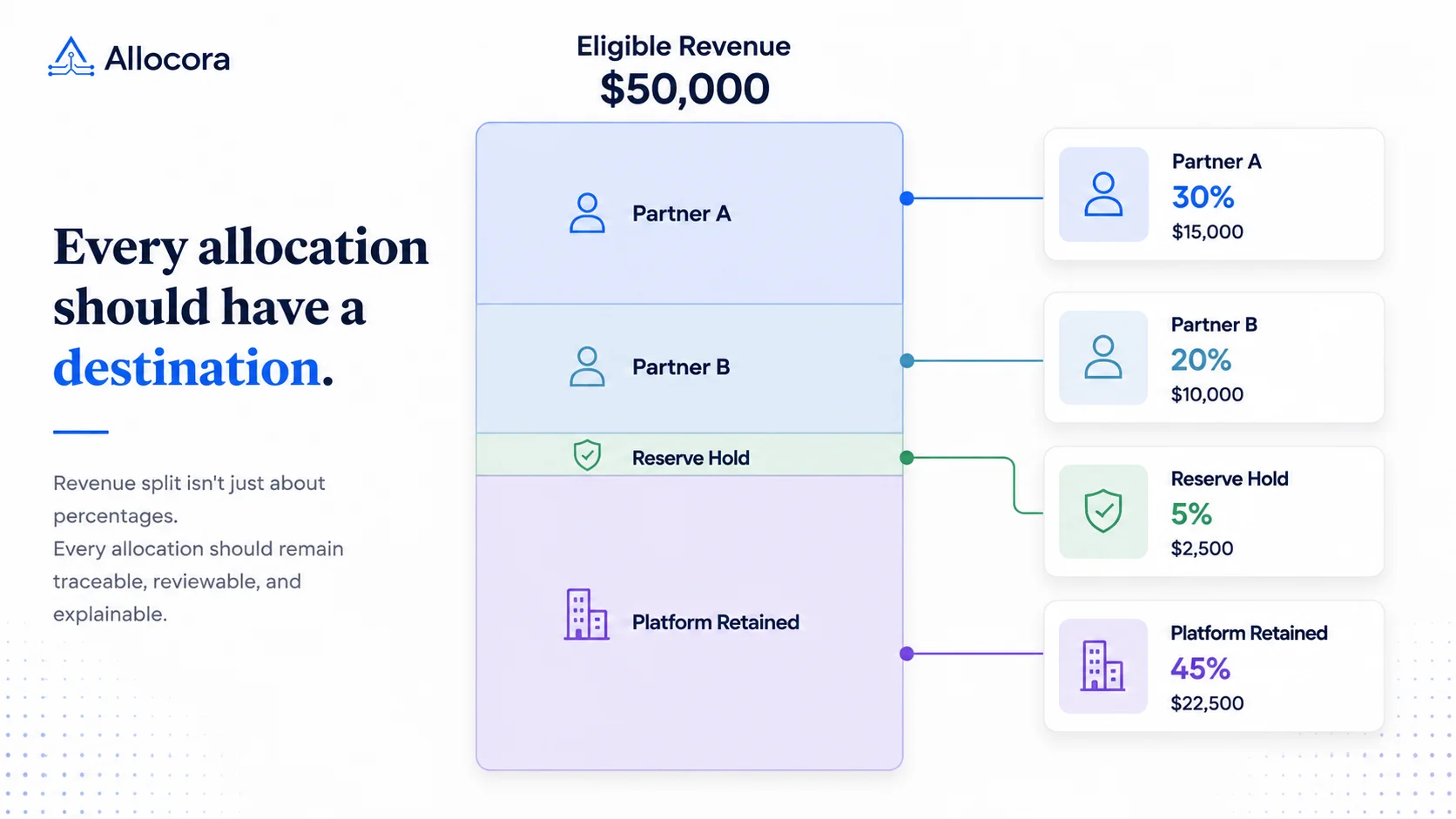 Revenue Split Calculator Guide for Multi-Payee Payouts
A multi-payee revenue split calculator guide for teams that need clear split math, retained revenue checks, deductions, statements, and audit evidence.
Aug 04, 2026 - 7 min read
Revenue Split Calculator Guide for Multi-Payee Payouts
A multi-payee revenue split calculator guide for teams that need clear split math, retained revenue checks, deductions, statements, and audit evidence.
Aug 04, 2026 - 7 min read
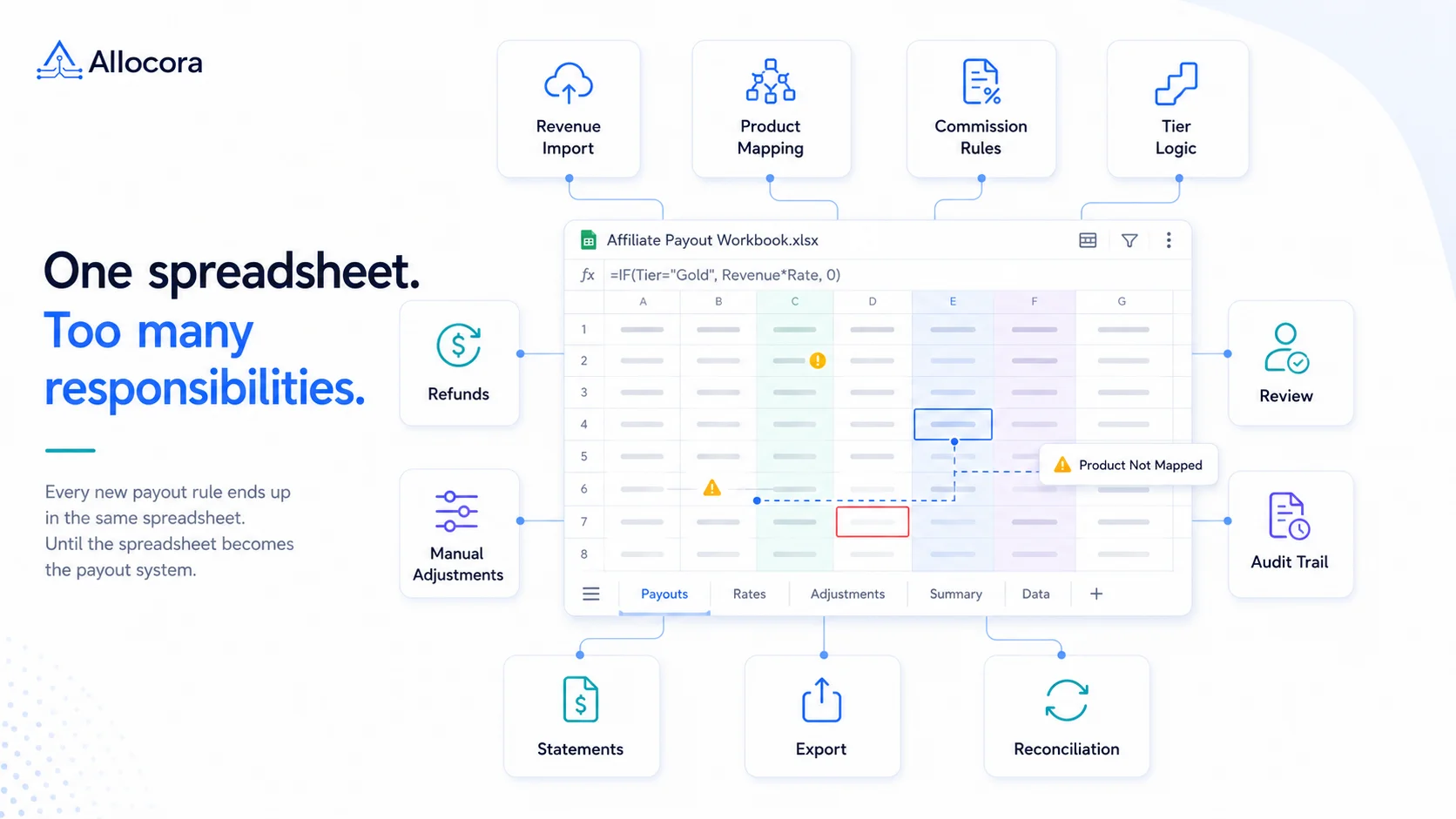 Monthly Affiliate Payout Spreadsheet: Required Fields, Controls, and Review Flow
Structure a monthly affiliate payout spreadsheet with source fields, refund adjustments, review controls, export checks, and a clear path to governed payout runs.
Jul 22, 2026 - 5 min read
Monthly Affiliate Payout Spreadsheet: Required Fields, Controls, and Review Flow
Structure a monthly affiliate payout spreadsheet with source fields, refund adjustments, review controls, export checks, and a clear path to governed payout runs.
Jul 22, 2026 - 5 min read