Yes, if the recording agreement lets the label recover the advance from royalties on both albums. If the agreement keeps each album’s balance separate, the second album can earn a payment for the artist while the first still has an advance to recover. Using royalties from one release to recover an advance on another is called cross-collateralization.
Two albums, one quarterly statement
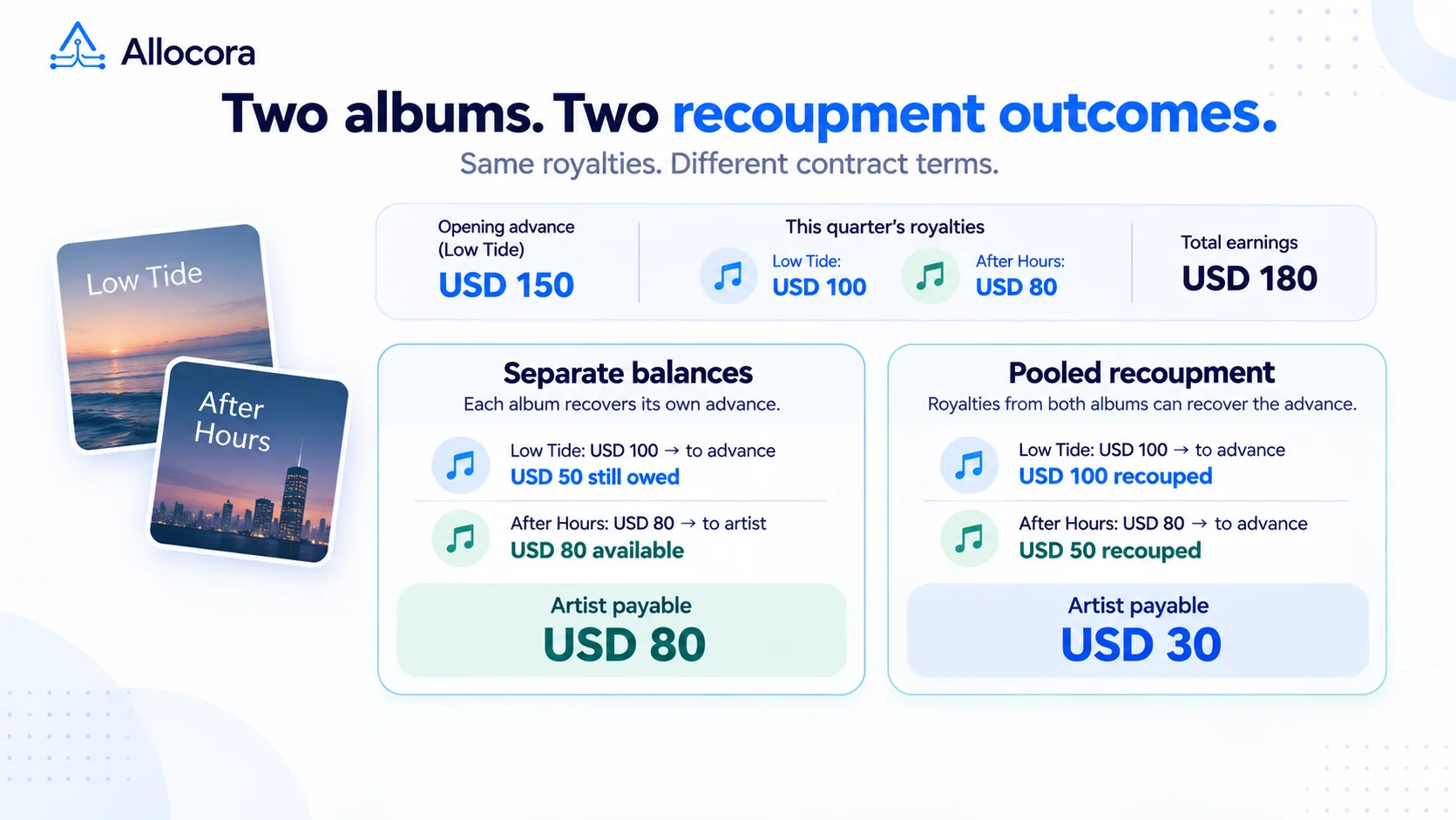
Suppose your label paid an advance for an artist’s debut album, Low Tide. At the start of the quarter, $150 of that advance is still outstanding. The follow-up, After Hours, has no advance of its own.
This quarter Low Tide earns the artist $100 and After Hours earns $80. Those amounts are the artist’s royalties after applying each release’s rate. All figures are fictional, in US dollars, with no other deductions, reserves or previous amounts due.
| What the agreement allows | Amount due this quarter |
|---|---|
| Each album recovers its own advance | $80 |
| Royalties from both albums can recover the debut advance | $30 |
If each album has its own balance
All $100 from Low Tide goes toward its $150 advance balance. That leaves $50 to carry forward on the debut. After Hours has no advance to recover, so its entire $80 is due to the artist.
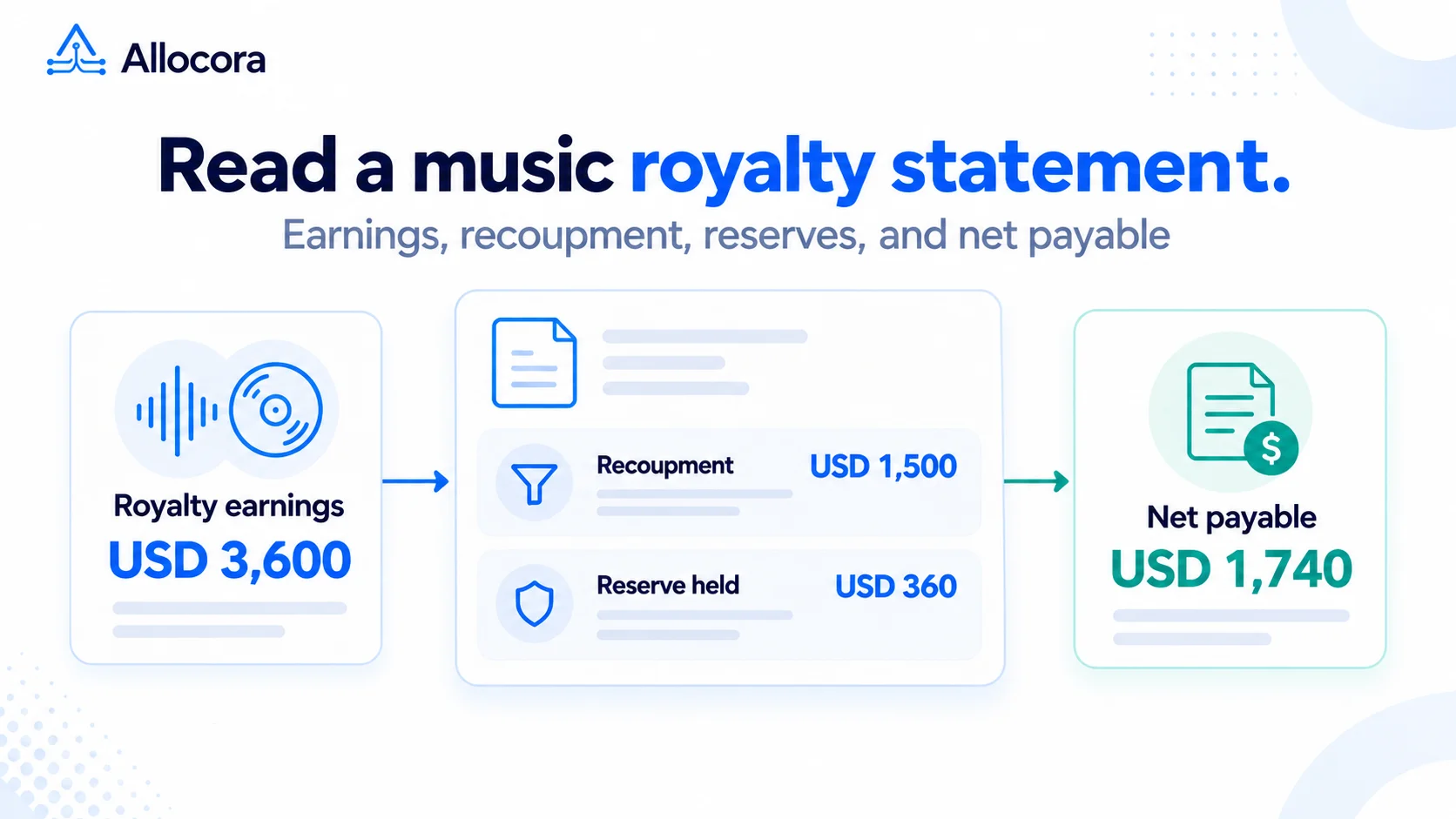
On the statement, show the $50 still outstanding against Low Tide alongside the $80 due from After Hours. The artist can see why the debut still has an advance balance when the follow-up earns a payment. For a filled example showing how earnings, recoupment, reserves, and net payable appear on an artist statement, see Music Royalty Statement Example: What You Owe Your Artist.
If the agreement pools these two albums
The debut contributes $100 toward the $150 balance. Of the $80 earned by After Hours, $50 clears the rest of the advance. The remaining $30 is due to the artist, and the next quarter opens with $0 left to recover.
Both statements credit the artist with the full $180. The $50 difference in the amount due is the portion of After Hours earnings used to clear the debut advance this quarter.
What to check before sending the statement
Find the recoupment clause and identify which recordings’ royalties can be used against this particular advance. Check any release schedules or amendments it refers to. The same artist’s name on both releases tells you who earned the royalties. The signed terms tell you which earnings can repay the advance.
Match the $150 opening balance to the previous statement. Then show the earnings of each album, how much of each went toward the advance, what remains due, and the balance that carries into the next quarter. If the terms are unclear, resolve which releases are covered before you apply the second album’s $50.
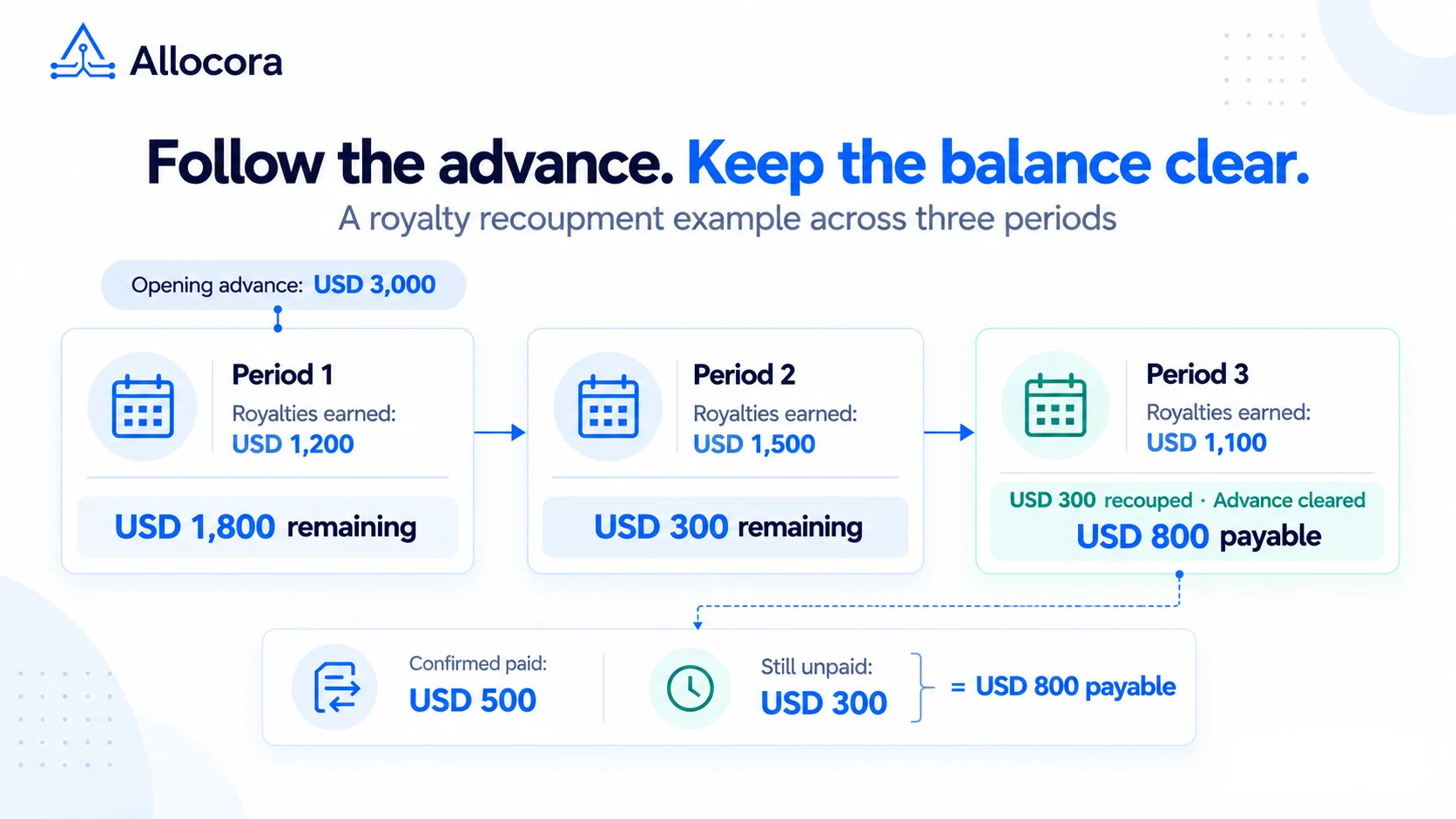
For an example of how an outstanding advance changes across reporting periods, see Royalty Recoupment Explained: Advance Balances Across Three Periods.
Check release earnings in Allocora
Allocora applies earnings from both releases against one advance balance for the artist in the same currency. With the figures above, it applies $150 of the $180 earned to the advance and shows $30 due.
If your agreement keeps the albums separate, set up a separate payee for each album, point each album’s rule to its own payee, and enter the advance only on the Low Tide payee. Each payee then has its own balance and statement. This quarter, After Hours shows $80 due, and Low Tide shows $0 due with $50 still to recover. Do not use the pooled $30 payable as the amount due under an agreement that requires separate album balances.
Open the music sample in a free Allocora workspace. Mira Vale earns 45% on her single and 35% on her album. Generate her statement from the locked sample run to see what each release earned her and how much of her combined royalties went toward her $350 advance.