
How to Calculate Book Royalties for Publishers: Sales, Returns, and Author Splits
Work through a publisher's paperback, ebook, and audiobook royalties, including returns, coauthor splits, advance balances, and the amount newly payable.
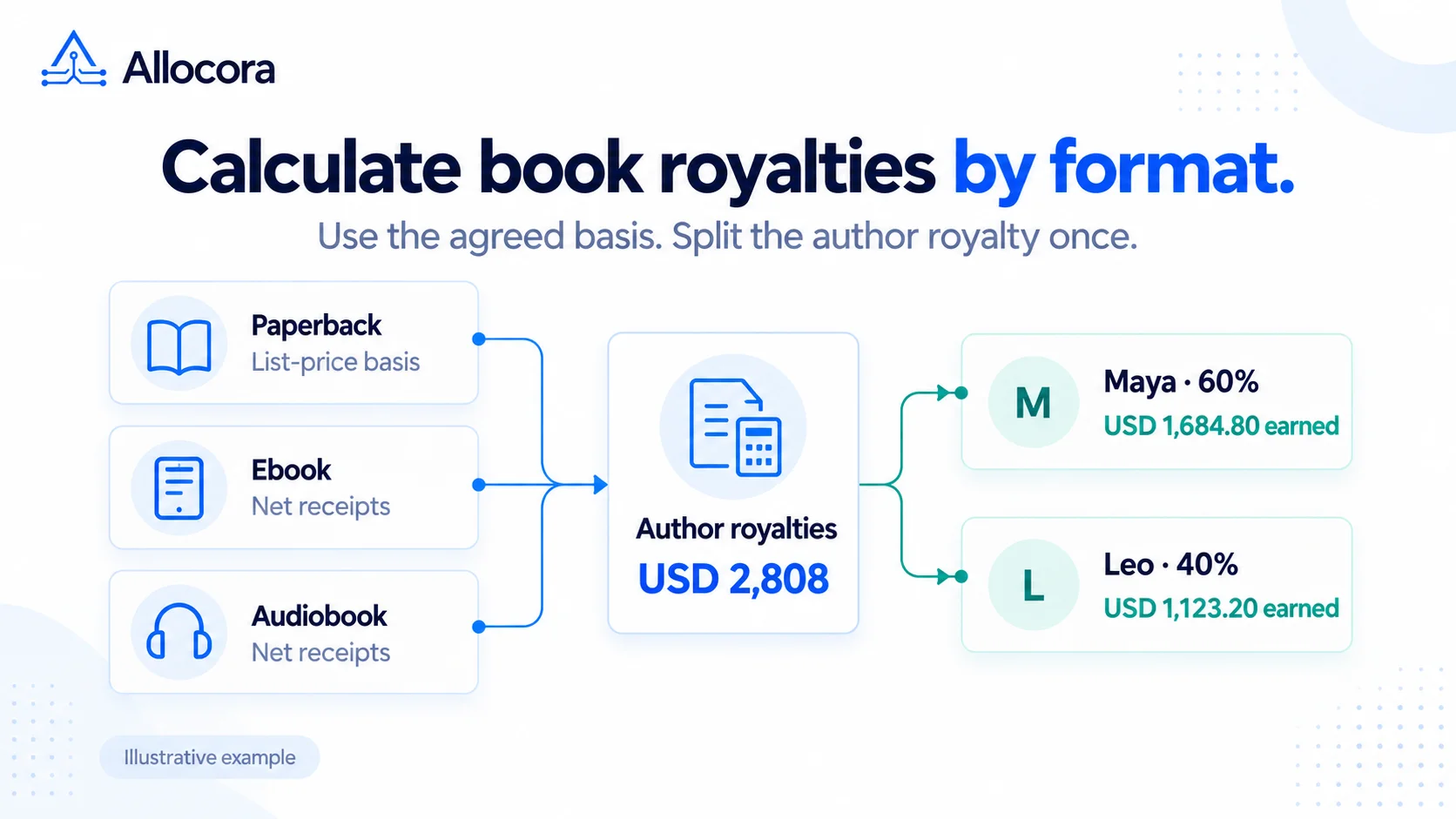
To calculate book royalties as a publisher preparing author statements, identify the contract's royalty basis for each format, account for eligible sales and returns, apply the royalty rate, and divide the resulting author royalty between the entitled authors. Then apply each author's advance balance and any other agreed adjustments to determine the amount currently payable.
The percentage alone is not enough. Ten percent of a book's list price produces a different result from ten percent of the publisher's net receipts. A distributor's sales report also answers a different question from the bank record showing when the publisher received money.
This guide works through one hypothetical publisher's quarterly close for a paperback, ebook, and audiobook. The rates, contract terms, and amounts are illustrative. They are not standard publishing terms or advice on a particular contract's legal, tax, or financial-reporting treatment.
Start with the royalty basis for each format
Before calculating, record the applicable terms alongside the title and edition identifiers:
| Contract detail | What the worksheet needs |
|---|---|
| Format and scope | Paperback, ebook, audiobook, and any relevant channel or territory |
| Royalty basis | List price, defined net receipts, or another expressly agreed basis |
| Rate and effective period | The applicable percentage, effective dates, and any sales thresholds |
| Returns and exclusions | Treatment of actual returns, refunds, free copies, and author purchases |
| Author participation | Each author's share of the royalty, including any format-specific differences |
| Advance terms | Opening unrecouped balance, whose earnings can recoup it, and which rights or formats participate |
| Statement and payment timing | Which transactions enter the period and when a resulting payment is due |
WIPO's publishing guide explains both selling-price and net-receipts royalty bases and describes an advance as a payment against future royalties. Those are different contractual arrangements; the guide does not supply the terms for your title. See its sections on royalty payments and advances, pages 65–66.
For a list-price arrangement with one eligible price and rate:
Royalty = eligible net units × contractual list-price basis × royalty rateFor a net-receipts arrangement:
Royalty = contract-defined eligible net receipts × royalty rateIf prices or rates vary, calculate separate lines before summing them. Define exactly what is already included in a net-receipts figure. Subtracting a distributor fee or refund that the source has already deducted would reduce the basis twice.
Worked example: one title in three formats
Assume a small publisher is preparing the July–September statement for a coauthored title. All amounts below are USD. For this example:
- The paperback earns a combined author royalty of 10% of a $20 contractual list-price basis per eligible net unit.
- The ebook earns a combined author royalty of 25% of eligible net receipts; the audiobook earns 20%.
- The two authors divide each format's author royalty 60% to Maya and 40% to Leo.
- The shown sales and actual returns all fall within this statement's eligibility rules. All receipts shown have been collected by the publisher within the period, including the effect of the refunds.
- Rates and prices are constant. There are no escalating tiers, free copies, author purchases, reserves, additional recoupable expenses, minimum payment thresholds, or currency conversions.
- Source amounts already reflect the contract's permitted retailer and distributor deductions. No additional deduction for those costs is applied. No tax or payment-fee calculation is included.
These assumptions keep the example focused on the royalty calculation. They must be replaced with the terms and source evidence for a real close.
Paperback: use the list-price basis
The source reports 1,000 royalty-eligible copies sold and 100 actual returns. Under this hypothetical contract, each return reverses the royalty at the same $20 basis and 10% rate as its original sale.
Eligible net units = 1,000 − 100 = 900
Royalty basis = 900 × $20 = $18,000
Paperback author royalty = $18,000 × 10% = $1,800
The publisher received $9,000 for those net sales after the agreed trade deductions. That receipt figure is useful for the publisher's internal reconciliation, but the contract here bases the royalty on list price. Replacing $18,000 with $9,000 would incorrectly reduce the paperback royalty to $900.
For returns involving an older price, rate, or agreement, retain the original sale reference and establish the reversal treatment before using the current period's rate.
Ebook and audiobook: use net receipts
For these two formats, the contract uses receipts rather than list price. The source amounts in the next table are already after the permitted trade deductions, but the actual refunds are still shown separately.
| Format | Reported units sold | Returned or refunded units | Receipts before the shown refunds | Actual refunds | Eligible net receipts | Rate | Author royalty |
|---|---|---|---|---|---|---|---|
| Ebook | 500 | 20 | $3,000.00 | −$120.00 | $2,880.00 | 25% | $720.00 |
| Audiobook | 100 | 4 | $1,500.00 | −$60.00 | $1,440.00 | 20% | $288.00 |
The ebook result is ($3,000 − $120) × 25% = $720. The audiobook result is ($1,500 − $60) × 20% = $288.
The net unit counts are 480 ebooks and 96 audiobooks. They help reconcile activity, but the formula uses the actual eligible receipts. Multiplying those counts by a retail list price would change the agreed basis.
Combine the author royalties
| Format | Combined author royalty |
|---|---|
| Paperback | $1,800.00 |
| Ebook | $720.00 |
| Audiobook | $288.00 |
| Total earned before author-specific recoupment | $2,808.00 |
The three bases cannot be treated as interchangeable revenue. The paperback's $18,000 is a list-price calculation basis; the ebook's $2,880 and audiobook's $1,440 are receipts. Add the resulting royalties to find the total author royalty, rather than describing the mixed bases as cash received.
Apply the coauthor split once
The contract in this example gives Maya and Leo shares of the combined author royalty. It does not give each of them the full format rate.
| Format | Maya: 60% of author royalty | Leo: 40% of author royalty | Check |
|---|---|---|---|
| Paperback | $1,080.00 | $720.00 | $1,800.00 |
| Ebook | $432.00 | $288.00 | $720.00 |
| Audiobook | $172.80 | $115.20 | $288.00 |
| Total earned | $1,684.80 | $1,123.20 | $2,808.00 |
For example, Maya's paperback royalty is $18,000 × 10% × 60% = $1,080. An equivalent direct rate is 6% of that paperback basis. Use either the 10%-then-60% calculation or the 6% direct rate; applying another 60% split to the 6% result would count her participation twice.
An actual publisher's process illustrates why the distinction matters: Collective Ink's royalty explanation distinguishes trade-sale royalty calculations from a subsequent multiple-author split. Its rules describe Collective Ink's own contracts and statements, not a universal coauthor policy.
Separate earnings from advance recoupment and new payment
Assume Maya opens the quarter with a $1,500 unrecouped advance and Leo with $1,400. Under their hypothetical terms, each author's earnings across these three formats recoup only that author's own advance. Their balances are not pooled, and no new advance is paid during the quarter.
For each author in this positive-earnings example:
Advance recouped = smaller of earned royalty and opening advance balance
Closing advance balance = opening advance balance − advance recouped
New royalty payable = earned royalty − advance recouped| Author | Opening advance balance | Earned this quarter | Applied to advance | Closing advance balance | New royalty payable |
|---|---|---|---|---|---|
| Maya | $1,500.00 | $1,684.80 | $1,500.00 | $0.00 | $184.80 |
| Leo | $1,400.00 | $1,123.20 | $1,123.20 | $276.80 | $0.00 |
| Total | $2,900.00 | $2,808.00 | $2,623.20 | $276.80 | $184.80 |
Two checks now reconcile:
- Earned royalties:
$2,808 = $2,623.20 recouped + $184.80 newly payable. - Advance balances:
$2,900 opening = $2,623.20 recouped + $276.80 closing.
Leo earned $1,123.20 even though no additional royalty payment is due to him in this example. Maya's $184.80 is a calculated payable; the worksheet alone does not establish that a transfer occurred. Keep the subsequent payment date, amount, and confirmation separate.
If an agreement uses a shared advance or restricts recoupment to a particular format or title, change the balance scope before calculating. Do not transfer one author's unrecouped balance to another author merely to make a combined total fit.
Distinguish actual returns from a reserve
The worked example includes actual returns and refunds. A reserve for possible future returns is a separate item. For example, Harlequin's royalty-statement terminology distinguishes books actually returned from a reserve estimating future returns. That source describes Harlequin's statement fields; it does not establish a reserve percentage for another publisher.
If your agreement provides for a reserve, track its opening balance, current hold, releases, and closing balance separately from actual return rows. A refund already included in net receipts should not be deducted again as an actual return elsewhere in the worksheet. A contractual reserve needs its own calculation and release treatment.
A period can also contain more returns than sales. Preserve the negative royalty calculation and its source references, then apply the agreement's carry-forward or recovery treatment. A zero payment for that period does not justify deleting the negative amount from the royalty history.
Keep the publisher worksheet separate from each author's statement
The internal worksheet can reconcile receipts, earned royalties, and the amount remaining before publisher costs:
Receipts = $9,000 paperback + $2,880 ebook + $1,440 audiobook = $13,320
Amount remaining before publisher costs = $13,320 − $2,808 = $10,512
The $10,512 is not a profit calculation: printing, production, marketing, and other publisher costs have not been modeled. Advance recoupment explains how part of the author earnings is covered by earlier payments; it does not create another royalty deduction in this retained-amount check.
For each author, prepare a statement showing their own period, title and format breakdown, earned royalty, applicable adjustments, advance movement, and new payable. Keep the other author's balances and the publisher's retained amount in internal review records.
Before closing the period, check that:
- Each source row belongs to the right title, edition, format, currency, and statement period.
- Sold units, actual returns, receipt amounts, and collection dates retain their distinct meanings.
- The basis and rate match the applicable terms, including price changes and thresholds.
- Refunds, deductions, royalty rates, and coauthor splits are each applied once.
- Author earnings add back to the combined royalty, and advance movements reconcile.
- Statements agree with reviewed calculations; recorded payments agree with separate payment evidence.
Test the calculation before moving a recurring close
Allocora's publishing royalty calculator models a revenue amount and royalty rate with an advance balance, expenses, and reserve hold. It can help explore a simple scenario, but it does not reproduce this three-format, two-author worksheet as one calculation. Prepare the applicable basis and keep the author-specific balances separate.
For a recurring workflow, review the import template library against the columns your source files actually contain. Allocora supports source revenue imports, product mapping, payees, allocation rules, calculations, statements, and exports; payment execution happens in the external payment workflow. A template's source label does not establish that your file's amounts already match your author contracts.
Start with the publishing royalty sample workspace to inspect sample titles, payees, rules, revenue, and calculation output after signup. Then compare one representative period against your reviewed worksheet before adopting it for your own close.
Related Articles
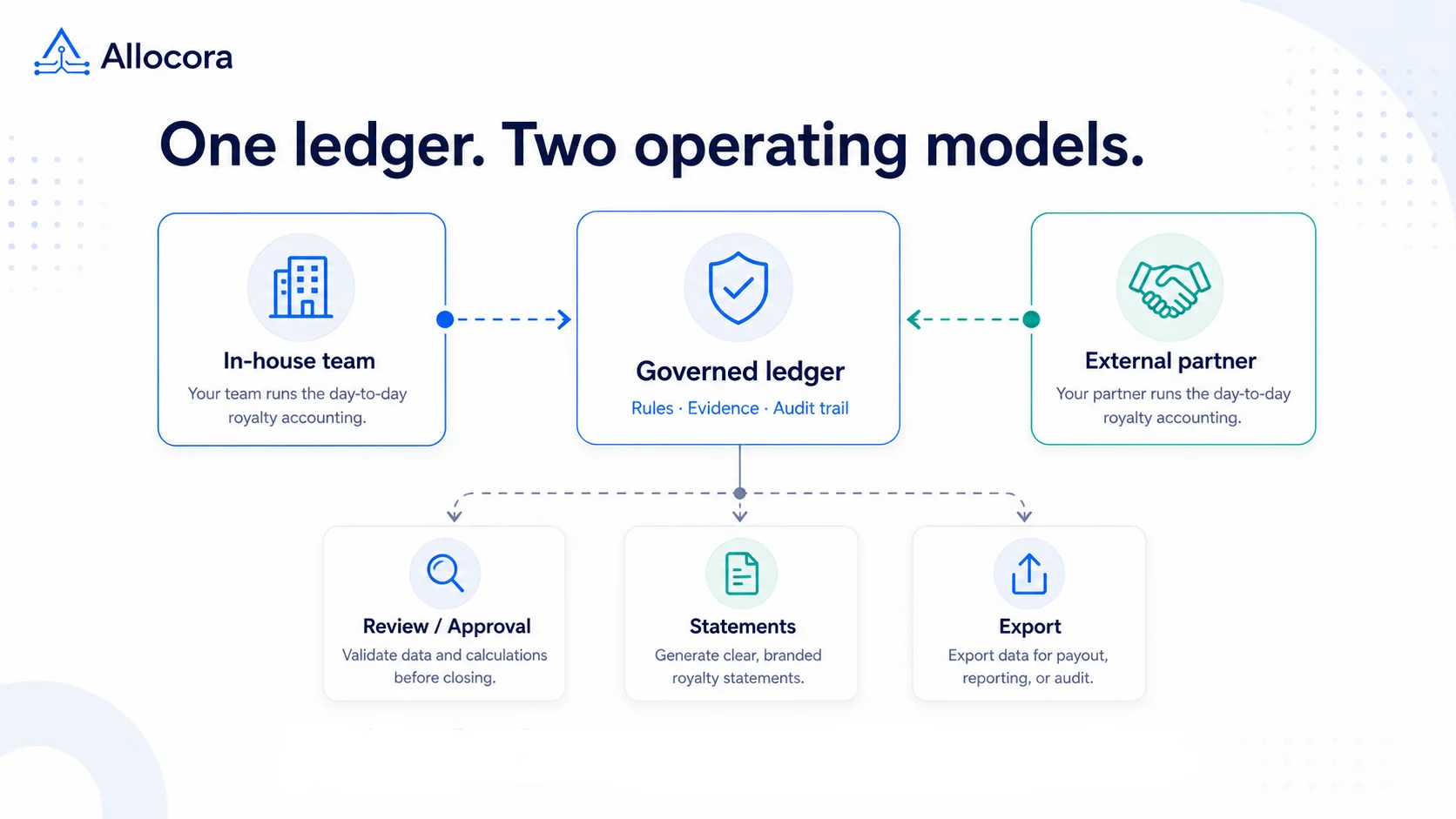 Outsourcing Royalty Accounting vs In-House: A Practical Guide for Growing Teams
A decision guide for labels, publishers, and platforms comparing outsourced royalty accounting, spreadsheet workflows, software-led operations, and hybrid models.
Sep 03, 2026 - 8 min read
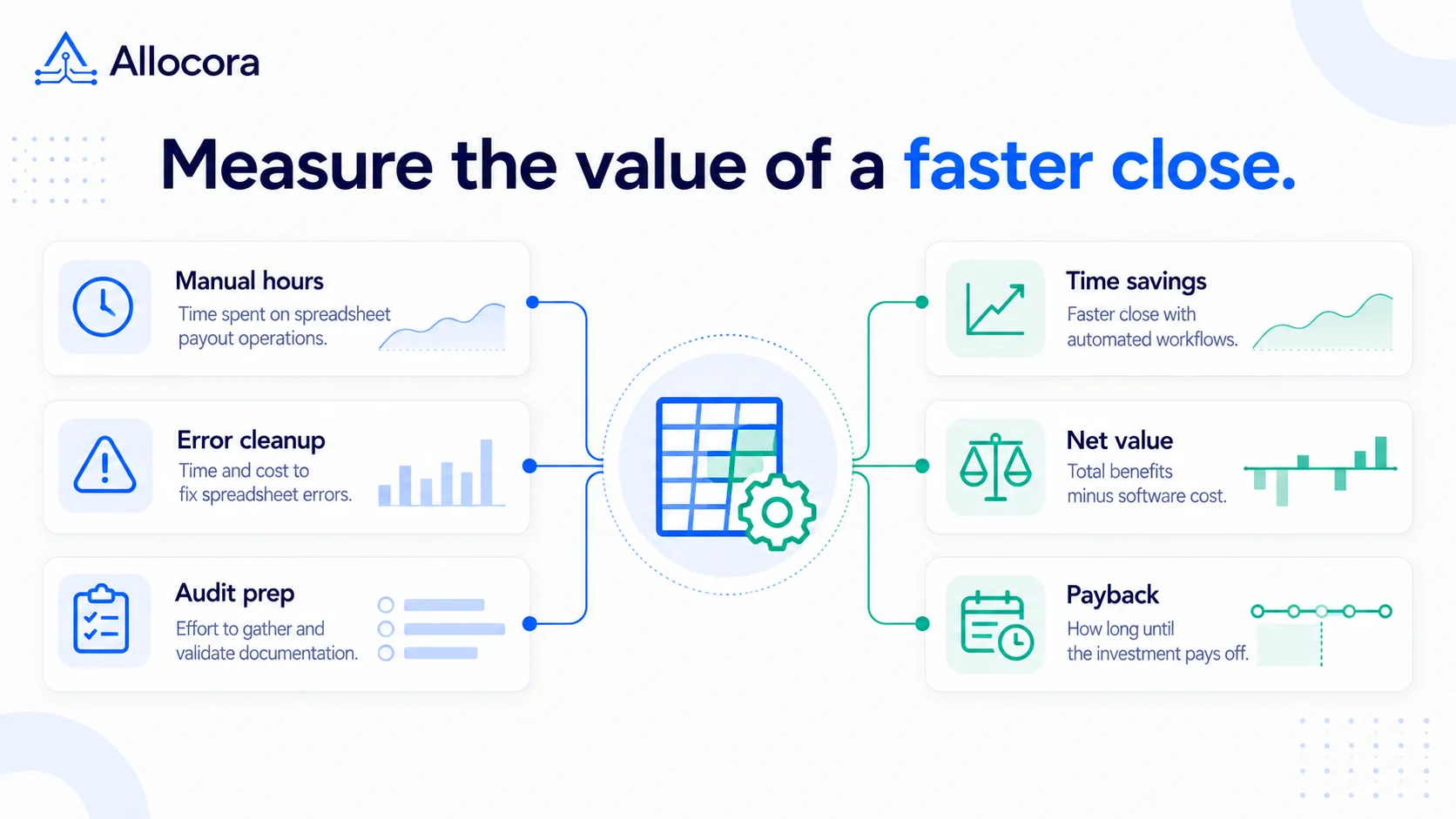 Royalty Ledger Automation ROI: When Spreadsheet Payout Operations Pay for Software
A practical before-and-after ROI model for evaluating royalty-ledger automation using close-time savings, avoided error costs, audit cleanup, and software cost.
Aug 27, 2026 - 11 min read
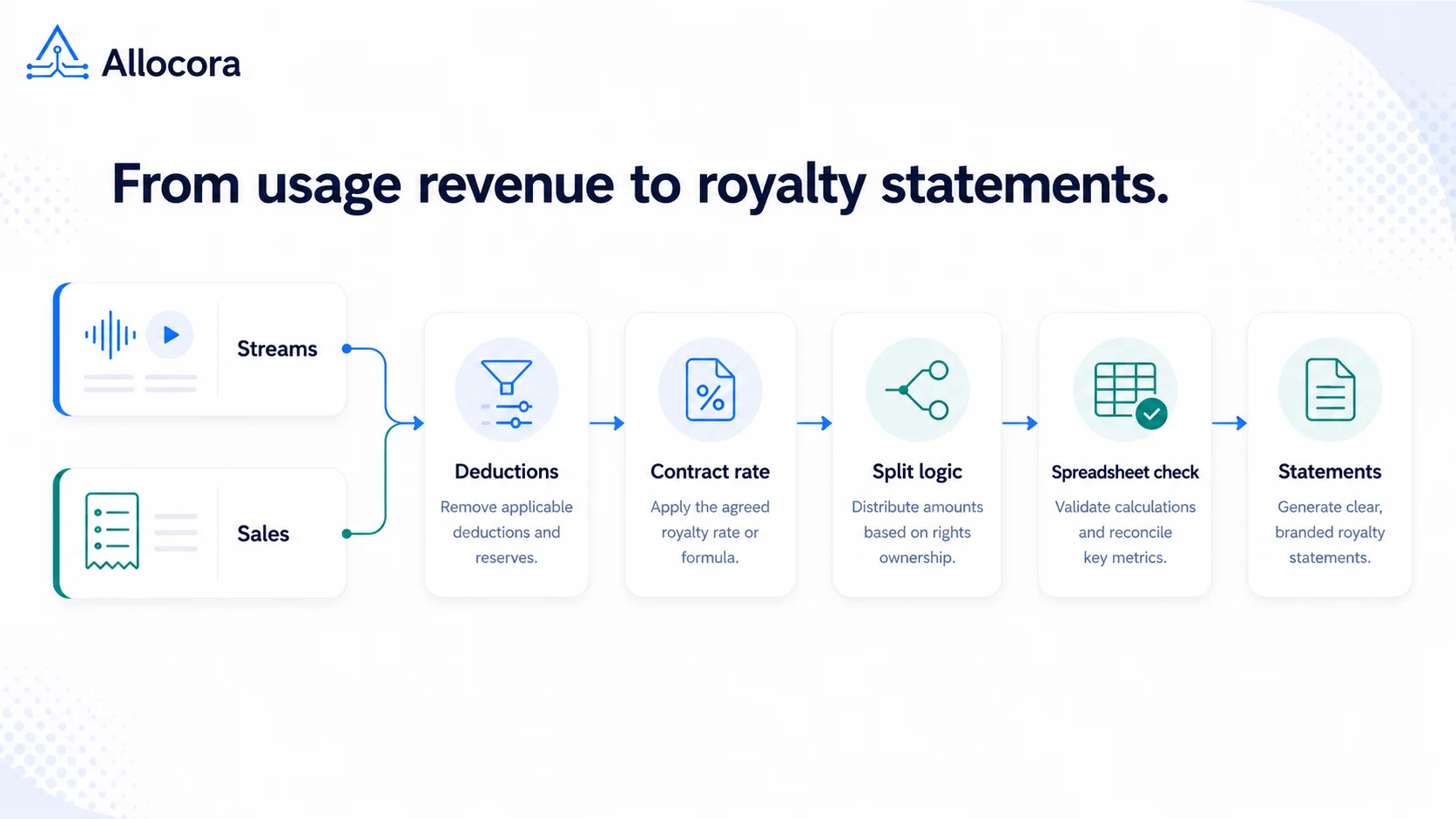 How to Calculate Music Royalties: Formula, Examples, and Spreadsheet Checks
A plain-language guide to calculating music royalties from gross revenue, deductions, splits, recoupment, statements, and audit notes.
Aug 21, 2026 - 8 min read