
Music Royalty Statement Example: Earnings, Deductions, and Net Payable
Read a filled music royalty statement showing how USD 3,600 in earnings becomes USD 1,740 payable after advance recoupment, an expense, and a reserve.
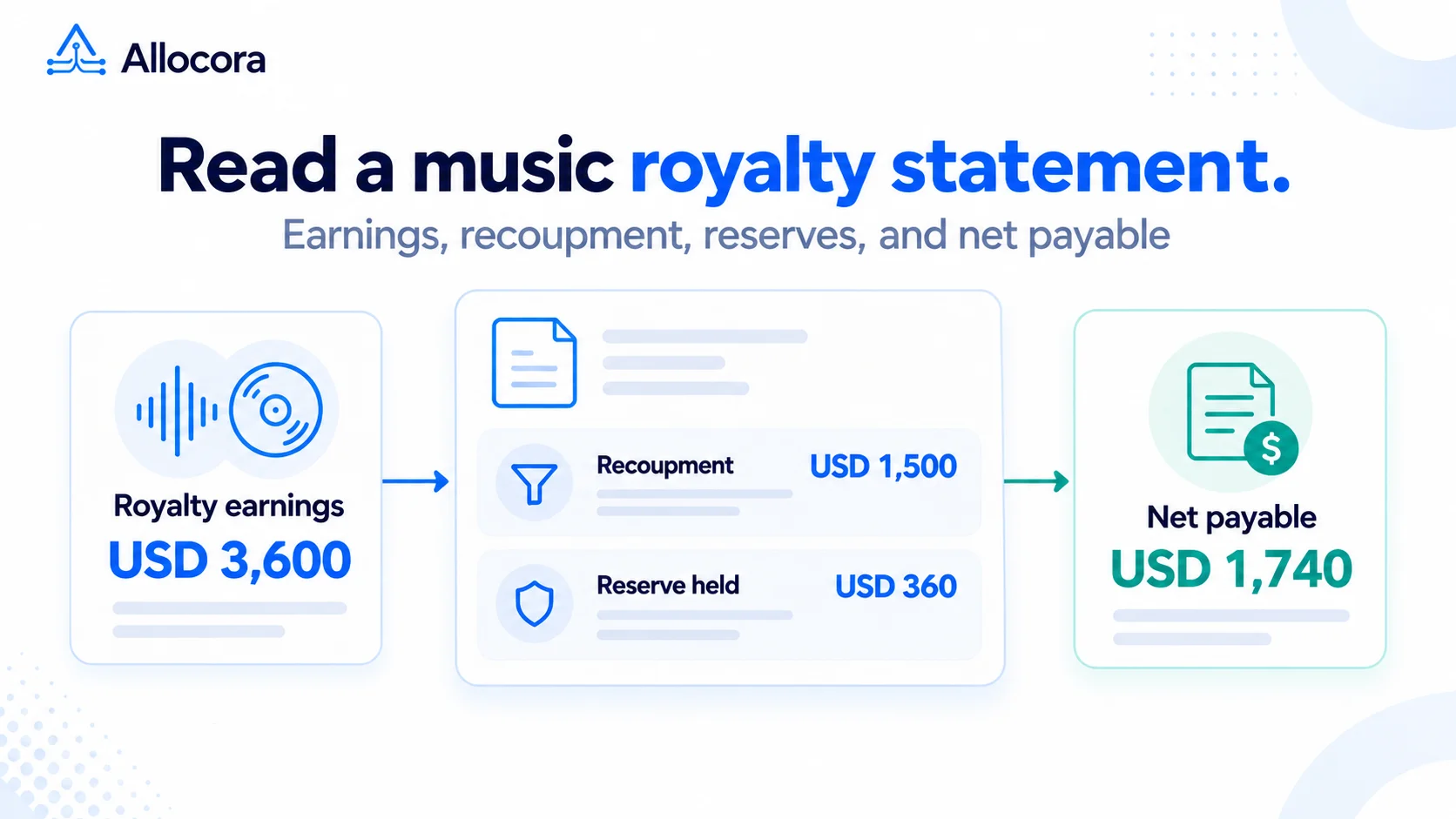
A royalty statement explains how a recipient's earnings and balance movements lead to an amount payable for a reporting period. To read it, keep four amounts separate: royalties earned, amounts recouped, royalties still held, and net payable. Payment confirmation is a separate record.
The filled music royalty statement below follows one fictional artist from USD 3,600 in earnings to USD 1,740 payable. It includes a return correction, late-reported income, advance recoupment, an approved expense, and a reserve carried into the next period.
A filled music royalty statement example
This is an educational label-to-artist recording royalty example. All names, references, amounts, and contract terms are invented. It is an illustrative reading aid, rather than an Allocora export or a prescribed statement format. Songwriting and publishing income are outside this example.
The example uses a contractual royalty-account calculation, not a tax calculation or a financial-statement recognition policy. It assumes all amounts are USD, the listed earnings have already been calculated using the applicable royalty bases and rates, and there is no withholding tax, VAT, currency conversion, or transfer fee.
Statement header
| Field | Example value |
|---|---|
| Issuer | Example Sound Co. — fictional label |
| Recipient | Alex Rowan — fictional artist |
| Statement reference | EXAMPLE-2026-Q2 |
| Reporting period | April 1–June 30, 2026 |
| Source-report cutoff | Reports received through June 30, 2026 |
| Statement date | July 15, 2026 |
| Currency | USD |
| Covered recordings | Harbor Lights; Night Signal |
| Payment due date | July 31, 2026, under the assumed agreement |
| Payment evidence at statement date | No payment confirmation attached |
The reporting period describes this statement cycle. The usage or sales period identifies when the underlying activity happened. The detail below deliberately includes March streaming earnings reported late; they are included once in this cycle and labeled accordingly.
Earnings detail
These amounts are Alex's royalty earnings before the payee-level deductions and holds below. They are not the label's total revenue. The references are fictional source-line references that a recipient could use when asking about an entry.
| Reference | Recording | Activity and usage period | Royalty earnings, USD |
|---|---|---|---|
| EX-01 | Harbor Lights | Streaming, April–June | 2,400.00 |
| EX-02 | Night Signal | Downloads, April–June | 450.00 |
| EX-03 | Harbor Lights | Vinyl sales, April–June | 650.00 |
| EX-04 | Harbor Lights | Return correction to a May vinyl sale | −50.00 |
| EX-05 | Night Signal | March streaming reported late | 150.00 |
| Total earnings reported this cycle | 3,600.00 |
For EX-01, assume the agreement gives Alex 20% of USD 12,000 in eligible receipts attributable to Harbor Lights for April–June. Those receipts already reflect the source-level deductions permitted by this fictional agreement, and no further participant split applies to Alex's royalty on this line:
EX-01 royalty earnings = USD 12,000 eligible receipts × 20% = USD 2,400The rate and receipts are invented inputs for this example, not a typical streaming rate. They explain the USD 2,400 earnings line before Alex's advance, expense, and reserve are applied in the summary below.
The negative USD 50 is already included in the USD 3,600 total. Deducting it again in the statement summary would count the same correction twice. The USD 150 late report is credited for the first time in this statement.
From earnings to net payable
For this example, the agreement requires the following order: hold 10% of the current-cycle earned royalties as a reserve, deduct the approved recoupable expense, then recover the outstanding advance from the remaining amount. This matches the calculation order used by Allocora's free Royalty Statement Generator.
| Statement line | Calculation or explanation | Effect on payable, USD |
|---|---|---|
| Earnings reported this cycle | Total from the detail above | 3,600.00 |
| New reserve held | 10% × 3,600 | −360.00 |
| Approved expense recouped | Recover the expense added this cycle | −250.00 |
| Advance recouped | Recover the remaining advance | −1,250.00 |
| Net payable for this statement | 3,600 − 360 − 250 − 1,250 | 1,740.00 |
The example assumes there is no minimum payment threshold or separate payment hold, so the full USD 1,740 is payable.
Balances carried into the next cycle
| Balance | Opening, USD | Added this cycle, USD | Recovered or released, USD | Closing, USD |
|---|---|---|---|---|
| Unrecouped advance | 1,250.00 | 0.00 | 1,250.00 recovered | 0.00 |
| Unrecouped approved expense | 0.00 | 250.00 | 250.00 recovered | 0.00 |
| Reserve held for Alex | 0.00 | 360.00 | 0.00 released | 360.00 |
Under the invented agreement, the new reserve will be reviewed at the end of the next statement cycle and released to the extent it is no longer required against corrections. The closing USD 360 remains a separate held balance; it is not part of the USD 1,740 payable now. No release has occurred in this example.
Two checks tie the statement together:
Current earnings: 3,600 = 360 newly held + 1,500 recouped + 1,740 payable
Reserve balance:   360 = 0 opening + 360 newly held - 0 released
How to read each amount
Earned royalties: what this statement credited to the artist
The USD 3,600 represents the royalties credited in this statement cycle, including the identified late report and return correction. It is neither the label's gross receipts nor the amount deposited into Alex's bank account.
When checking an earnings line, identify the recording or release, source, usage period, relevant royalty basis, and applied rate. Where a source report already reflects a deduction, confirm whether it has also been deducted elsewhere. For a separate worked calculation from source revenue to a payee share, see how to calculate music royalties.
Recoupment: earnings applied against an existing balance
In the example, USD 1,250 of earned royalties clears the advance balance, and USD 250 clears the approved expense balance. These amounts explain why earnings exceed the current payable. They are not new bank payments to Alex.
For a worked example of how an advance balance changes across reporting periods, see Royalty Recoupment Explained: Advance Balances Across Three Periods.
The permitted costs, recovery base, and order come from the agreement. The Musicians' Union's explanation of its specimen recording agreement illustrates why the base matters: its discussion distinguishes costs recovered from an artist's royalty from costs deducted before a net-profit share is calculated. That specimen does not establish the terms of another artist's contract.
Held royalties: an amount retained for a stated reason
The reserve opens at zero and ends at USD 360. This period's earnings funded that amount, but it remains held under the assumed agreement. Keep its reason and review or release condition visible beside the balance.
Recoupment and a reserve have different effects here. The USD 1,500 recouped clears the advance and expense balances. The USD 360 reserve remains on the artist's account for later review. Combining both into one unexplained “deductions” line would conceal that distinction.
Net payable: what the statement makes available for payment
The USD 1,740 is the amount payable under the example's terms, before any deductions excluded by its assumptions. A statement alone does not establish that a bank transfer completed.
Match the statement to payment evidence
At July 15, the example records USD 1,740 payable and no payment confirmation attached. That absence does not prove payment failed or is overdue; the assumed due date is July 31.
If the payer subsequently provides a completed-payment confirmation for USD 1,740, compare its recipient, currency, amount, and payment date with this statement. The recipient can also compare the credit shown in their own bank records. Keep that payment evidence linked to the statement without rewriting the historical earnings or recoupment lines.
If the bank credit differs, identify the cause before treating the statement as wrong. Check whether one transfer covers more than one statement, whether only part was paid, and whether a separately documented fee, withholding, conversion, return, or reversal explains the difference. Do not insert an unexplained balancing deduction into royalty earnings.
Check what kind of statement you received
A label's recording royalty statement and a music publishing or collection statement can organize different activity. Before comparing totals, check the covered rights, recipient, period, currency, and level of detail.
For instance, The MLC describes two statement layouts: Royalty Detail provides data corresponding to individual sound recordings in DSP usage reports, while Work Summary groups royalty data by musical work. A different grouping does not, by itself, indicate missing income. Compare records covering the same scope.
For a question about this example, a useful message would be: “On statement EXAMPLE-2026-Q2, can you explain the USD 50 return correction on EX-04 and confirm which earlier sale it reverses?” That identifies a checkable line. For a payment question, cite the statement's USD 1,740 payable and ask for the corresponding payment status or confirmation.
Prepare a statement in Allocora
For a simpler input-based preview, open the free Royalty Statement Generator. It calculates gross royalty from source revenue and a royalty rate, then applies the reserve, recoupable expenses, and advance recovery before arriving at net payable. The statement example above follows the same deduction order. The generator models one aggregated USD scenario, while the detailed earnings lines and carried balances in this article are an illustrative statement example rather than a literal export from that tool.
For your own royalty close, use Allocora's royalty calculations workflow to work from source revenue and configured payee terms. Review the calculation, lock the run, and generate enabled summary or product statement PDFs. The first-statement quickstart explains that sequence. Payment execution remains with your external payment or accounting workflow.
Start with one recipient and one period. Verify the earnings detail, recoupment movements, retained balances, and payable against the reviewed calculation before sharing the statement.
Related Articles
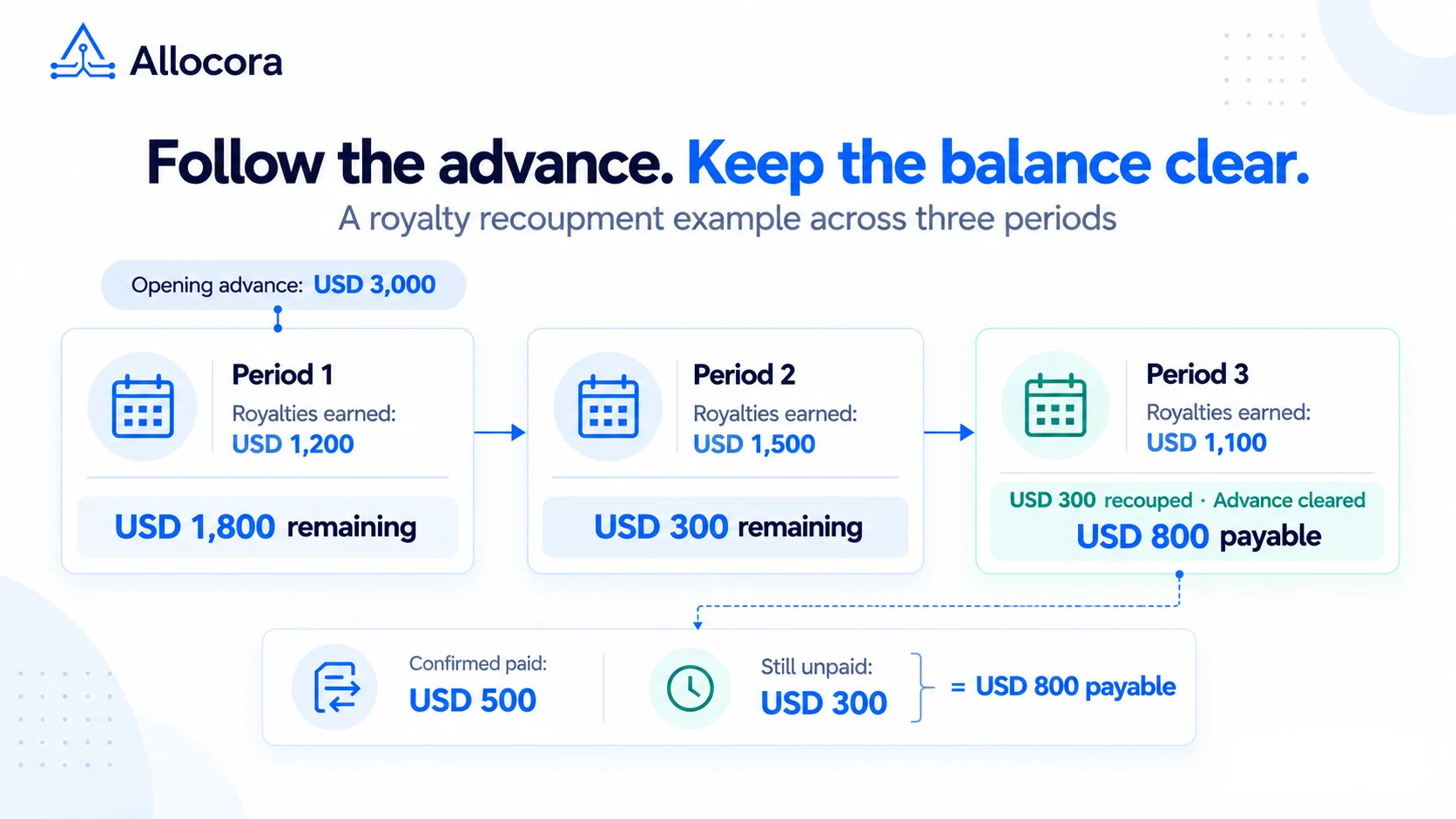 Royalty Recoupment Explained: Advance Balances Across Three Periods
Follow one advance through three royalty periods, check the carried balance, and distinguish earned royalties, net payable, and confirmed cash payments.
Nov 02, 2026 - 8 min read
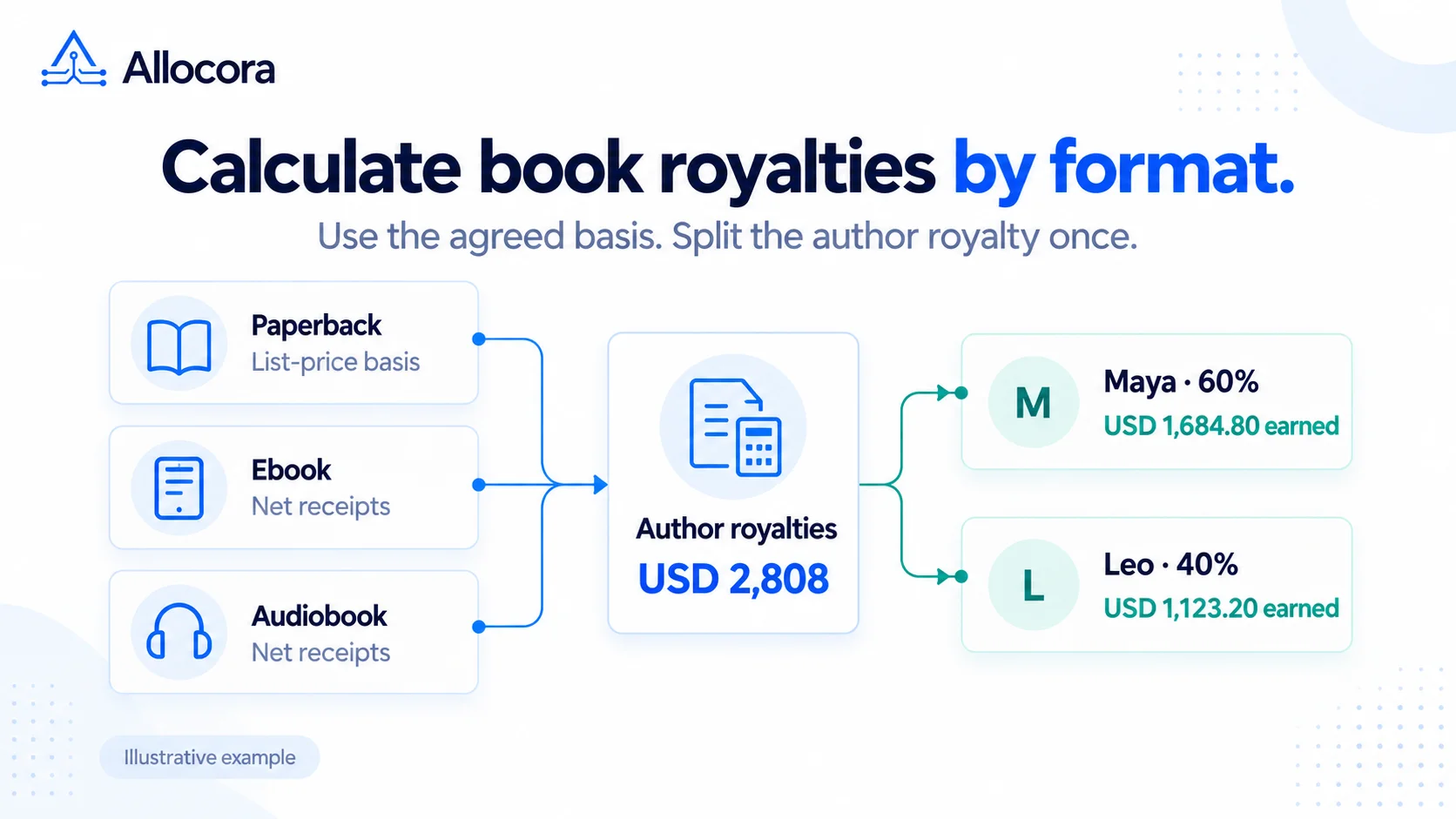 How to Calculate Book Royalties for Publishers: Sales, Returns, and Author Splits
Work through a publisher's paperback, ebook, and audiobook royalties, including returns, coauthor splits, advance balances, and the amount newly payable.
Oct 27, 2026 - 9 min read
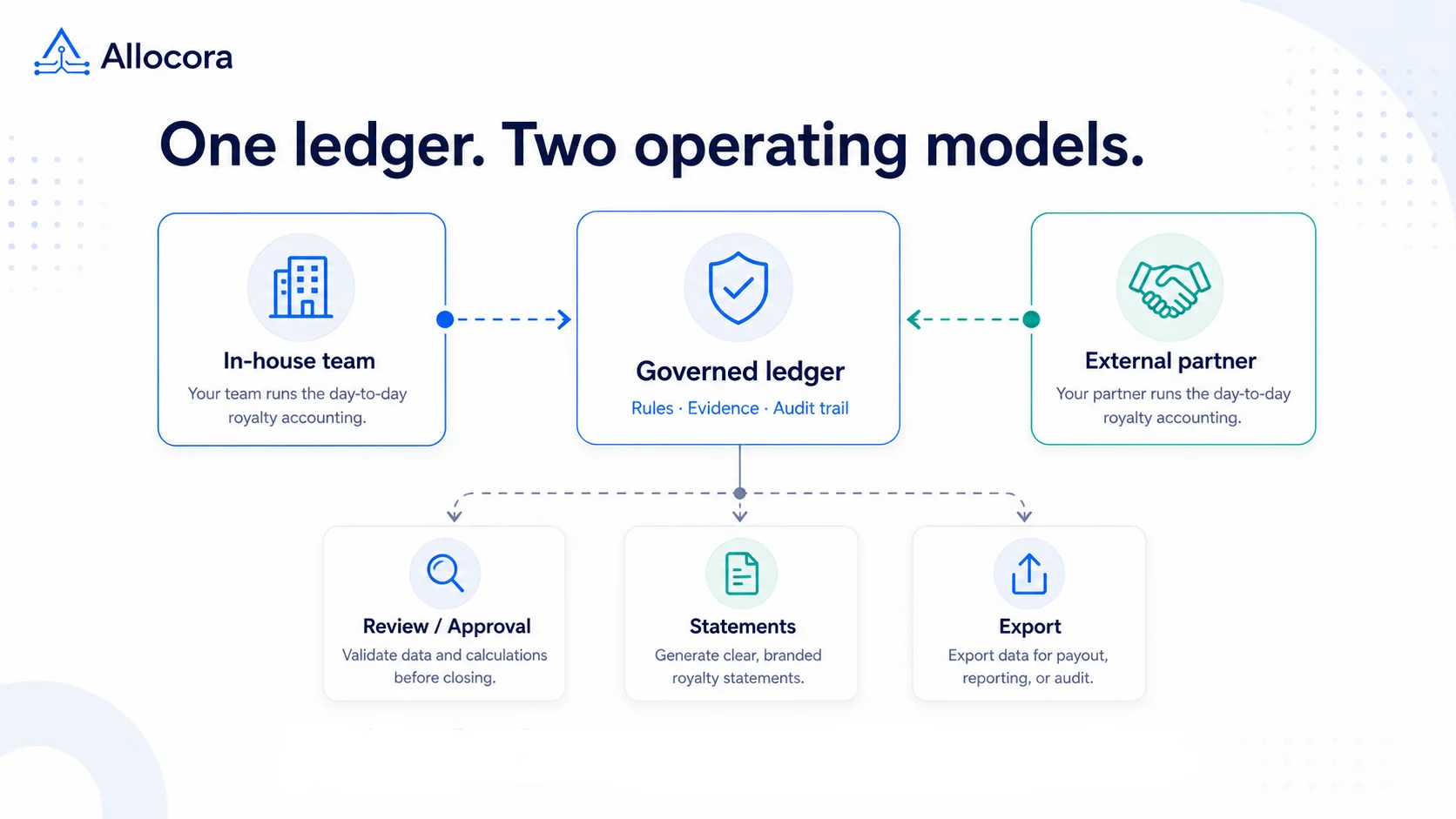 Outsourcing Royalty Accounting vs In-House: A Practical Guide for Growing Teams
A decision guide for labels, publishers, and platforms comparing outsourced royalty accounting, spreadsheet workflows, software-led operations, and hybrid models.
Sep 03, 2026 - 8 min read