
Royalty Recoupment Explained: Advance Balances Across Three Periods
Follow one advance through three royalty periods, check the carried balance, and distinguish earned royalties, net payable, and confirmed cash payments.
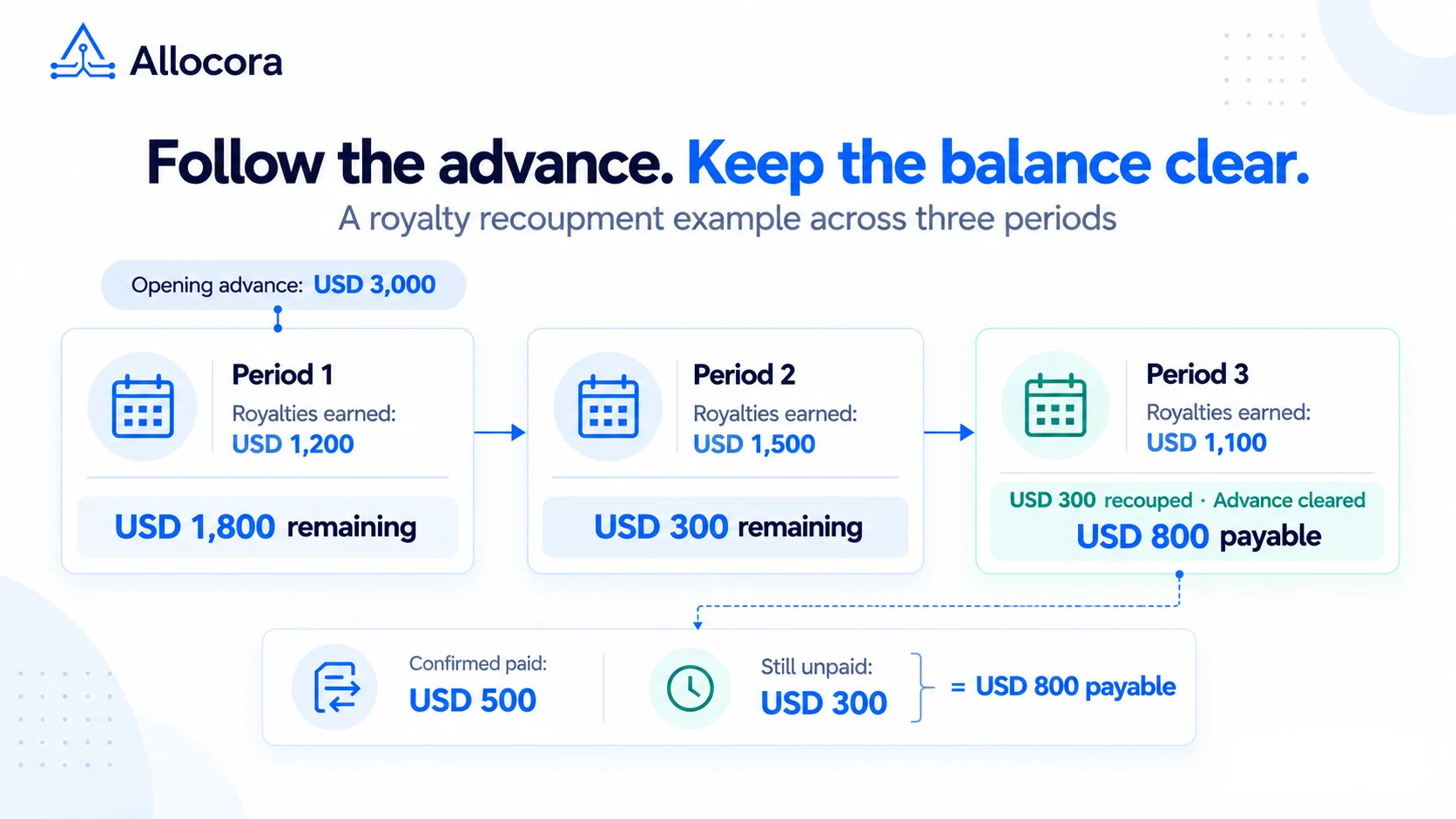
Royalty recoupment applies eligible earned royalties against an outstanding advance or other contractually recoupable balance. For the person preparing a statement, the useful questions are: how much was earned, how much reduced the balance, how much is now payable, and how much has actually been paid?
Those amounts can be different. A payee can earn royalties while receiving no additional royalty payment because the earnings are being applied to an advance. Once the advance is cleared, a payable can arise before the corresponding cash payment takes place. Reprtoir's recoupment documentation describes the contract-driven offset of royalties against recoupable expenses.
This guide follows one hypothetical advance through three reporting periods, then reconciles the resulting payable to a partial payment. The amounts and terms are illustrative, for a label or publisher checking a royalty statement.
Start with the recoupable amount and eligible royalty
Before calculating, identify the payee, agreement, covered catalog, currency, and income that can be applied to the advance. Record the opening unrecouped amount and the evidence behind it: the original advance, its recoupable portion, previous royalty applications, and approved adjustments.
The cash advance and its recoupable amount need not be identical. Reprtoir's advance fields, for example, distinguish the amount paid from the amount eligible for recovery under the contract. Use the contractual recoupable amount when establishing the balance.
Earned royalty in the example below means the payee's calculated royalty share before advance recoupment. It is already based on the applicable revenue, deductions, rate, and participant split. Do not apply the royalty percentage again to that earned amount. For the earlier steps, see How to Calculate Music Royalties. For a publishing example with separate author advances and format-specific earnings, see How to Calculate Book Royalties for Publishers.
A three-period advance example
Assume the following terms solely for this example:
- One payee received a USD 3,000 cash advance before Period 1, and the full amount is recoupable.
- Only that payee's royalties from one defined catalog are eligible. No other payee, agreement, or catalog contributes to recovery.
- All eligible earned royalties go toward the remaining advance until it reaches zero. Any excess becomes a new royalty payable for that period.
- There are no new advances, expense recoveries, reserves, payout thresholds, refunds, taxes, currency conversions, payment fees, or other adjustments.
- The earned royalty has already been calculated. The three reporting periods do not imply a particular contractual payment deadline.
All amounts below are USD. A positive advance balance means an amount still to be recouped; it is not a cash amount currently payable to the payee.
| Reporting period | Opening advance balance | Earned royalty | Applied to advance | Closing advance balance | New net royalty payable |
|---|---|---|---|---|---|
| Period 1 | 3,000.00 | 1,200.00 | 1,200.00 | 1,800.00 | 0.00 |
| Period 2 | 1,800.00 | 1,500.00 | 1,500.00 | 300.00 | 0.00 |
| Period 3 | 300.00 | 1,100.00 | 300.00 | 0.00 | 800.00 |
In Period 1, the full USD 1,200 earned royalty reduces the advance. The next period therefore opens at USD 1,800. Period 2 reduces that balance by USD 1,500, leaving USD 300.
In Period 3, only USD 300 of the USD 1,100 earned royalty is needed to clear the advance. The remaining USD 800 becomes payable under the example's terms. Recoupment does not consume the whole period's royalty simply because the period started with an outstanding advance.
For these assumptions, the calculation is:
amount_recouped = min(earned_royalty, opening_advance_balance)
closing_advance_balance = opening_advance_balance - amount_recouped
new_net_royalty_payable = earned_royalty - amount_recouped
next_period_opening_advance = closing_advance_balance
These formulas assume nonnegative earned royalties and advance balances, full application of eligible royalties, and no other movements. A contract with partial recovery, additional charges, or other adjustments needs its own calculation order.
Across the three periods, the control totals are:
Total earned royalty = 1,200 + 1,500 + 1,100 = USD 3,800
Total recouped       = 1,200 + 1,500 + 300   = USD 3,000
Total new payable   = 0 + 0 + 800           = USD 800

USD 3,800 earned = USD 3,000 recouped + USD 800 payable
USD 3,000 opening advance - USD 3,000 recouped = USD 0 remaining
Opening and closing balances are snapshots. Adding the three opening balances together would count the same outstanding advance more than once.
Carry the remaining balance, not the original advance
Subtracting the original USD 3,000 advance from each period would produce the wrong result. By Period 3, USD 2,700 has already been recouped. Only USD 300 remains available for recovery.
A spreadsheet should link each period's opening balance to the reviewed closing balance of the previous period. Keep the original advance as supporting history, not as a deduction copied into every new period.
Check each row with two identities:
Opening advance - recouped = closing advance
Earned royalty - recouped = new royalty payable
If a new advance or approved correction is added, show it as a separate movement with its date and reference. Explain the change between periods instead of silently replacing the opening figure. Likewise, editing a historical statement requires a review of any later opening balances that depended on it.
Payable and paid: a separate reconciliation
The USD 800 in Period 3 is a calculated payable. The recoupment table alone does not establish that a payment occurred.
Continue the same hypothetical example: no additional royalty payments were made during Periods 1 or 2. After Period 3, a bank confirmation shows a USD 500 payment allocated to the USD 800 payable. At the review cutoff, the remaining USD 300 has not been paid. There are no fees, returns, or other movements.
| Payment record | Cash received by the payee | Treatment in this example |
|---|---|---|
| Advance paid before Period 1 | 3,000.00 | Establishes the advance; retain its payment reference |
| Additional royalty payments during Periods 1 and 2 | 0.00 | Earned royalties were fully applied to recoupment |
| Confirmed payment after Period 3 | 500.00 | Reduces the USD 800 royalty payable to USD 300 |
The royalty payable reconciliation is:
Opening unpaid royalty payable + new royalty payable - confirmed payment
= closing unpaid royalty payable

USD 0 + USD 800 - USD 500 = USD 300
Cash received across the whole example is USD 3,500: the original USD 3,000 advance plus the later USD 500 payment. Applying USD 3,000 of earned royalties to that advance does not create a second USD 3,000 cash transfer.
Keep the statement reference, payment reference, date, currency, and amount matched to the payable. If payment evidence is missing, record the amount as unconfirmed; a blank payment field does not establish a confirmed zero payment. Whether the remaining amount is overdue depends on the applicable payment terms and dates.
For more on matching partial payments and unresolved amounts to reviewed obligations, see Payout Reconciliation: Matching Partner Obligations to Actual Payments.
Keep expenses, reserves, and thresholds distinct
An advance balance is only one possible reason earned royalties differ from the amount available for payment. Keep separate records for other mechanisms so the statement explains what each amount represents.
| Mechanism | What to record | What to check |
|---|---|---|
| Advance recoupment | Opening advance, royalty applied, remaining advance | The recoupable portion, eligible income, and recovery rate |
| Recoupable expense | Identified cost, authorized recoverable amount, amount applied, remaining cost balance | Contract basis, supporting cost evidence, scope, and any cap |
| Reserve holdback | Opening reserve, new amount retained, any release, closing reserve | Holdback basis and the conditions and timing for release |
| Minimum payout threshold | Threshold, eligible unpaid amount, amount retained or released | When the threshold is tested and how the balance carries forward |
| Payment | Confirmed cash movement and the payable it settles | Payment date, currency, amount, reference, and any return |
This is a record-keeping checklist, not a prescribed order of deductions. Use the agreement's order and definitions. A reserve release needs its own basis; clearing an advance does not by itself establish that a reserve should be released.
For an example of explicit transaction categories, Curve documents advances, royalty payments, royalties, and reserves separately. Its signs and controls belong to Curve's workflow; the positive advance balances in this article are a teaching convention.
Checks before issuing the next statement
Use the worked example as a small review case for your own process:
- Trace the opening balance. Match it to the previous reviewed close and explain any intervening additions or corrections.
- Confirm the eligible earnings. Use the correct payee, catalog, currency, period, and royalty basis. Keep unrelated royalties outside the recovery calculation.
- Cap the recovery correctly. Under the example's full-recovery terms, the applied amount cannot exceed either eligible earned royalties or the remaining advance.
- Show all three outcomes. Report earned royalty, advance recouped, and new payable, including periods where the payable is zero.
- Keep held amounts visible. Identify expenses, reserves, and threshold balances separately when they apply.
- Match payment evidence afterward. Retain the amount still unpaid or unconfirmed at a stated cutoff rather than marking the statement paid when it is generated.
If earned royalty is zero and there are no other movements, the advance carries forward unchanged. If the earned amount exceeds the remaining advance, the excess is available for the next contractual step. A refund or negative correction falls outside the simple formula above: preserve its source and period, establish the required treatment, and recalculate the affected balances.
Review the calculation and statement together
Allocora supports royalty calculations, PDF statement generation from locked calculation runs, and structured exports. Payment execution takes place through the external bank, payout provider, or accounts-payable workflow.
Start with one payee and a representative sequence of periods. Compare earned royalties, amounts applied to recoupment, closing balances, and net payables, then reconcile the payable to actual payment evidence. The three-period example gives you specific expected numbers to check before using your own terms and revenue.
Related Articles
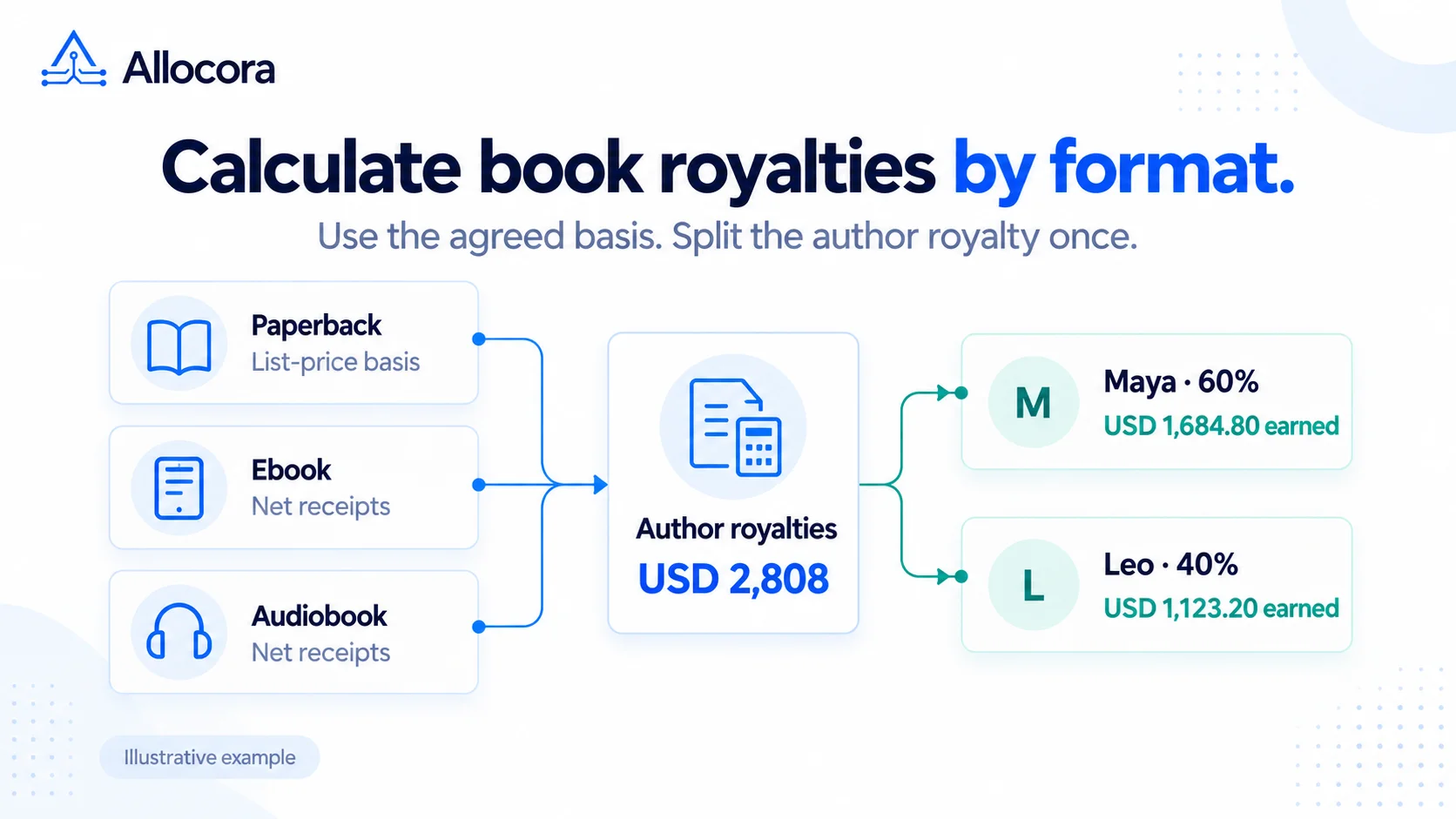 How to Calculate Book Royalties for Publishers: Sales, Returns, and Author Splits
Work through a publisher's paperback, ebook, and audiobook royalties, including returns, coauthor splits, advance balances, and the amount newly payable.
Oct 27, 2026 - 9 min read
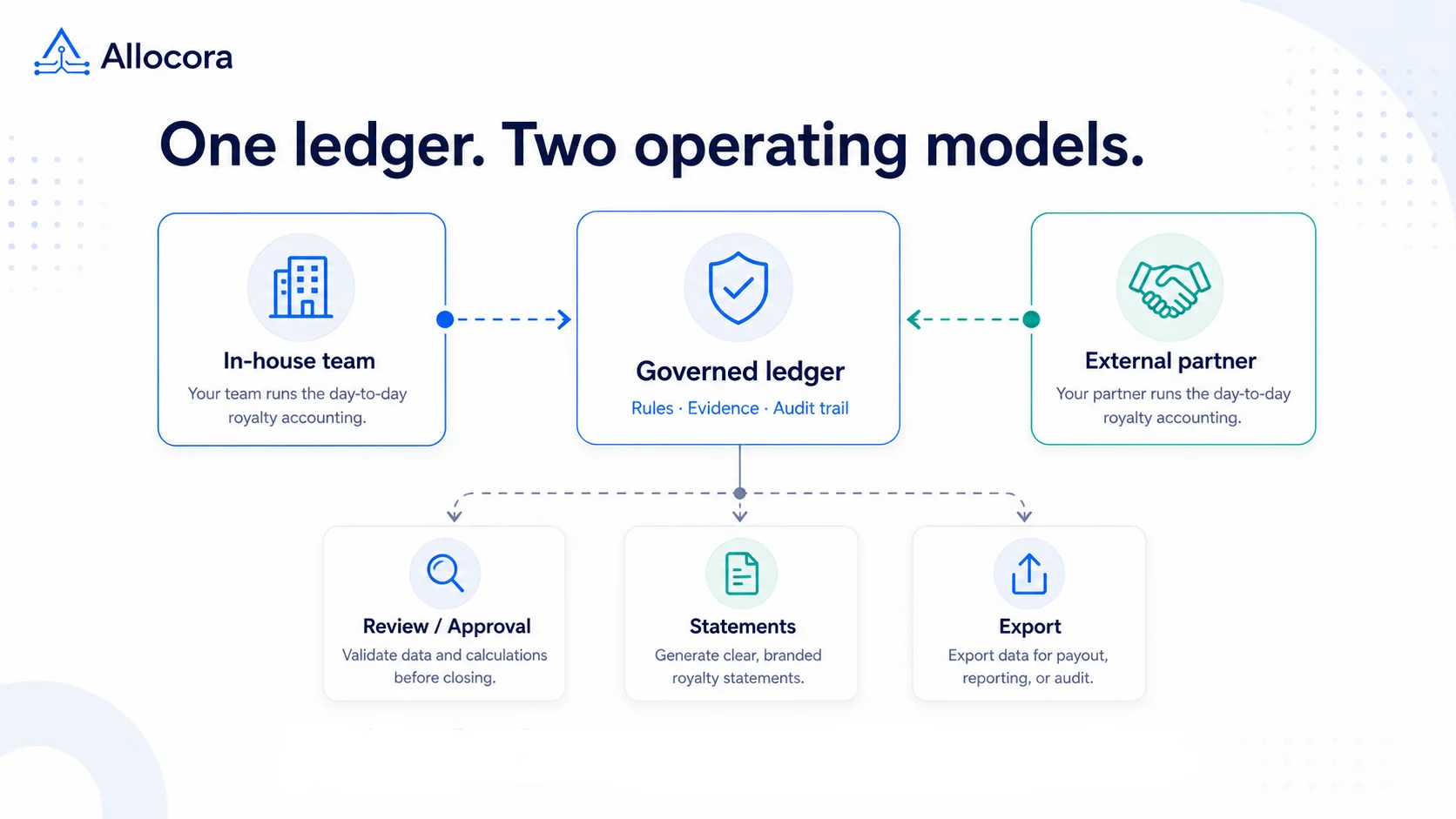 Outsourcing Royalty Accounting vs In-House: A Practical Guide for Growing Teams
A decision guide for labels, publishers, and platforms comparing outsourced royalty accounting, spreadsheet workflows, software-led operations, and hybrid models.
Sep 03, 2026 - 8 min read
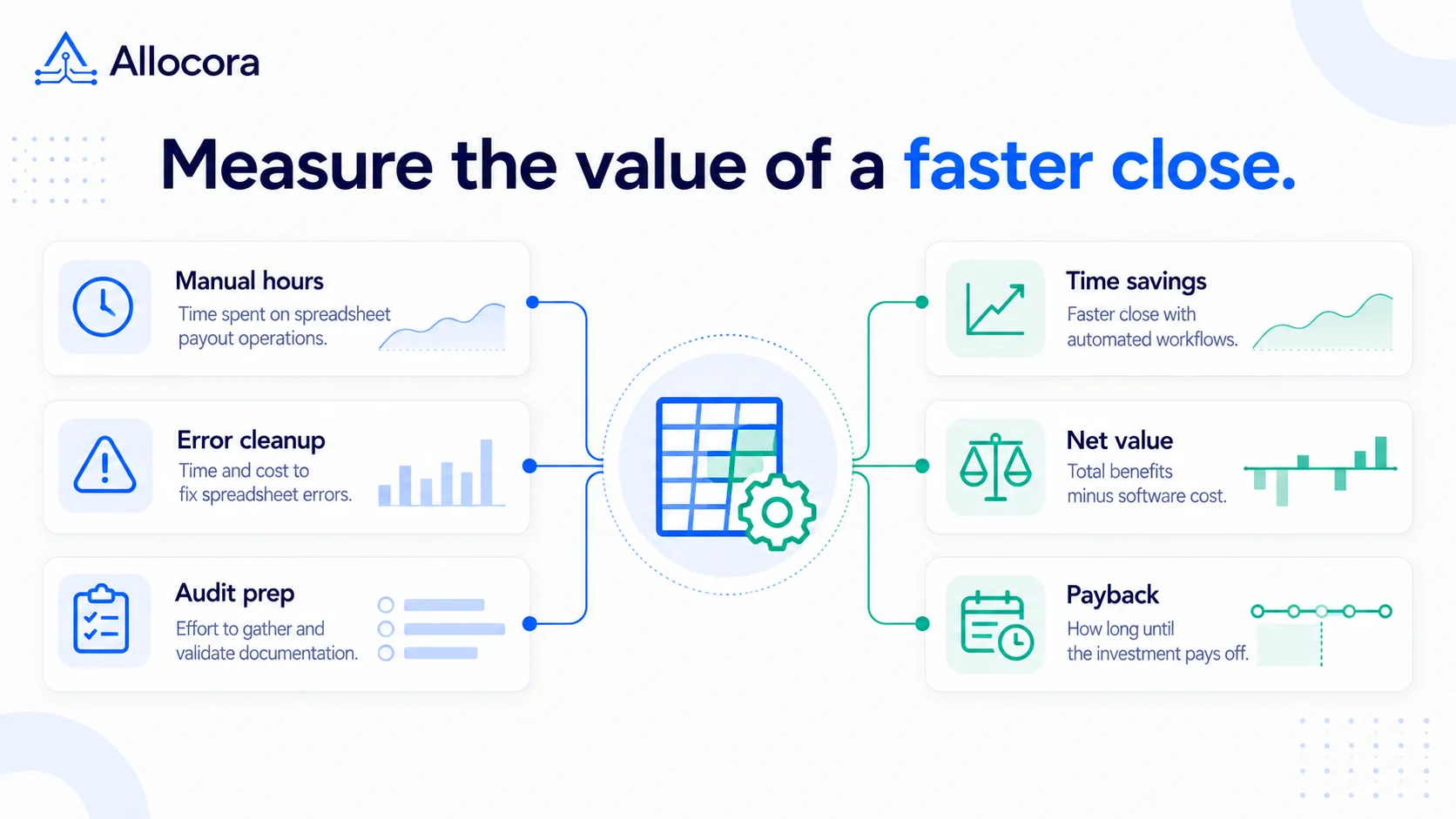 Royalty Ledger Automation ROI: When Spreadsheet Payout Operations Pay for Software
A practical before-and-after ROI model for evaluating royalty-ledger automation using close-time savings, avoided error costs, audit cleanup, and software cost.
Aug 27, 2026 - 11 min read