
How to Calculate Music Royalties: Formula, Examples, and Spreadsheet Checks
A plain-language guide to calculating music royalties from gross revenue, deductions, splits, recoupment, statements, and audit notes.
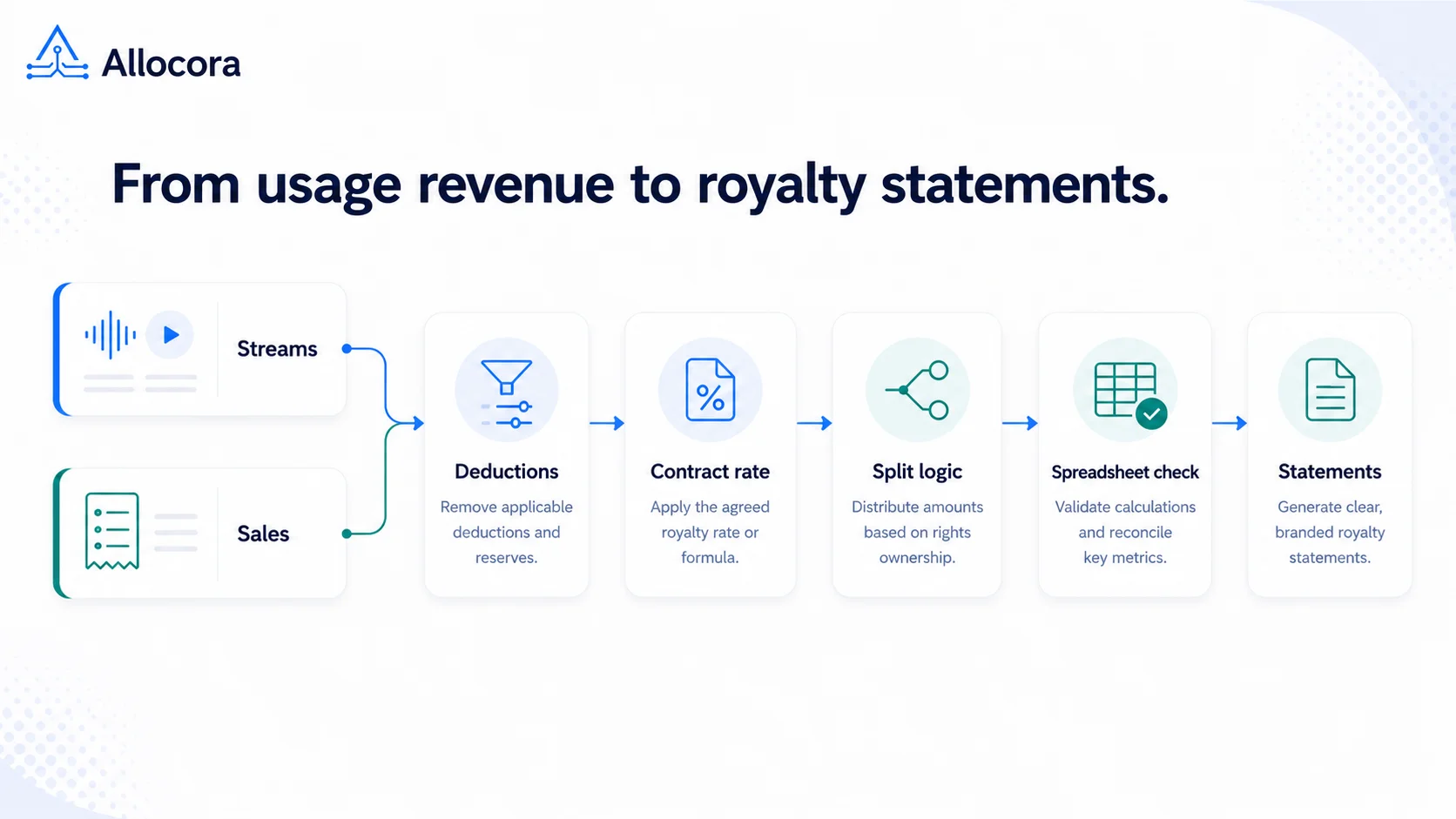
Music royalty calculation starts with a simple idea: take the revenue that is eligible for a royalty, apply the right contract logic, split the result across payees, and produce statement-ready amounts. The hard part is not the basic formula. The hard part is proving which revenue was included, which deductions were allowed, which split applied, and how recoupment or adjustments changed the final payable.
This guide explains a practical calculation model for labels, publishers, artist managers, production libraries, and finance teams moving royalty work out of spreadsheets. It is not legal or accounting advice. Contract language varies, and professional review still matters.
Basic music royalty formula
A simple royalty calculation can be expressed like this:
NET = GROSS_REVENUE - ALLOWED_DEDUCTIONS
ROYALTY_POOL = NET * RIGHTS_HOLDER_SHARE
PAYEE_SHARE = ROYALTY_POOL * PAYEE_SPLIT
NET_PAYABLE = max(PAYEE_SHARE - RECOUPMENT - HOLDS, 0)
For a scenario where percentage-based deductions are applied sequentially:
NET = GROSS_REVENUE * (1 - PLATFORM_FEE_PERCENT) * (1 - TAX_OR_WITHHOLDING_PERCENT)
ROYALTY_POOL = NET * RIGHTS_HOLDER_SHARE_PERCENT
PAYEE_SHARE = ROYALTY_POOL * PARTICIPANT_SPLIT_PERCENT
PAYOUT = max(PAYEE_SHARE - UNRECOUPED_ADVANCE, 0)
This formula is only a teaching model. Real agreements may define deductions, reserves, recoupment, territories, advances, minimums, royalty bases, and statement timing differently.
Worked example
Assume a label receives USD 10,000 of gross revenue for a release. Under the agreement, a 15 percent platform fee is deducted before applying a 50 percent artist royalty share. Two participants split the artist share: Artist A receives 70 percent and Producer B receives 30 percent. Artist A has USD 1,000 of unrecouped advance.
GROSS_REVENUE = 10000.00
PLATFORM_FEE = 15%
NET = 10000.00 * (1 - 0.15) = 8500.00
ROYALTY_POOL = 8500.00 * 0.50 = 4250.00
ARTIST_A_GROSS_SHARE = 4250.00 * 0.70 = 2975.00
PRODUCER_B_SHARE = 4250.00 * 0.30 = 1275.00
ARTIST_A_NET_PAYABLE = max(2975.00 - 1000.00, 0) = 1975.00
A useful statement should show more than the USD 1,975 final payable. It should also preserve the source revenue, deduction basis, royalty pool, split, and recoupment.
Common revenue sources
Music royalties may come from:
- Streaming reports.
- Download sales.
- UGC platform reports.
- Sync licensing income.
- Physical sales.
- Direct-to-fan sales.
- Marketplace or subscription platform revenue.
- Distributor adjustments.
Each source may have different identifiers and row formats. That is why imports and mapping matter. Allocora's import template library includes a generic DSP royalty statement CSV sample and related publishing templates. Use them as shape references, not as legal templates.
Map identifiers before applying rates
A royalty formula is only correct if the revenue row is mapped to the right catalog item and payee terms. Common identifiers include ISRC, UPC, SKU, product ID, title ID, catalog ID, ISBN, and ASIN.
Spreadsheet workflows often blur transaction identity and product identity. Keep them separate:
- Transaction identity proves the source row.
- Product identity determines what the row belongs to.
- Payee identity determines who may receive a share.
- Rule identity determines which calculation logic applies.
Allocora's CSV workflow uses external_id for transaction traceability and external_product_identifier for product matching. That separation makes audits easier.
Apply deductions carefully
Deductions can include platform fees, distributor fees, taxes, reserves, chargebacks, or other contract-defined adjustments. Do not assume every deduction is allowed. The agreement should define the royalty basis.
For operational purposes, separate deductions into categories:
- Source-level deductions already reflected in the imported amount.
- Contract-level deductions that change the royalty pool.
- Payee-level economics such as advances or recoupable expenses.
- Payment-level deductions handled downstream by the payout rail or AP process.
This separation prevents double-counting. For example, if the distributor report already provides net royalty, do not subtract the same platform fee again.
Handle refunds and adjustments as rows
Refunds and adjustments should not live in a note column. They should be represented as explicit rows with a type, sign, date, source identity, product identifier, and reason where possible.
In a controlled workflow:
- Sales are positive rows.
- Refunds are negative rows.
- Adjustments may be positive or negative.
- Corrections are traceable to the source file or explanation.
Keeping refunds and adjustments as explicit revenue rows makes their effect on the calculation visible and reproducible.
Recoupment and balances
Music royalty statements often include recoupment. A payee may have an advance, recoupable expenses, reserve holdback, clawback balance, or minimum payout threshold. These economics should be evaluated after gross allocation is calculated so the statement can distinguish the amount earned from the amount currently payable.
A controlled workflow should preserve the opening balance, amounts applied during the period, remaining balance, and resulting net payable separately.
Spreadsheet checks before you trust the result
If you still calculate in a spreadsheet, run these checks:
- Does every source row have a stable external ID?
- Does every royalty-bearing row map to a product or catalog item?
- Are refunds and adjustments typed separately from sales?
- Are rates stored in a rules tab rather than hard-coded into formulas?
- Are effective dates applied?
- Are payee splits checked for totals over 100 percent?
- Are advances and balances shown separately from gross royalty share?
- Can you reproduce the same period after changing a future rule?
- Can you generate statements without copy-paste edits?
- Can a reviewer trace one statement line back to one source row?
If several answers are no, the spreadsheet is probably doing too much. For a broader migration checklist, see Royalty Accounting Software: How to Choose a System for a Label or Publisher.
Statement-ready output
A useful royalty statement should show:
- Payee name.
- Statement period.
- Source or catalog summary.
- Gross revenue or royalty basis.
- Deductions or adjustments.
- Rate or split.
- Gross allocated amount.
- Recoupment or holdbacks.
- Net payable.
- Carried balance.
- Notes or audit reference.
The exact format depends on your business, but the principle is stable: the payee should understand the amount, and the finance team should be able to defend it.
CSV example for a royalty test
A minimal test file might look like this:
external_id,date,amount,currency,type,external_product_identifier,description
dsp_001,2026-05-31,8500.00,USD,sale,ISRC123456789,May streaming revenue
dsp_002,2026-05-31,-125.00,USD,refund,ISRC123456789,Prior-period correction
dsp_003,2026-05-31,600.00,USD,adjustment,ISRC987654321,Distributor adjustment
The exact column names can differ, but the concepts should not. Keep transaction identity, amount, currency, row type, product identifier, and source context visible. If you have to infer those details from a free-form description, the calculation will be harder to audit.
Calculation review checklist
Before sending statements, review:
- Were all intended revenue sources included?
- Were unexpected currencies rejected or handled by policy?
- Were unmapped products resolved or intentionally excluded?
- Did every payee receive the expected rule treatment?
- Did refund rows reduce the correct royalty pool?
- Were advances, reserves, and thresholds shown separately?
- Can one statement line be traced back to a source row?
- Does the export match the reviewed statement totals?
These checks matter more than the formula itself. A mathematically correct number can still be operationally weak if nobody can explain it later.
Common mistakes in music royalty spreadsheets
Watch for these patterns:
- Net and gross amounts are mixed in the same column.
- Refunds are entered as positive rows with a note.
- The same catalog identifier appears under several spellings.
- Split percentages are rounded before the final calculation.
- Advances are subtracted from every participant instead of the correct payee.
- Statement totals are edited after formulas run.
- Prior-period corrections are added to the current period without a traceable reason.
Each mistake is fixable, but the fix should become part of the workflow. If a refund sign check catches one error, keep that check permanently. If an unmapped ISRC causes a missed royalty, require mapping review before future calculations.
Where a calculator helps and where it stops
A calculator is useful for understanding the math and testing simple scenarios. It is not enough for recurring royalty operations because it does not usually retain source files, rule versions, approval history, statements, exports, or reconciliation evidence. Use a calculator to learn the formula, then move to a ledger workflow when the result needs to be repeated and defended.
If you're evaluating systems for that next stage, see Best Royalty Management Software (2026): Practical Options for Growing Teams.
Try the calculation model
Use the music royalty calculator for a quick model, then try music royalty sample data when you want to see the governed workflow with imports, rules, calculation runs, statements, exports, and reconciliation evidence.
A governed workflow preserves the context behind the calculation so the next close does not depend on rebuilding the logic from memory.
FAQ
What is the simplest music royalty formula?
Start with gross revenue, subtract allowed deductions, apply the royalty share, apply participant splits, then apply recoupment or holds to determine net payable.
Should refunds reduce royalties?
Usually refunds or reversals reduce the royalty pool, but the exact treatment depends on the contract and source report. Operationally, keep refunds as explicit negative rows.
What is recoupment?
Recoupment applies earned royalties against an advance or approved expense balance before cash becomes payable. The statement should show both earned royalty and the remaining balance.
Can software calculate royalties automatically?
Software can automate repeatable import, mapping, rule, statement, and export workflows. The team still needs to define terms correctly and review output before downstream payment.
Related Articles
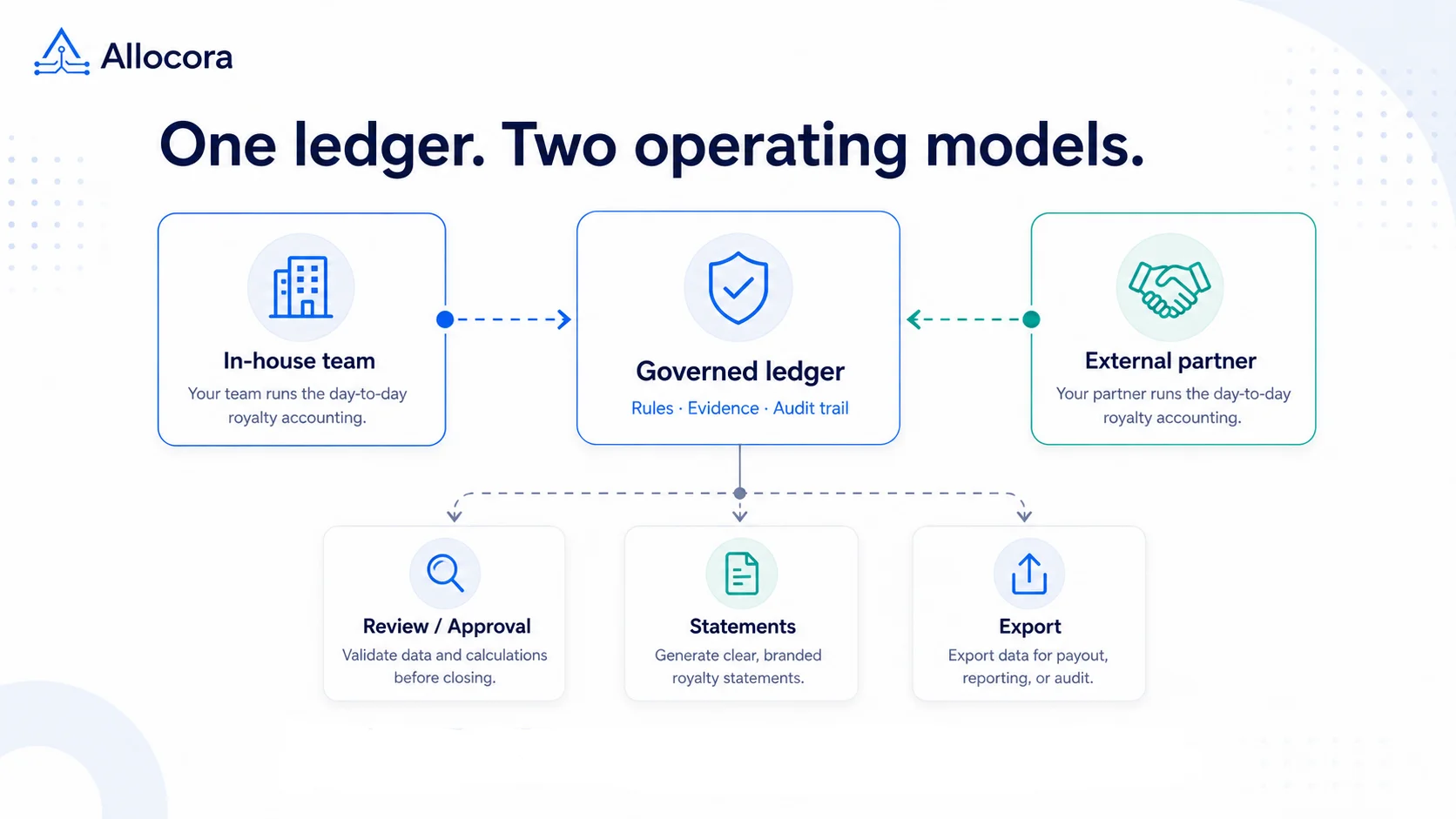 Outsourcing Royalty Accounting vs In-House: A Practical Guide for Growing Teams
A decision guide for labels, publishers, and platforms comparing outsourced royalty accounting, spreadsheet workflows, software-led operations, and hybrid models.
Sep 03, 2026 - 8 min read
Outsourcing Royalty Accounting vs In-House: A Practical Guide for Growing Teams
A decision guide for labels, publishers, and platforms comparing outsourced royalty accounting, spreadsheet workflows, software-led operations, and hybrid models.
Sep 03, 2026 - 8 min read
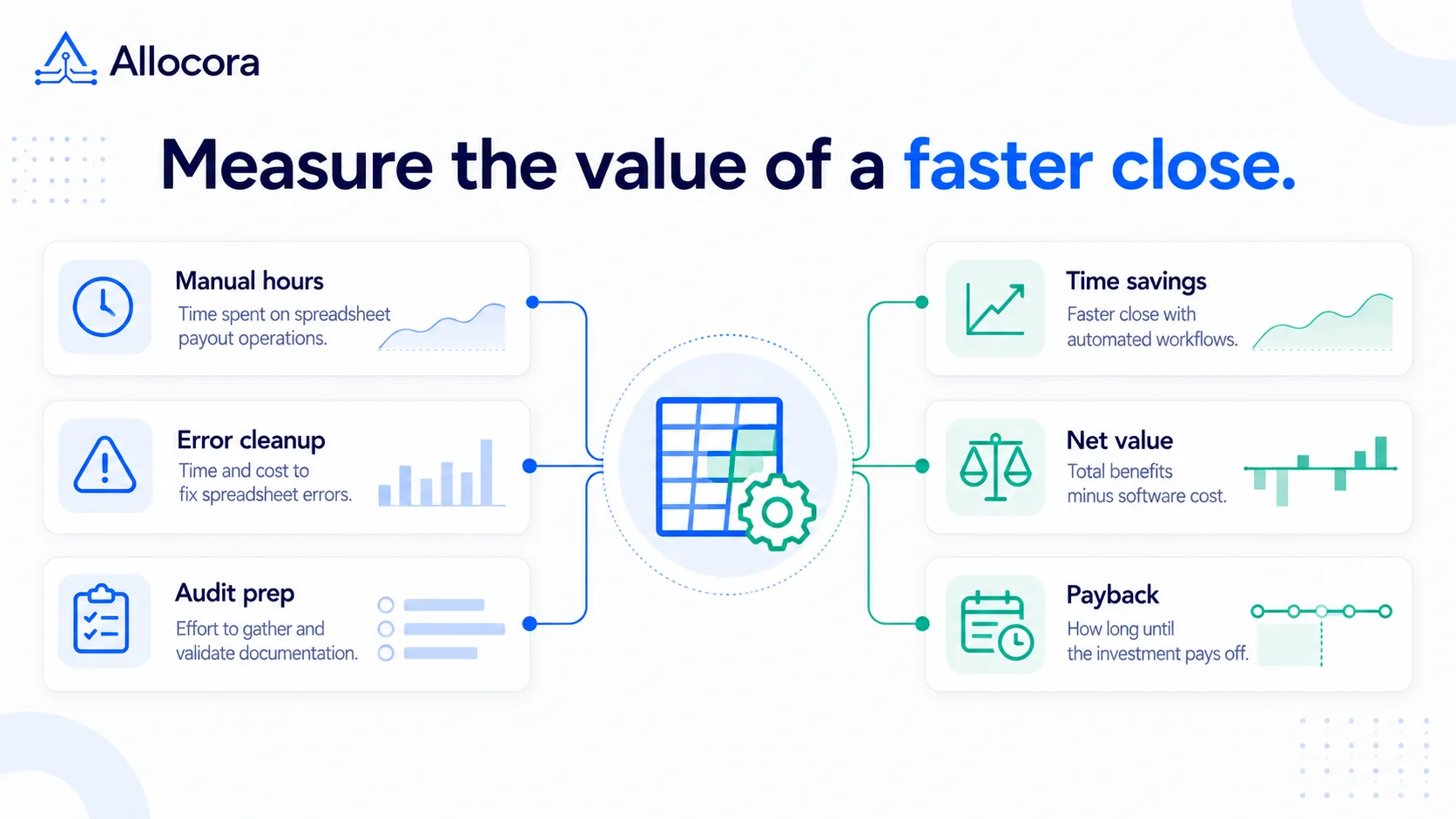 Royalty Ledger Automation ROI: When Spreadsheet Payout Operations Pay for Software
A practical before-and-after ROI model for evaluating royalty-ledger automation using close-time savings, avoided error costs, audit cleanup, and software cost.
Aug 27, 2026 - 11 min read
Royalty Ledger Automation ROI: When Spreadsheet Payout Operations Pay for Software
A practical before-and-after ROI model for evaluating royalty-ledger automation using close-time savings, avoided error costs, audit cleanup, and software cost.
Aug 27, 2026 - 11 min read
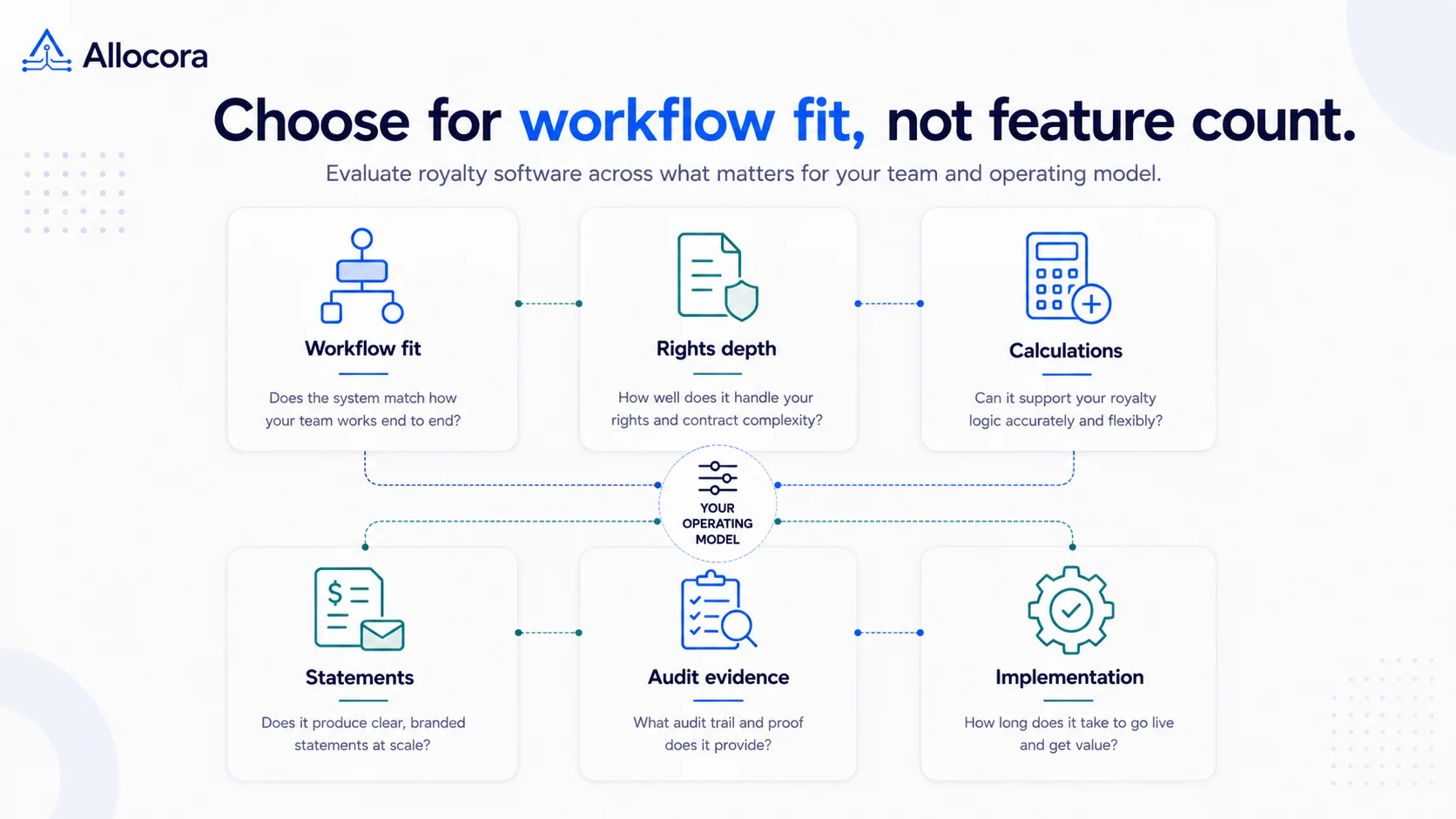 Best Royalty Management Software (2026): Practical Options for Growing Teams
A practical comparison framework for royalty management software, covering calculation scope, implementation effort, pricing transparency, and audit evidence.
Aug 18, 2026 - 10 min read
Best Royalty Management Software (2026): Practical Options for Growing Teams
A practical comparison framework for royalty management software, covering calculation scope, implementation effort, pricing transparency, and audit evidence.
Aug 18, 2026 - 10 min read