
Outsourcing Royalty Accounting vs In-House: A Practical Guide for Growing Teams
A decision guide for labels, publishers, and platforms comparing outsourced royalty accounting, spreadsheet workflows, software-led operations, and hybrid models.
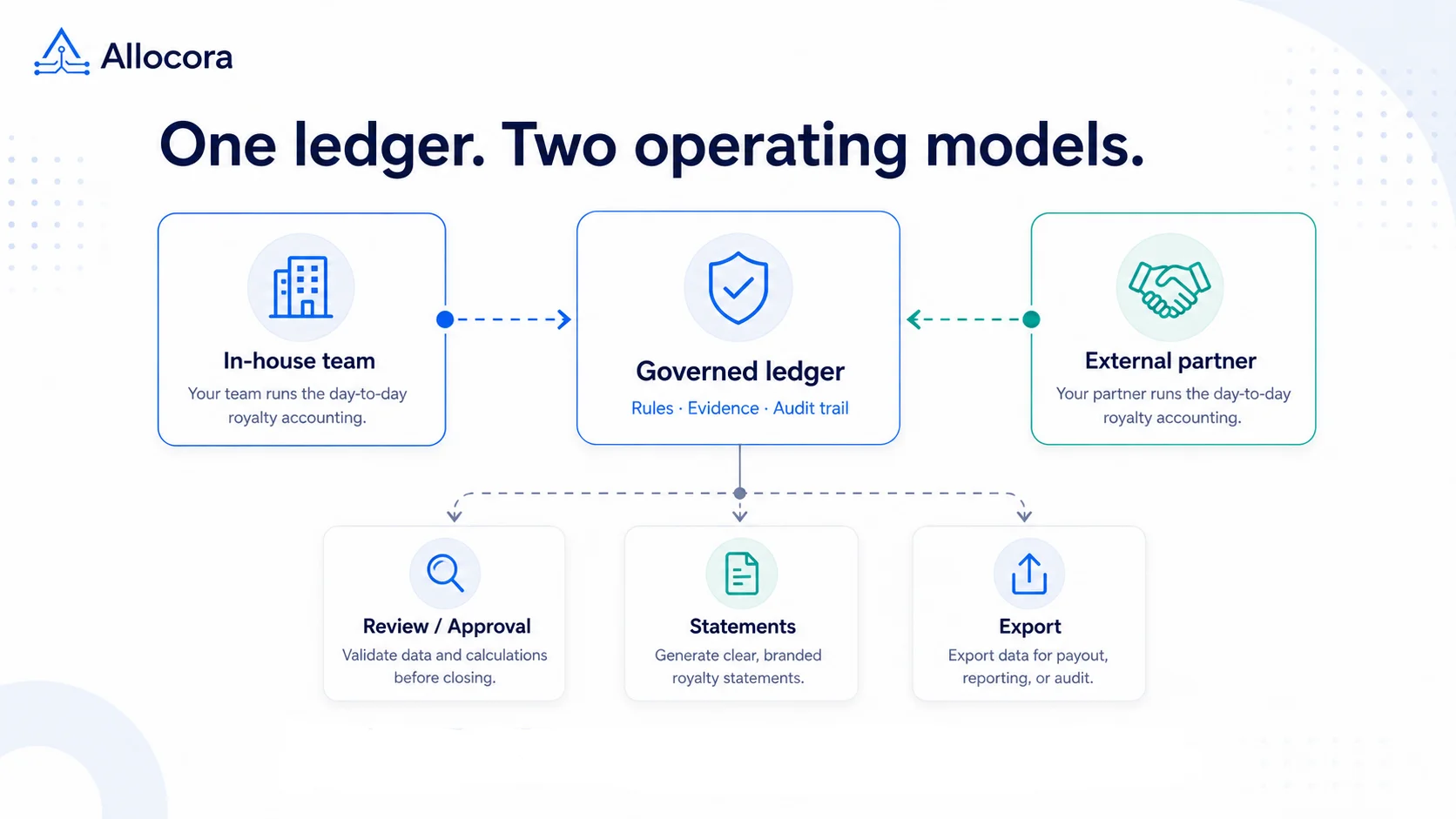
Royalty accounting can be handled in-house, outsourced to a specialist, supported by software, or split across a hybrid model. The best choice depends on volume, complexity, audit pressure, team capacity, and how much control you need over calculation evidence.
This guide is for small and mid-sized labels, publishers, production libraries, marketplaces, and creator platforms that are deciding whether to keep royalty accounting internal or outsource the process. The goal is not to declare one model universally better. The goal is to make the operating tradeoffs visible.
The four operating models
For this comparison, we can group royalty accounting workflows into four operating models:
| Model | What it means | Best when |
|---|---|---|
| Spreadsheet-based in-house | Internal team calculates royalties in Excel or Google Sheets | Volume is low and terms are simple |
| Outsourced provider | External specialist prepares calculations and statements | Internal capacity is low or expertise is missing |
| Software-led internal process | Internal team uses software for imports, rules, runs, statements, and exports | The team wants control, repeatability, and audit evidence |
| Hybrid model | Internal team owns calculation evidence while external providers handle accounting, review, or payments | The workflow needs both control and outside expertise |
The mistake is treating this as a pure cost decision. Royalty accounting also affects trust, close speed, dispute handling, and institutional knowledge.
Spreadsheet-based in-house process
Spreadsheets are usually the first model because they are flexible. One person can import a report, build formulas, create statements, and send totals downstream. This works when volume is small and the same person understands every rule.
The risk grows when:
- More payees are added.
- More source files arrive each period.
- Contract terms change.
- Refunds and adjustments become common.
- Statements need review by someone other than the workbook owner.
- Old periods need to be reconstructed.
The hidden cost is not just hours. It is dependency. If one operator understands the workbook and everyone else trusts the output, the organization has a control problem.
Outsourced royalty accounting provider
Outsourcing can be useful when the team lacks time or domain expertise. A provider may bring process knowledge, statement experience, and familiarity with common royalty scenarios.
Outsourcing can reduce internal workload, but teams should evaluate potential tradeoffs:
- Slow correction cycles.
- Limited visibility into the calculation process.
- Dependency on provider-specific files or methods.
- Higher cost as volume grows.
- Harder internal learning.
- Less direct control over evidence.
Outsourcing works best when the provider returns clear, reviewable artifacts rather than only final totals. Ask what you receive after each close: source reconciliation, rule assumptions, statement files, export files, and a change log.
Software-led in-house process
Software-led royalty accounting keeps the calculation workflow inside the team while reducing spreadsheet risk. The internal team owns source data, rules, runs, review, statements, exports, and reconciliation.
This model makes sense when the team needs:
- Faster recurring close cycles.
- More consistent statement output.
- Better audit history.
- Less dependency on one workbook owner.
- A reusable operating workflow.
- Self-serve sample data and onboarding.
Allocora fits this model. It gives finance and operations teams a governed place to import revenue, map products, model payees and rules, run calculations, generate statements, export close evidence, and reconcile downstream payments.
The tradeoff is that the team still owns setup and review. Software reduces manual fragility, but it does not remove the need to understand the business rules.
Hybrid model
The hybrid model is often the most practical path. Internal teams use software to preserve calculation evidence and statements, while outside accountants, consultants, or payout providers handle review, advisory, tax, or payment execution.
This works well when:
- The business wants internal visibility into calculations.
- An outside provider still reviews the close.
- A payment rail handles money movement.
- The team wants to avoid locking all knowledge inside an external process.
The handoff should be evidence-based. Instead of sending a workbook and asking for trust, the internal team sends reviewed calculation runs, statements, exports, and reconciliation packages.
Build the cost map
Compare models with a full cost map, not only vendor fees.
Include:
- Software subscription.
- Implementation and migration.
- Analyst hours.
- Data cleanup.
- Statement preparation.
- Correction cycles.
- Audit preparation.
- Dispute support.
- External provider fees.
- Payment or accounting handoff work.
- Error-related cost.
Compare the expected cost of each operating model rather than treating current spreadsheet labor as zero:
TOTAL_OPERATING_COST = recurring labor + software or provider fees + correction and review costs + implementation cost allocationKeep the categories mutually exclusive, and use measured correction costs where possible rather than assuming every calculation error becomes a cash loss.
For a full before-and-after model, see Royalty Ledger Automation ROI: When Spreadsheet Payout Operations Pay for Software.
The automation threshold
In-house spreadsheets usually break at a combination of factors, not one number. Watch for these thresholds:
- A growing number of active payees.
- More than one revenue source.
- More than one person reviewing or editing calculations.
- Refunds, reserves, recoupment, or thresholds.
- Multiple statement formats.
- Monthly or quarterly close pressure.
- Payee disputes that require source-row proof.
As several of these factors accumulate, software-led or hybrid operations become worth evaluating.
Risk comparison
| Risk | Spreadsheet in-house | Outsourced | Software-led |
|---|---|---|---|
| Formula drift | High | Depends on provider | Lower with versioned rules |
| Process opacity | Medium | Can be high | Lower if runs and logs are visible |
| Internal dependency | High | Lower internally, higher externally | Lower with shared workflow |
| Correction speed | Fast for simple fixes, risky for complex ones | Depends on provider availability | Depends on workflow design and internal ownership |
| Audit readiness | Usually weak | Depends on deliverables | Depends on retained runs, logs, and exports |
| Payment execution | Manual or external | Often external | External by design |
The biggest question is not "who does the work?" It is "can the organization prove the work later?"
For a practical evidence review, use the Royalty Audit Checklist: 10 Steps to Prepare Statements, Evidence, and Payout Records.
What should stay internal even if you outsource?
Even when an outside provider does the calculation work, keep several things internally visible:
- Source revenue scope.
- Current payee list.
- Contract terms that affect calculation.
- Statement approval status.
- Export or payment handoff files.
- Payee dispute history.
- Evidence retention policy.
Outsourcing should not mean the organization loses its own operating memory. A provider can prepare work, but the business still owns the obligations and the relationship with payees. That is one reason a hybrid workflow can be useful: software keeps the evidence accessible while outside specialists help with review, advice, or execution.
When to switch models
Switch from spreadsheets to software when the same manual checks happen every period. Switch from fully outsourced to hybrid when internal teams need faster visibility into statements, evidence, or payee questions. Switch from internal software-led work to outside support when business rules become too specialized for the current team to maintain confidently.
These switches do not need to be dramatic. A team can start by running one period in software while keeping the old provider or spreadsheet as a comparison point. The first goal is confidence in the operating evidence, not a perfect migration.
The cleanest transition plan has an owner, a period scope, a source-file list, and a success test. For example: "Reproduce the May close for the top 25 payees, generate statements, and explain three sample statement lines from source revenue to export." That is concrete enough to evaluate without turning the migration into an open-ended project.
A practical decision rule
Keep spreadsheets if the process is simple, low volume, easy to review, and not disputed.
Outsource if you lack internal capacity or need specialist review quickly.
Use software-led operations if you need repeatability, statement consistency, audit evidence, and direct control over calculations.
Use a hybrid model if you want internal calculation proof plus external accounting, advisory, or payment support.
How to start without a full migration
Run one close period as a proof:
- Choose a representative period.
- Import one source file.
- Map catalog identifiers.
- Create the highest-volume payees and rules.
- Run calculations.
- Generate statements.
- Export the evidence package.
- Compare against the current spreadsheet or provider output.
Allocora's royalty sample workspaces let teams see this before using real data. That self-serve path keeps evaluation focused on the workflow, not a sales process.
FAQ
Is outsourcing royalty accounting cheaper?
Sometimes, especially when internal capacity is limited. But compare total cost, including correction cycles, audit preparation, internal review time, and loss of process visibility.
Can software replace an outsourced accountant?
Software can replace manual calculation and evidence assembly, but it does not replace professional accounting, legal, or tax judgment. Many teams use software and outside review together.
What should an outsourced provider deliver?
At minimum: source revenue summary, assumptions, rule logic, statement files, payee totals, export files, and enough evidence to trace a statement line back to source data.
When should a team bring royalty accounting in-house?
Bring more of the process in-house when close cycles are recurring, evidence matters, disputes are increasing, or the team needs faster control over rules, statements, and exports.
Related Articles
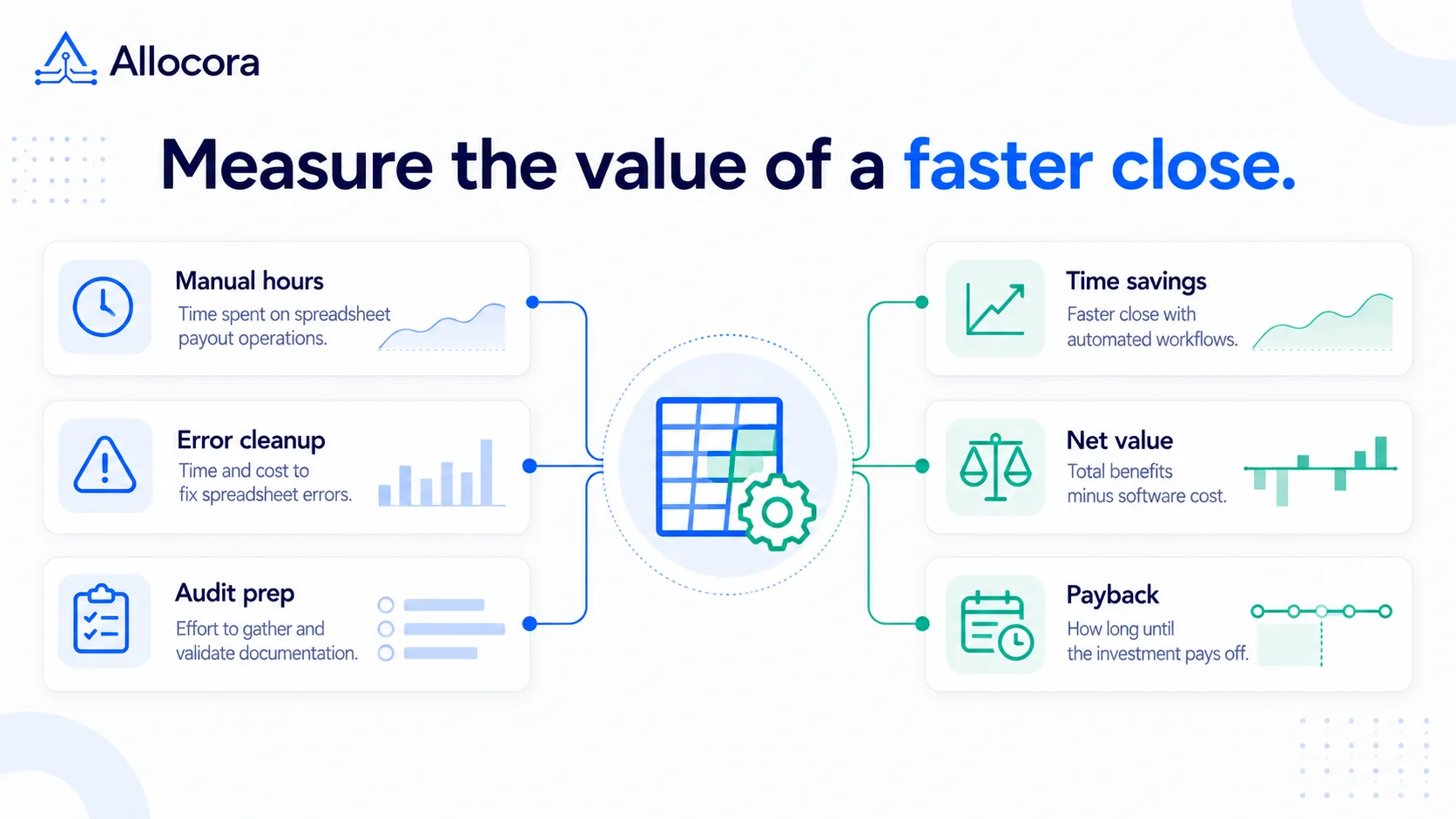 Royalty Ledger Automation ROI: When Spreadsheet Payout Operations Pay for Software
A practical before-and-after ROI model for evaluating royalty-ledger automation using close-time savings, avoided error costs, audit cleanup, and software cost.
Aug 27, 2026 - 11 min read
Royalty Ledger Automation ROI: When Spreadsheet Payout Operations Pay for Software
A practical before-and-after ROI model for evaluating royalty-ledger automation using close-time savings, avoided error costs, audit cleanup, and software cost.
Aug 27, 2026 - 11 min read
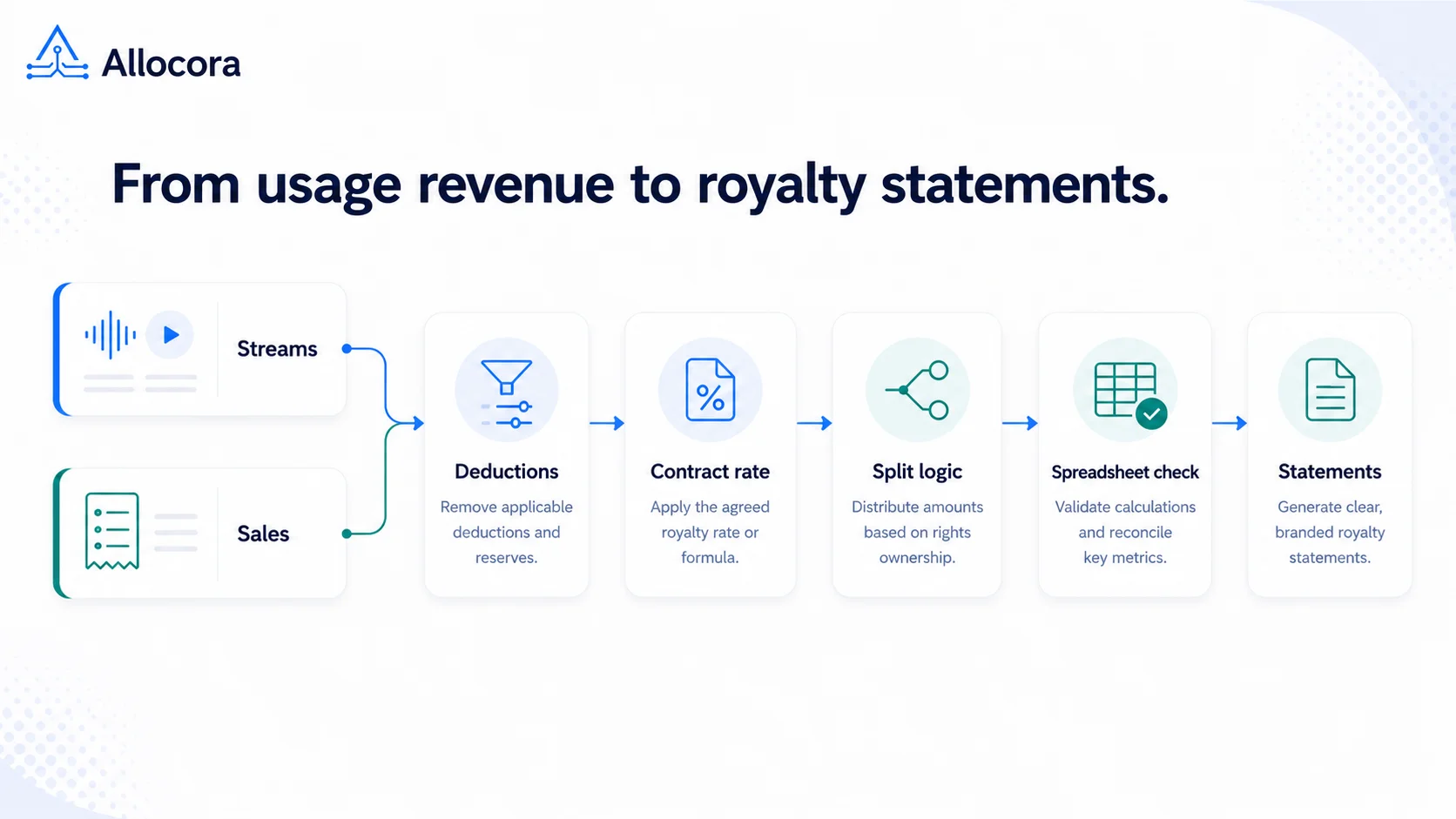 How to Calculate Music Royalties: Formula, Examples, and Spreadsheet Checks
A plain-language guide to calculating music royalties from gross revenue, deductions, splits, recoupment, statements, and audit notes.
Aug 21, 2026 - 8 min read
How to Calculate Music Royalties: Formula, Examples, and Spreadsheet Checks
A plain-language guide to calculating music royalties from gross revenue, deductions, splits, recoupment, statements, and audit notes.
Aug 21, 2026 - 8 min read
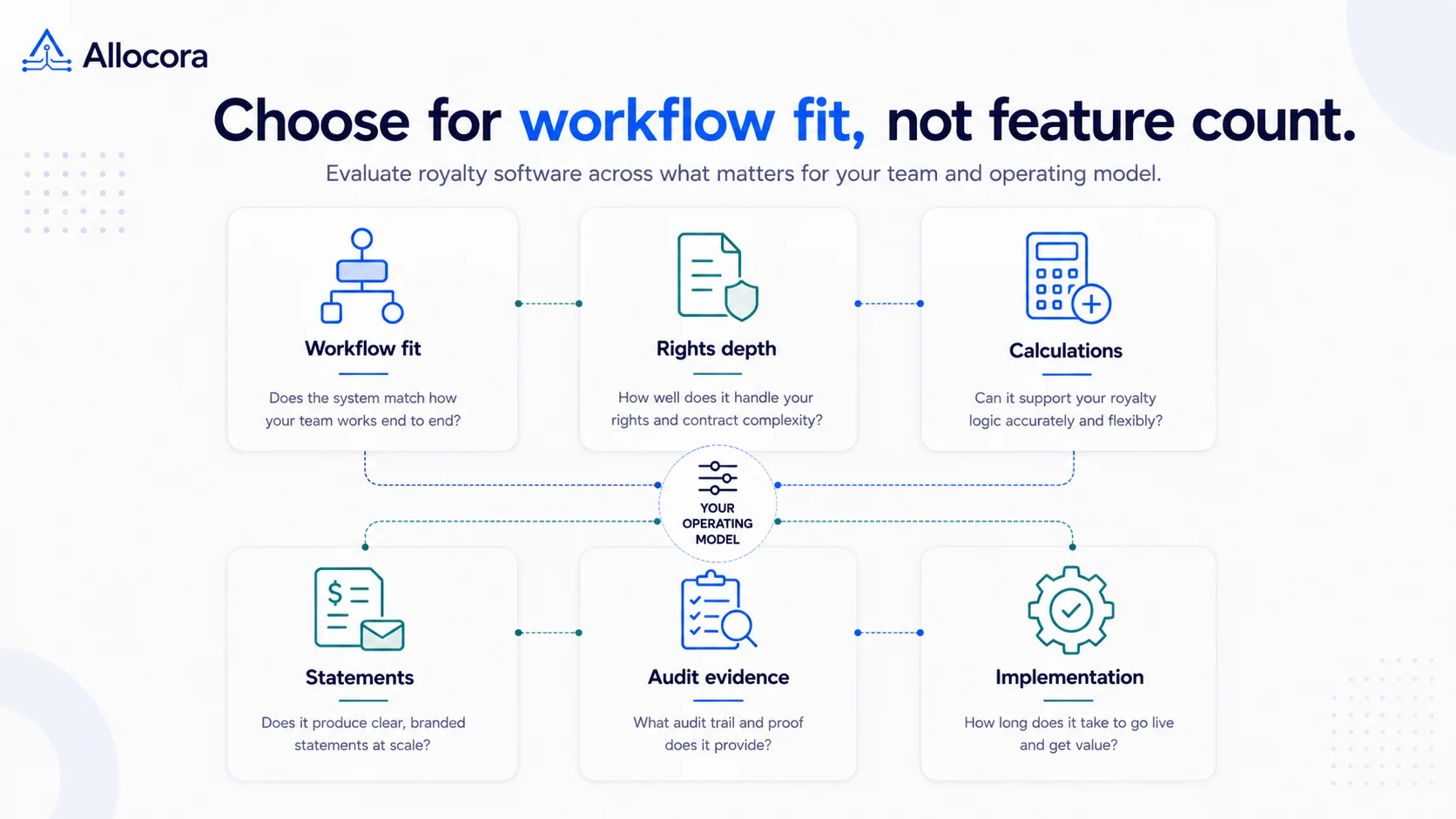 Best Royalty Management Software (2026): Practical Options for Growing Teams
A practical comparison framework for royalty management software, covering calculation scope, implementation effort, pricing transparency, and audit evidence.
Aug 18, 2026 - 10 min read
Best Royalty Management Software (2026): Practical Options for Growing Teams
A practical comparison framework for royalty management software, covering calculation scope, implementation effort, pricing transparency, and audit evidence.
Aug 18, 2026 - 10 min read