
Payout Reconciliation: Matching Partner Obligations to Actual Payments
A worked payout reconciliation guide covering partial payments, failed attempts, returned funds, fees, and the evidence behind each partner's remaining obligation.
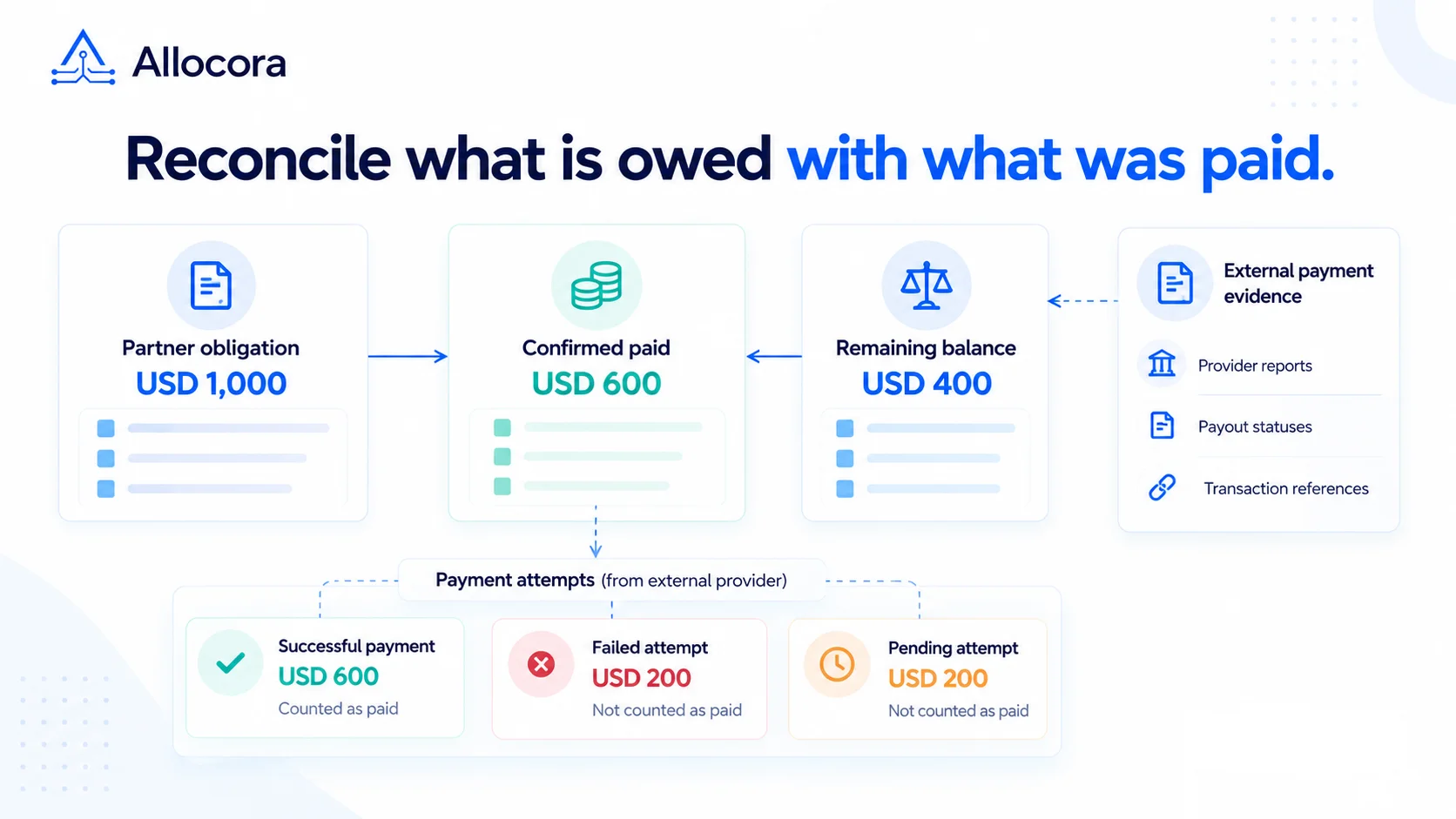
Payout reconciliation answers a practical question: how much of each reviewed partner obligation has actually been paid, and what remains unresolved? A total at the bottom of a payment file cannot answer that on its own. The review needs the payee, currency, obligation, individual payment references, and the outcome of each payment attempt.
For royalties, affiliate commissions, marketplace sellers, and agency revenue shares, start with the agreed amount owed to each payee. Match external payment evidence to that obligation, combine distinct partial payments, and investigate missing, extra, failed, or returned payments at a stated cutoff.
Start with the obligation you intend to settle
Keep three records connected:
| Record | Question it answers | Evidence to retain |
|---|---|---|
| Calculation and settlement record | What is included in this payment handoff? | Reviewed calculation, period, payee, currency, holds and exclusions |
| Payment instruction | What did the operator ask the bank or provider to send? | Submitted file or request and its reference |
| Payment outcome | What happened to that instruction? | Provider or bank confirmation, recipient reference, amount, date and outcome |
An instruction can be accepted before its outcome is known. Preserve the relationship between these records rather than treating an exported amount as a completed payment.
Use the reviewed amount included in the payment handoff as the expected obligation. Keep held and below-threshold amounts visible as exclusions until their payment eligibility has been reviewed.
Also identify which reconciliation you are performing. Stripe, for example, provides a payout reconciliation report for the transactions in a settlement batch paid from a Stripe balance to a bank account. That report can explain a processor-to-bank transfer. Your partner's commission or royalty obligation still needs its own calculation and payment evidence. See Stripe's payout reconciliation documentation for that report's scope.
A worked example: USD 1,000 owed, USD 600 paid
Assume a hypothetical June close has one reviewed, payment-ready obligation of USD 1,000 to Partner A. All amounts below are USD. There are no fees, currency conversions, reserves, or later changes to the amount owed. Review the evidence as of July 5.
| External record | Amount successfully applied to the obligation | Outcome at the cutoff | Reconciliation treatment |
|---|---|---|---|
| BANK-600, July 2 | 600.00 | Completed, supported by bank evidence | Include once |
| BANK-400-TRY1, July 3 | 0.00 | Failed attempt for an intended 400.00 | Keep the failure evidence; no paid amount |
| BANK-400-TRY2, July 5 | 0.00 | New attempt for 400.00 is pending | Keep open until its outcome is supported |
| Total confirmed paid | 600.00 | ||
| Remaining obligation | 400.00 |
The attempted amounts are payment instructions. The amounts counted as paid in this table depend on the supported outcome. The failure and pending attempt do not contribute another USD 800 to the paid total.
Use a consistent sign convention:
signed variance = confirmed paid amount - expected amount
signed variance = 600.00 - 1,000.00 = -400.00

unpaid remainder = expected amount - confirmed paid amount
unpaid remainder = 1,000.00 - 600.00 = 400.00
Here, a negative variance means underpayment. The remainder formula describes this unchanged, underpaid obligation; if paid amounts exceed the obligation, report the excess as overpayment instead of presenting a negative amount as a new payment instruction.
On July 7, suppose BANK-400-TRY2 is confirmed completed for USD 400. The cumulative paid amount becomes USD 1,000 and variance becomes zero. Keep the earlier pending observation as history and count the completed payment once. Do not add both observations as separate payments.
Match the identity before matching the amount
Two payments of USD 400 can belong to different recipients, periods, or obligations. An amount match alone is insufficient.
For each record, establish:
- The payee reference used by the source system and its relationship to your payee record.
- The obligation or locked run being settled.
- The payment currency and amount basis.
- A payment reference that identifies the external event within its provider or account context.
- The source outcome and paid date, when supplied.
- Any fee, return, or correction evidence needed to interpret the amount.
Retain the original file or provider record alongside the reviewed mapping. If the source does not supply a paid date or a status, preserve that gap. An import timestamp establishes when evidence was recorded, not when funds reached the recipient.
Treat suspected duplicates as review items. The same payment can appear in an original export, an updated export, and a bank statement. Conversely, equal amounts with different references can be legitimate instalments. Compare identity, source context, and outcome history before counting a row again.
Keep partial payments on the same obligation
In the example, USD 600 and USD 400 settle one USD 1,000 obligation. Creating a second USD 1,000 expected amount because another confirmation arrived would double the expected total.
Before preparing another external payment, review the current unpaid remainder and outstanding payment attempts. A pending attempt for USD 400 and a new instruction for the same USD 400 can expose the operator to a duplicate payment if both execute.
Investigate failed and returned payments separately
A failed attempt and a payment returned after processing have different histories. Trolley documents both outcomes, including a returned payment following successful processing. It also defines a complete batch as one whose payments have reached processed, failed, or returned outcomes. Review individual outcomes even when the batch is complete. See Trolley's payment and batch status definitions.
Suppose the USD 400 payment in the example is subsequently returned in full. If review establishes that the obligation remains unchanged and the returned amount no longer settles it, the operational position is again USD 600 paid and USD 400 outstanding. Retain the original payment, the return reference, its amount, and the evidence connecting them. Confirm any replacement payment against that reviewed position.
Explain fees and currency differences before closing a gap
Decide which amount the agreement and payment process require you to compare. These are different situations:
- A USD 1,000 obligation is paid in full, with a separate USD 20 fee charged to the sender.
- A transfer instruction is USD 1,000, but the recipient receives USD 980 after a fee.
- The obligation and recipient payment use different currencies.
In the first case, the sender's separate fee does not reduce the USD 1,000 paid to the recipient. In the second, determine who bears the fee under the agreed terms before explaining the USD 20 difference. For a currency conversion, retain both currency amounts and the source of the rate, then apply the approved comparison basis. Do not add amounts in different currencies into one unlabeled total.
Review differences per payee, not only in aggregate
A zero overall variance can hide two unresolved cases:
| Payee | Expected (USD) | Confirmed paid (USD) | Signed variance (USD) |
|---|---|---|---|
| Partner A | 1,000.00 | 900.00 | -100.00 |
| Partner B | 500.00 | 600.00 | 100.00 |
| Total | 1,500.00 | 1,500.00 | 0.00 |
The sum of the absolute payee variances is USD 200. Both payees require review even though the net total balances. Keep unmatched confirmations visible as well: an unassigned payment does not settle a named partner's obligation merely because the overall totals happen to agree.
For each unresolved difference, record the evidence, owner, next action, and next review date. A documented timing difference can remain open; it should not be relabeled paid to make a report balance. For a broader view of reconciliation variance and other close-quality indicators, see Payout Operations Metrics: What to Track From Calculation to Reconciliation.
A practical close review
Before treating the period as reconciled, check that:
- Expected amounts come from the reviewed settlement scope, with holds and exclusions accounted for.
- Confirmed payments belong to the correct payee, obligation, and currency.
- Distinct partial payments are combined and repeated observations are counted once.
- Failed, pending, returned, and unmatched records remain visible with their supporting evidence.
- Fees and currency differences use a documented comparison basis.
- Payee-level differences are resolved or carried as explicit open items.
- A reviewer can follow the amount from calculation to instruction to external outcome.
Reconcile partner payouts in Allocora
Allocora compares payment confirmations with the included settled obligations from a locked calculation run. Review the payee, currency, holds, exclusions, and current unpaid remainder before preparing another payment handoff. Your bank, payout provider, or accounts-payable process executes the payment.
Use an Allocora confirmation workbook or a mapped provider-file import to record external payment evidence. The generated workbook captures paid amounts, dates, references, and notes. For structured pending, failed, cancelled, or reversed payment statuses, use the provider-file import and review the reconciliation results.
If a previously recorded payment is returned, review its original confirmation and the return evidence before retrying. Recording a reversed status does not automatically undo the earlier paid amount. Fee and FX evidence preserves the supplied context without converting amounts or recalculating the obligation.
Start with the partner settlements workflow, and use the payout audit checklist to review the handoff before funds move.
Questions about payout reconciliation
Does a matched amount prove the recipient was paid?
It establishes an amount match within the evidence you reviewed. Check the external payment outcome and any later return or reversal before treating the obligation as settled.
Should I change the original royalty calculation when a transfer fails?
If the amount owed has not changed, retain it and investigate payment execution. A contractual correction to the amount owed is a different decision and needs its own reviewed calculation evidence.
What if a provider file contains the same payment again?
Compare the provider/account context, payment reference, amount, and outcome history. Retain the source evidence and count the economic payment once. Do not assume every repeated reference is a new instalment or every equal amount is a duplicate.
Related Articles
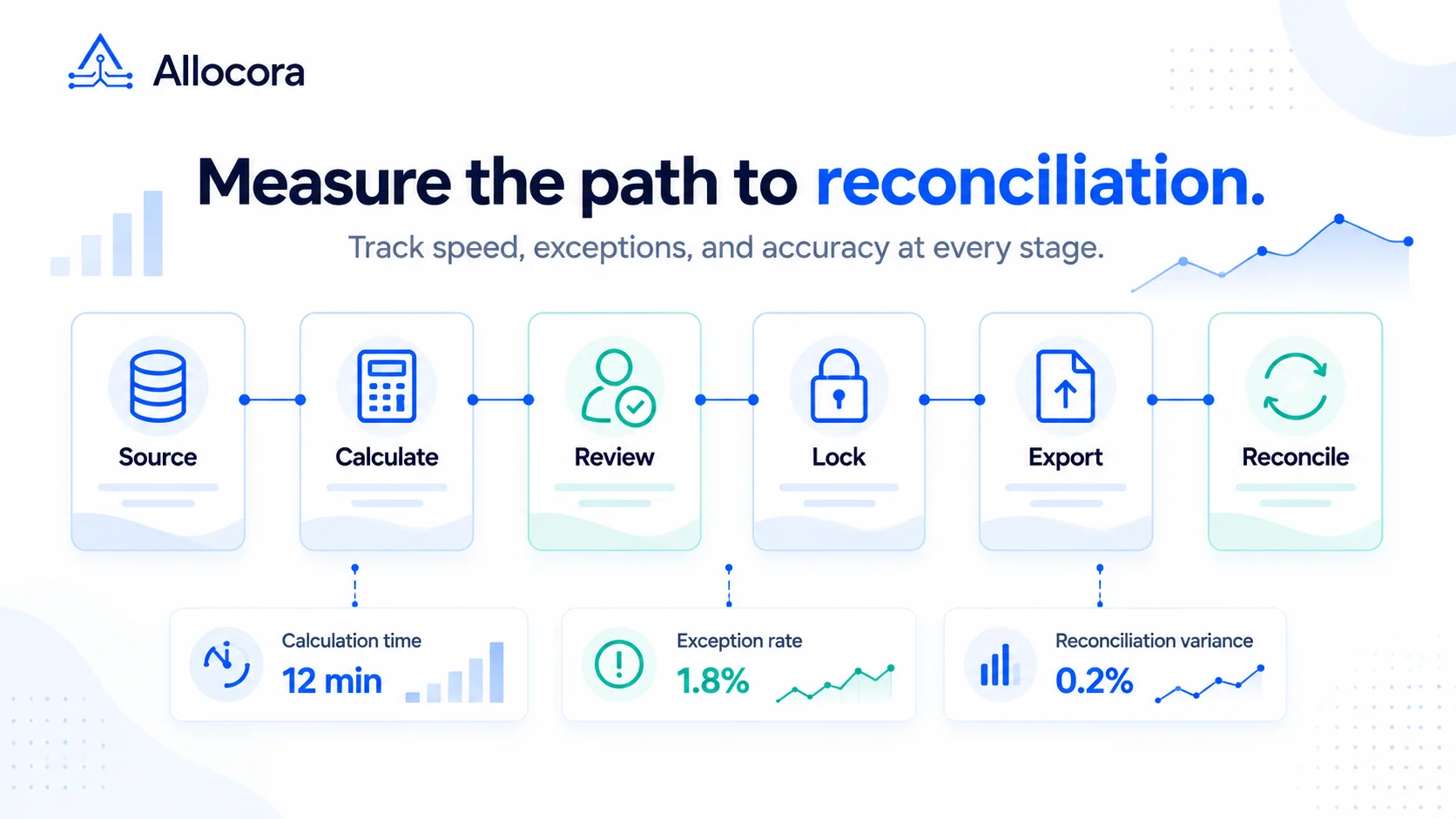 Payout Operations Metrics: What to Track From Calculation to Reconciliation
Track payout operations metrics from source data to calculation, review, export, payment confirmation, reconciliation.
Oct 22, 2026 - 9 min read
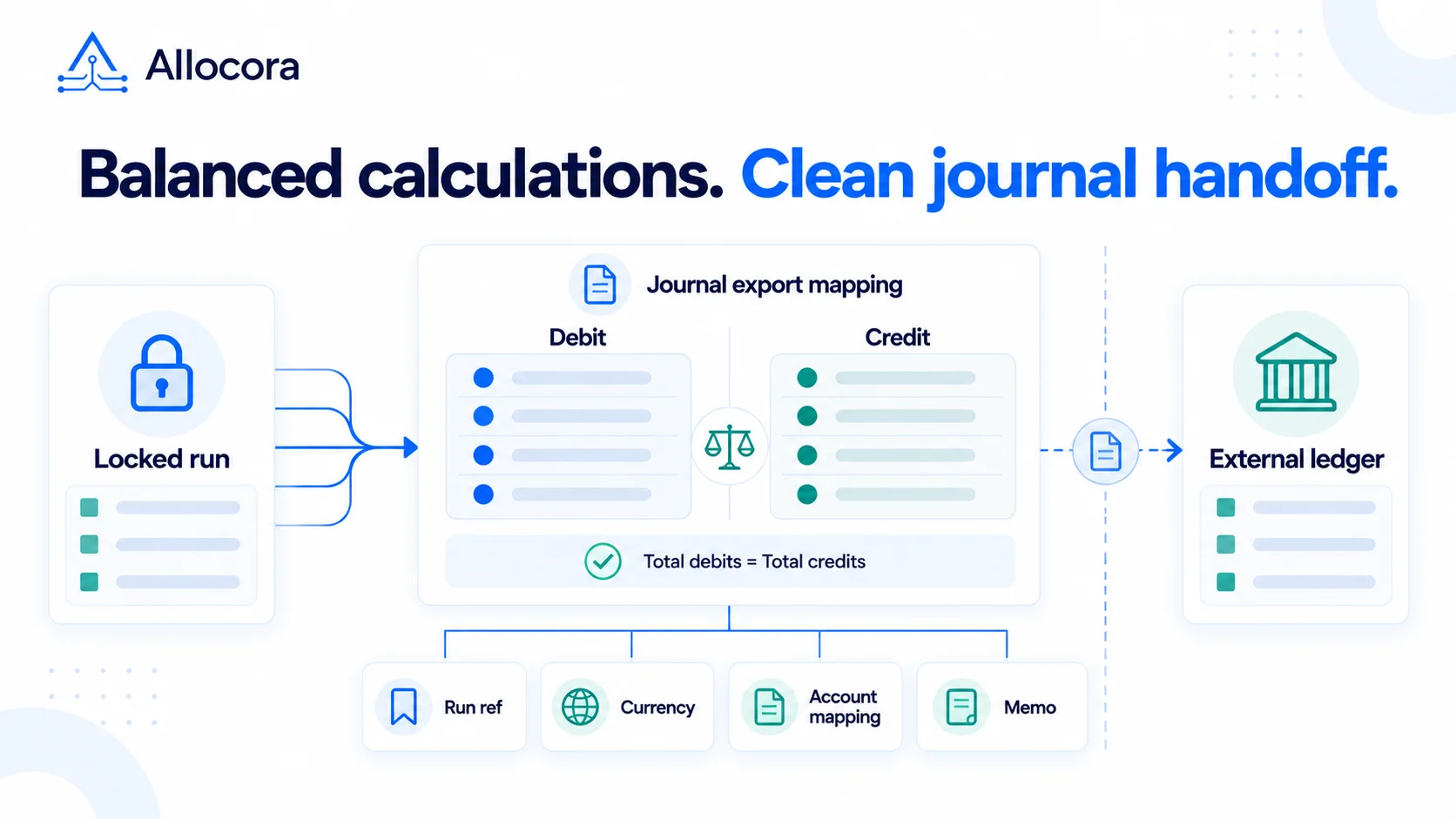 Journal Export Planning for Revenue Share, Royalties, and Partner Payouts
Plan a reviewed accounting handoff for revenue share, royalties, and partner payouts, with journal-basis choices, account mapping, and vendor-specific import checks.
Oct 15, 2026 - 8 min read
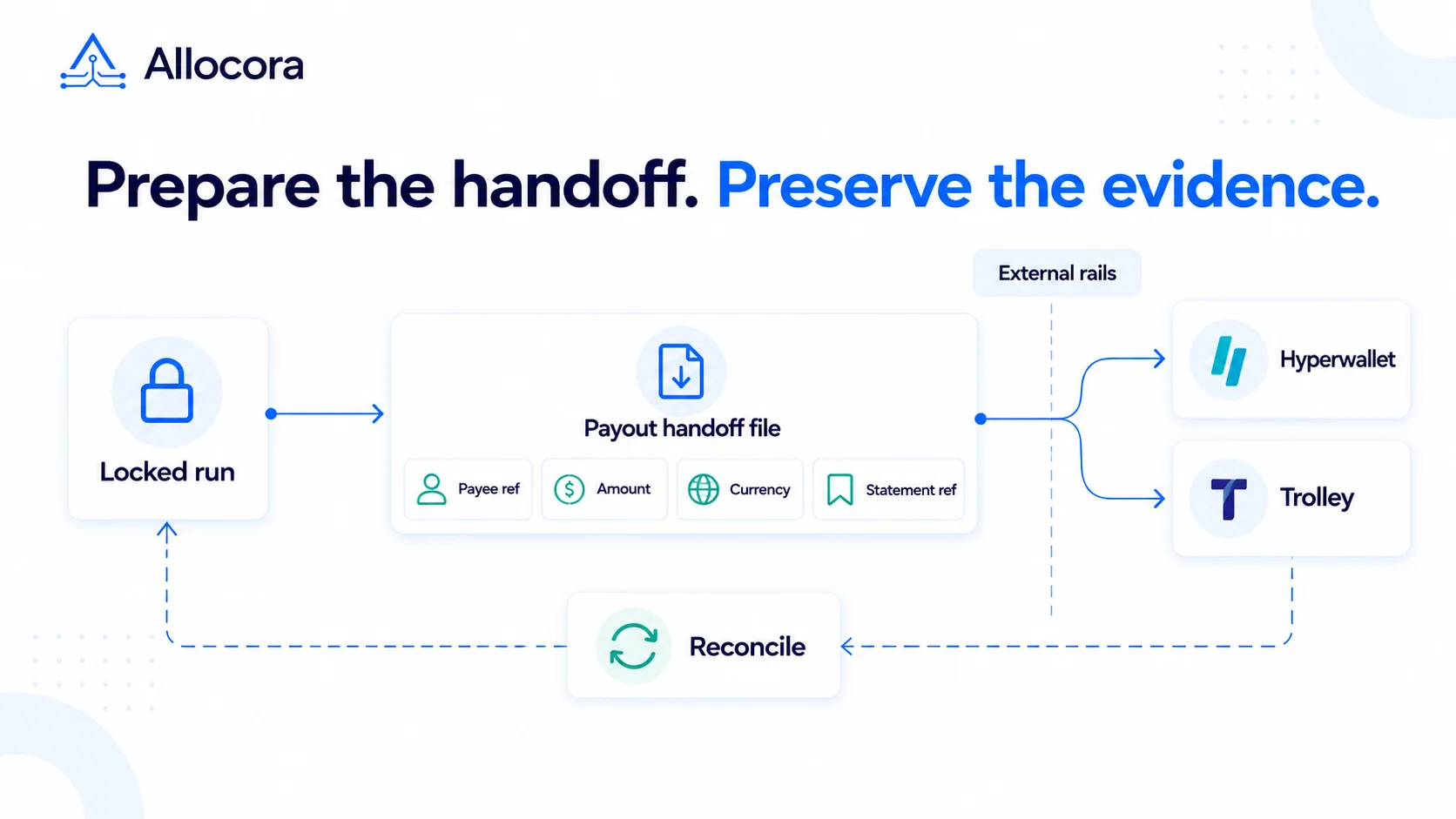 Hyperwallet and Trolley Payout Handoff Planning: Evidence and Fields to Prepare
Plan a Hyperwallet or Trolley payment handoff by separating locked obligations, export mapping, provider checks, and reconciliation evidence. This is not a provider-ready upload template.
Oct 05, 2026 - 5 min read