
Payout Operations Metrics: What to Track From Calculation to Reconciliation
Track payout operations metrics from source data to calculation, review, export, payment confirmation, reconciliation.
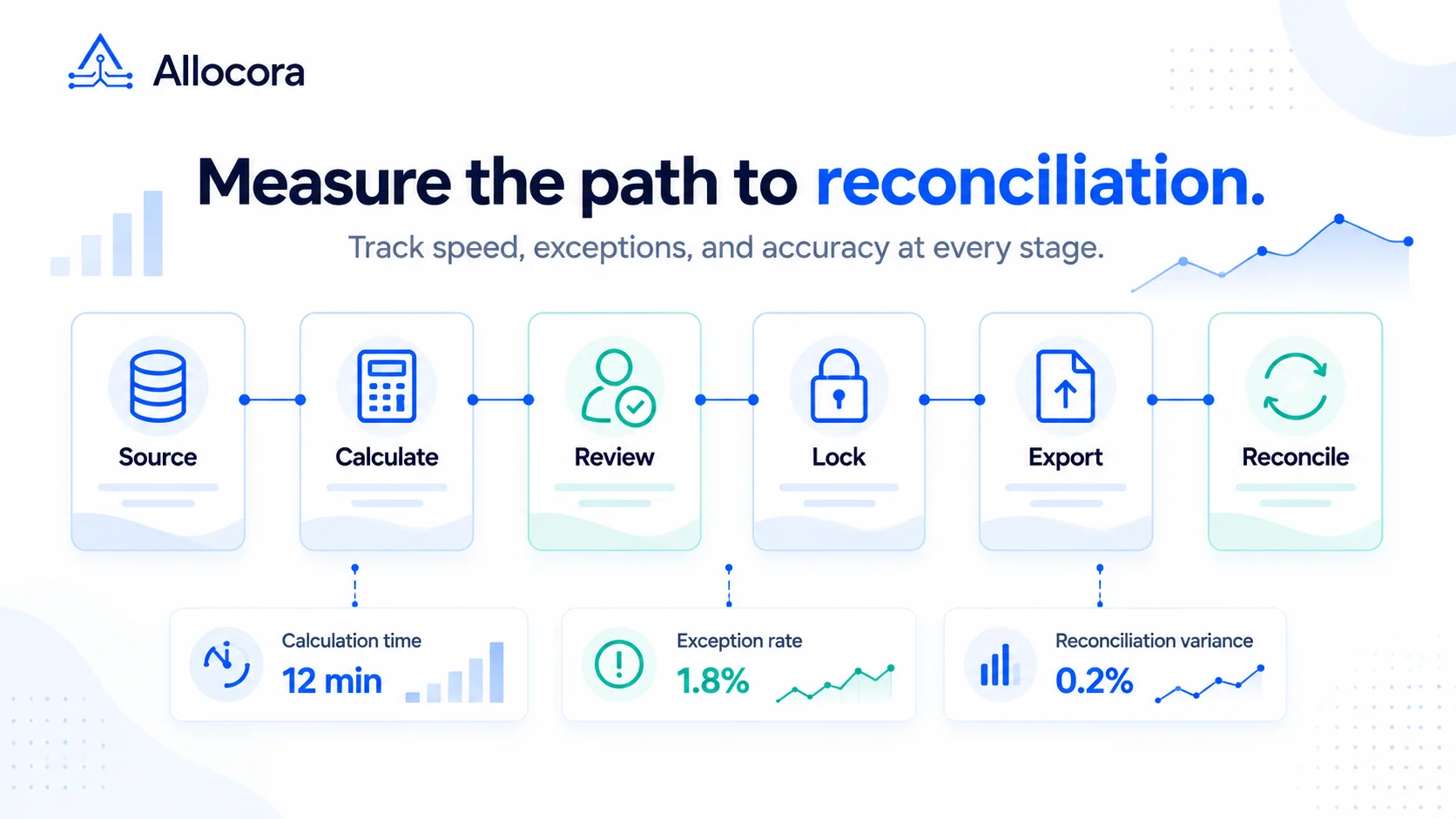
Payout operations metrics help a finance team compare process time, exceptions, and unresolved differences across payout periods. Use them alongside a repeatable audit-ready settlement review before and after external payment execution.
The definitions below are a measurement plan for affiliate commissions, royalties, marketplace seller payouts, agency revenue share, and other multi-payee workflows—not a claim that every KPI is a built-in Allocora dashboard metric.
Quick answer
Track close cycle time, source exception rate, manual adjustment rate, rule coverage, statement question rate, export readiness, and reconciliation variance. Define the population and measurement window before comparing results.
For every KPI, record the reporting period, run or cohort, data source, owner, and observation cutoff. Count each object once within its defined population. Report rates as percentages by multiplying the stated ratio by 100; report “not applicable” when the denominator is zero and “not measured” when evidence is missing. Keep monetary amounts separate by currency and use a consistent rounding policy.
Some inputs are business events that your team must record: when source data was declared ready, manual review milestones, adjustment reasons, and payment-provider exceptions. Capture them in an operating log if your tools do not retain them. Do not infer a missing event from a nearby timestamp.
1. Close cycle time
Close cycle time measures elapsed time from source data readiness to a locked payout run.
close_cycle_time = locked_run_at - source_data_ready_at
Define source readiness as the point when the agreed source set is available and reconciled for review. Record that event explicitly, use one time zone, and measure elapsed calendar hours. If your team uses working hours instead, document the calendar and keep that series separate.
Useful milestones:
- Source data ready.
- First calculation run.
- Exception review complete.
- Run locked.
- Export generated.
- Payment confirmations reconciled.
Only the first and fourth milestones define this KPI. Export and reconciliation timings are separate measures. For a payout-period summary, report the median cycle time and number of locked runs, plus the count and current age of unfinished runs; excluding unfinished work without showing it can obscure delays.
A rising cycle time is a prompt to inspect where elapsed time accumulates. It does not identify manual review as the cause by itself.
2. Source exception rate
Source exception rate measures the share of reviewed source rows with at least one blocking exception at a defined checkpoint.
source_exception_rate = distinct_source_rows_with_blocking_exceptions / total_source_rows_reviewed
Use the same initial review checkpoint each period. For files, identify a row by its source file or batch and physical row number; for API, synced, or manually entered data, use a stable source-row identifier. Do not merge different rows merely because they repeat a transaction identifier. Count a row once even if it has several issues. Report warning-only rows and unresolved blockers at close separately.
Possible review categories include missing required payee or product mappings, invalid currency data, suspected duplicates, missing contract references, and refunds requiring transaction review. These are suggested categories, not a list of automatic Allocora blockers. Document which conditions block your workflow and which require review only.
Break exceptions down by parsing, validation, mapping, rule evaluation, and calculation stage. The aggregate rate alone does not establish the cause. File-level failures without a reliable row count should be reported separately rather than silently excluded from the review.
For a practical review of the source data, mappings, and exceptions behind these metrics, see the Payout Audit Checklist: What to Review Before External Payments.
3. Manual adjustment rate
Track documented manual adjustments separately from routine rule-driven calculations.
manual_adjustment_line_rate = distinct_payout_lines_changed_by_documented_manual_adjustments / total_payout_lines_reviewed
Use one defined set of payout lines from the period's reviewed output, and count each affected line once even if it was changed repeatedly. Record adjustment reasons and reviewers. Define whether Adjustment Run deltas are included and how each delta maps to the reviewed lines; if that relationship is not captured, report adjustment counts and amounts separately instead of this rate.
Report positive and negative adjustment amounts separately by currency rather than allowing them to cancel in a net total. A recurring reason is a prompt to consider a rule change, source-data correction, or documented recurring control—not proof that one specific fix is required.
4. Rule coverage
Rule coverage describes how allocations were produced, including explicit-rule and fallback use.
Report allocation counts and amounts by currency in mutually exclusive categories: explicit-rule only, fallback only, mixed, or unclassified. Use the same definition of an allocation row each period. Keep positive and negative amounts separate; a net-value percentage can become misleading when refunds or adjustments offset positive allocations. If the required classification is not recorded, report coverage as not measured.
Track fallback usage against documented policy. A decrease is useful only when fallback represents missing mappings or unclear terms. An approved fallback can be valid; lower fallback usage is not a universal quality target.
When reviewing changes in rule coverage across periods, keep the calculation evidence and rule versions behind each result. The guide to immutable calculation runs explains why preserving historical rule context matters.
5. Statement question rate
Statement question rate measures recorded questions about delivered statements, not whether every payee understood the payout.
statement_question_rate = unique_delivered_statements_with_a_recorded_question / unique_statements_delivered
Define a cohort by first delivery during the payout period and a fixed question-observation window after that delivery. Compare only cohorts whose observation windows have closed, and identify newer cohorts as provisional. Count each statement once, regardless of repeated delivery attempts or multiple questions. Record later questions separately rather than silently changing a closed comparison.
Statement questions may be recorded through different Evidence Center and Payee Portal events. Initial questions and follow-up messages must be deduplicated by statement. Use a separately verified statement-delivery population for the denominator; the Payee Portal delivery record created when a question is submitted does not represent every delivered statement. If a complete delivery population is unavailable, report the number of unique statements with questions and mark the rate as not measured.
Allocora supports structured statement feedback categories: Amount question, Missing source, Contract economics, Payment status, Download/access issue, and Other. Review these separately so an access problem is not mistaken for an amount dispute.
If the question rate remains high, inspect the categories and evidence before attributing it to statement design. A low rate can also reflect limited engagement, so review delivery and access evidence alongside it.
6. Export readiness
Export readiness records whether a locked run's intended payment handoff passes a defined preflight without corrective editing.
first_pass_export_readiness = unique_handoffs_passing_initial_preflight / unique_handoffs_reviewed
Define one handoff by locked run, destination, and initially approved export configuration. Count its first preflight once; corrective configuration changes, regenerated files, and retries remain part of that handoff. Freeze the checklist for the comparison period and record any changes to its requirements.
Track generation errors, missing required payout references, missing destination-required fields, and required corrective edits. Record held payees and below-threshold amounts separately: an intentional exclusion under policy is not automatically an export defect. Passing preflight does not prove that the provider accepted or executed the payment file.
For a practical example of destination-specific field mapping and validation after the calculation export, see Hyperwallet and Trolley Payout Handoff Planning.
7. Reconciliation variance
Reconciliation variance compares expected payouts with confirmed paid amounts at a stated cutoff.
signed_reconciliation_variance = paid_amount - expected_amount
absolute_reconciliation_variance = abs(paid_amount - expected_amount)
Calculate both for each payee and currency against the agreed locked settlement and payment-handoff scope. Match and deduplicate confirmations before aggregating partial payments. Show unmatched confirmation counts and amounts separately alongside matched-payee totals until resolved; do not drop them from the review. Distinguish an unconfirmed amount from a confirmed zero payment.
Positive signed variance means overpayment relative to the expected amount; negative variance means underpayment. For a period summary, show the sum of absolute payee-level variances as well as signed totals, so overpayments do not cancel underpayments. Never combine currencies into an unlabeled total.
Track the evidence, owner, and resolution status for timing differences, held or below-threshold amounts, failed or returned payments, fees, and other approved differences. Payment-provider statuses must be interpreted from provider evidence; a reconciliation match does not itself establish successful execution.
At final reconciliation, target zero unexplained variance. Document remaining differences and resolve or carry them forward under policy rather than relabeling them as paid. Record export-to-reconciliation time separately, with unfinished reconciliations still visible.
A simple payout operations scorecard
| Metric | Interpretation and target |
|---|---|
| Close cycle time | Toward the documented timing target, without hiding unfinished runs or skipping controls |
| Source exception rate | Fewer blocking exceptions at the same review checkpoint; investigate categories |
| Manual adjustment line rate | Review reason and policy compliance; lower is not always better |
| Rule coverage | Explain explicit, fallback, mixed, and unclassified allocations against policy |
| Statement question rate | Review comparable delivery cohorts by question category and engagement |
| First-pass export readiness | Higher against the same preflight requirements |
| Signed reconciliation variance | Toward zero unexplained variance, whether initially positive or negative |
| Absolute reconciliation variance | Lower unexplained mismatch magnitude, with open cases still visible |
Review the scorecard every payout period alongside audit-ready settlement evidence. Record denominator sizes and process changes before interpreting a trend.
What not to measure alone
Do not rely on payout volume alone. Compare volume with the defined quality metrics and their evidence. Describe improvement only where measured outcomes move toward documented targets without weakening controls. A shorter close, for example, is not evidence of an improvement if unresolved exceptions were simply omitted.
FAQ
Which metric should a small team start with?
Source exception rate and close cycle time are a practical starting pair if the team can record their inputs consistently. They identify where to investigate data readiness and elapsed process time; they do not establish the root cause.
Related Articles
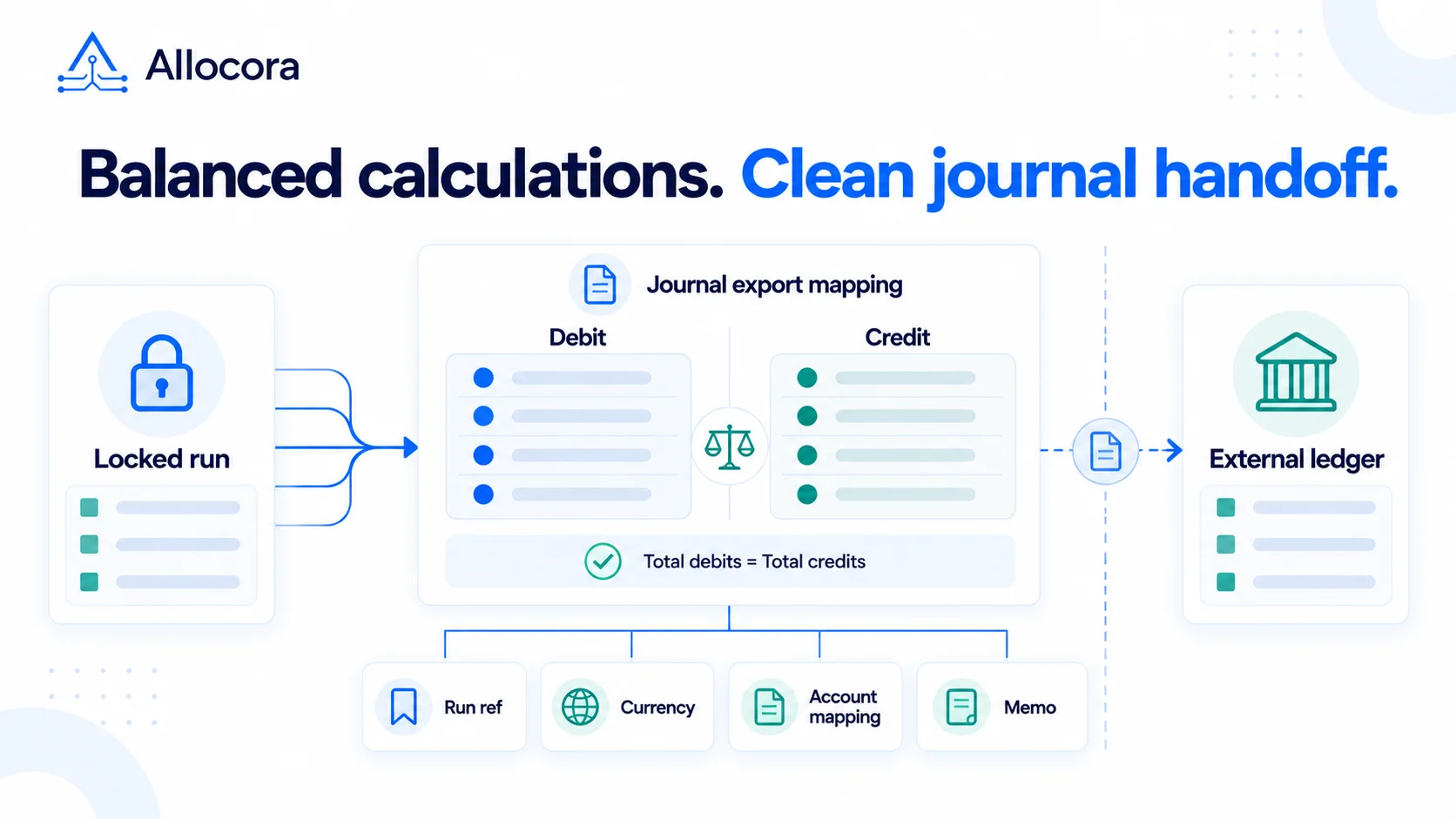 Journal Export Planning for Revenue Share, Royalties, and Partner Payouts
Plan a reviewed accounting handoff for revenue share, royalties, and partner payouts, with journal-basis choices, account mapping, and vendor-specific import checks.
Oct 15, 2026 - 8 min read
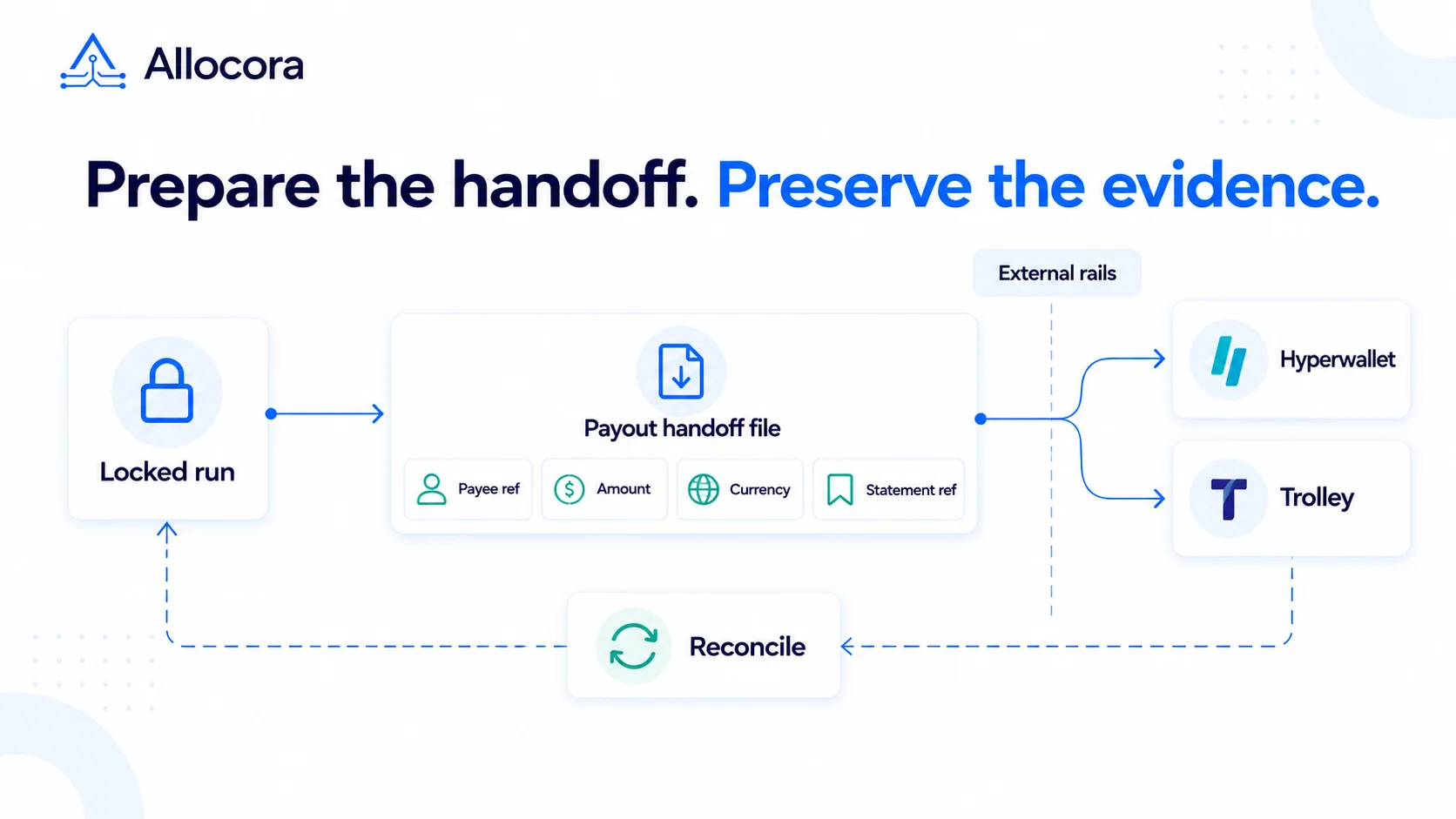 Hyperwallet and Trolley Payout Handoff Planning: Evidence and Fields to Prepare
Plan a Hyperwallet or Trolley payment handoff by separating locked obligations, export mapping, provider checks, and reconciliation evidence. This is not a provider-ready upload template.
Oct 05, 2026 - 5 min read
 Payout Software Pricing Models: Usage Limits, Fees, and a TCO Checklist
A practical checklist for comparing payout software pricing models, usage limits, add-ons, implementation effort, and total cost before choosing a plan.
Aug 05, 2026 - 9 min read