
Best Royalty Management Software (2026): Practical Options for Growing Teams
A practical comparison framework for royalty management software, covering calculation scope, implementation effort, pricing transparency, and audit evidence.
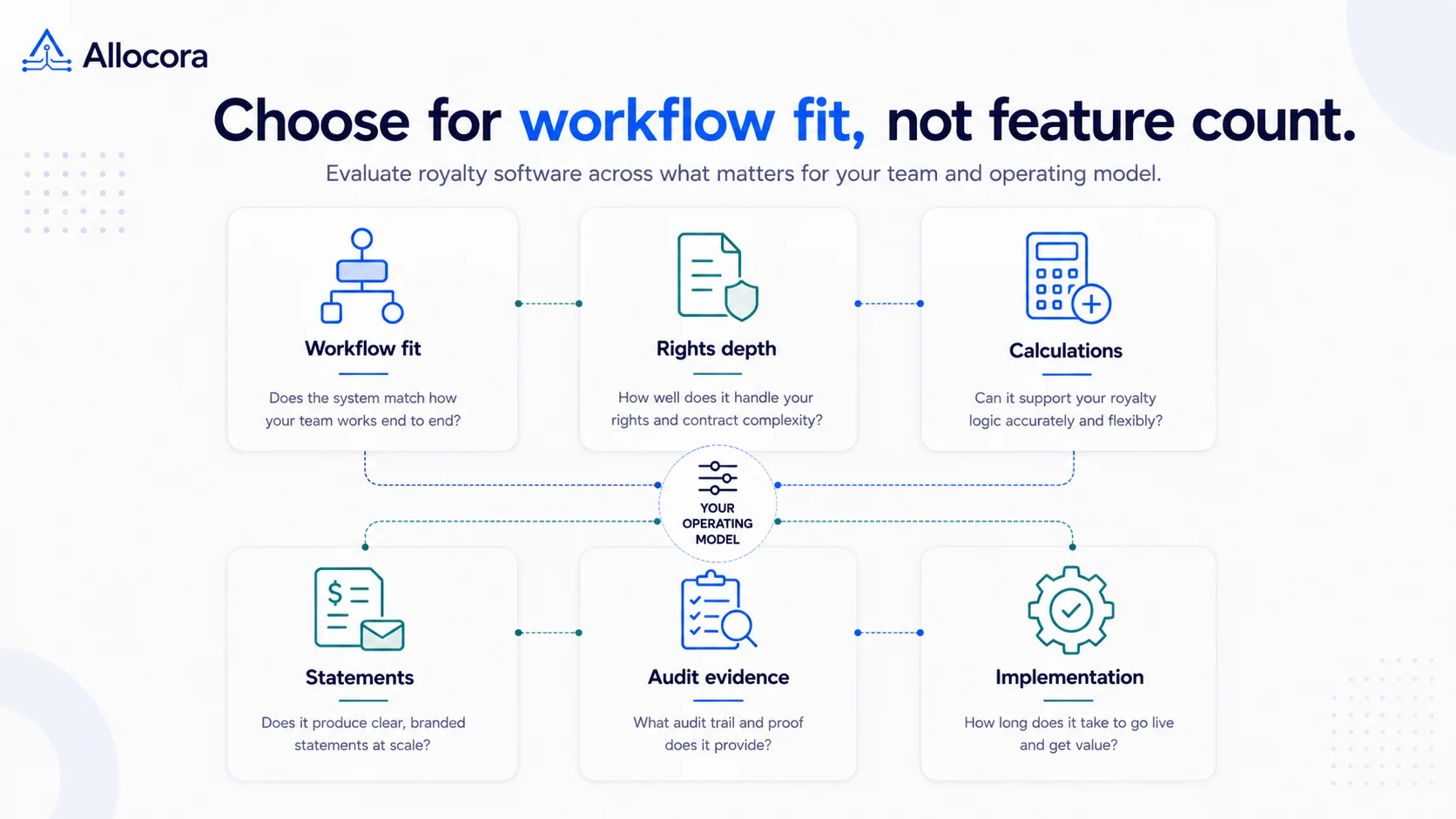
The best royalty management software depends on whether you need to manage rights, calculate royalties, or connect those jobs. This guide compares seven options for labels, publishers, and other teams evaluating royalty workflows.
If you already have source revenue and need to calculate amounts owed, generate statements, and prepare exports for external payment, start by evaluating the calculation workflow. If you also need catalog rights or licensing administration, include those requirements in your comparison.
This guide is published by Allocora. It compares documented product scope, not results from hands-on testing of every platform.
Quick comparison table
| Option | Best fit | Watch for |
|---|---|---|
| Allocora | Self-serve royalty and payout calculation, statements, exports, and reconciliation evidence | Not a full rights-management CRM or payment rail |
| Curve Royalty Systems | Record labels and publishers looking for a dedicated music royalty platform | Implementation scope and workflow fit should be validated directly |
| Reprtoir Royalty Accounting | Record labels and publishers that want catalog, rights, and royalty workflows together | Check supported source statements and how catalog assets connect to contracts |
| Roster | Labels, publishers, distributors, and managers looking for music royalty management workflows | Confirm current limits, feature fit, and pricing before relying on public summaries |
| Royalti | Distributors, labels, artists, and publishers looking for a broader music royalty platform | Validate import, statement, and accounting handoff requirements |
| MetaComet | Publishing and other IP-driven businesses that need rights and royalty management | Confirm implementation model and whether music-specific workflows fit |
| Vistex | Enterprise teams connecting royalties with contracts, accounting, settlements, and ERP | Check ERP integration, module scope, and implementation requirements |
This is not a claim that one vendor is universally better. It is a buyer map. The right choice depends on scope, data volume, audit requirements, and how much process you want to self-serve.
Try a royalty scenario in Allocora: Create a workspace with music royalty sample data or publishing royalty sample data. Registration is required. Use the sample to explore the calculation workflow before importing your own data.
How the options differ
Allocora focuses on self-serve royalty and payout calculation, statement generation, exports, and reconciliation evidence rather than rights administration or payment execution.
Curve Royalty Systems provides a dedicated music royalty platform for record labels and publishers, covering revenue ingestion, contract terms, royalty calculations, statements, catalog and publishing workflows, with payment functionality also available.
Source: platform and royalty-reporting documentation.
Reprtoir combines royalty accounting with catalog, contracts, and rights-management workflows for record labels and music publishers.
Source: official royalty accounting overview.
Roster focuses on music royalty management for labels, publishers, distributors, and managers, with royalty calculations, statements, artist portals, and related accounting workflows.
Source: official product overview.
Royalti provides an end-to-end music royalty platform for distributors, labels, artists, and publishers, covering statement ingestion, royalty calculations, splits, reporting, payments, and publishing workflows.
Source: official product overview.
MetaComet provides rights and royalty management software across publishing, media, licensing, life sciences, and other IP-driven industries, with particularly established workflows for book publishing.
Source: official solutions overview.
Vistex sits at the enterprise end of the spectrum, connecting rights and royalty management with contracts, accounting, settlements, and broader ERP processes.
Source: SAP rights and royalty management.
The important difference is scope. Buyers should validate current features, implementation requirements, integrations, and pricing directly with each vendor before choosing a system.
What "royalty management software" can mean
The phrase can refer to several different jobs:
- Rights and contract management.
- Catalog ownership and availability.
- Revenue imports from distributors or platforms.
- Royalty calculations.
- Recoupment, reserves, thresholds, and adjustments.
- Payee statements.
- Payout exports.
- Reconciliation after payments are made.
- Audit logs and evidence bundles.
The problem is that many buyers search for one term while needing only part of the workflow. If your main issue is "we cannot calculate and explain statements reliably," a full rights-management platform may be more than you need. If your main issue is "we do not know what rights we control by territory and media type," calculation software alone is not enough.
If that boundary is still unclear, start with Rights Management vs Royalty Accounting: Which Process Gap Are You Actually Solving?.
Calculation-first workflows
A calculation-first workflow can be enough when the team already has source revenue and the main problem is turning that data into governed, explainable obligations rather than administering legal rights.
Allocora is designed for this type of workflow.
Use Allocora when you need:
- CSV, XLS, XLSX, or Stripe-based revenue ingestion.
- Import templates for royalty, publishing, commission, marketplace, and revenue-share files.
- Product or catalog mapping from external identifiers.
- Payees and versioned rule logic.
- Deterministic calculation runs.
- Statements generated from reviewed output.
- Payment-ready payout CSVs or close packages for downstream rails.
- Reconciliation after external payment evidence is imported.
- Self-serve sample workspaces for music royalty or publishing royalty scenarios.
Allocora is not the right choice if your primary need is a legal rights registry, sync licensing CRM, bank payout rail, tax filing system, or KYC process. It complements those systems by preparing calculation proof.
Music-specific royalty platforms
Dedicated music royalty platforms can be a better fit when the entire operating workflow is music-specific and the team wants catalog, statement, accounting, and label/publisher workflows inside one product. Tools such as Curve, Reprtoir, Roster, and Royalti focus specifically on music royalty workflows and are worth evaluating when music-specific coverage is the primary requirement.
Look closely at:
- Supported source files and distributor formats.
- Statement formats and delivery workflows.
- Accounting exports.
- Multi-territory or multi-currency handling.
- Catalog and rights depth.
- Implementation support.
- Pricing model and contract length.
Do not compare tools only on feature lists. Test one close period. Import one source report, create one set of payees and rules, generate statements, and review the evidence a finance person would need later.
Enterprise royalty systems
Enterprise royalty systems can be appropriate when royalty workflows are part of broader contract, incentive, license, rebate, or ERP processes. Vistex is an example of an enterprise platform category that often serves larger operations with complex contract and revenue management requirements.
This can be the right direction when:
- Royalty logic is tied to enterprise contract management.
- ERP integration is mandatory.
- Multiple departments need governed workflows.
- Procurement, security, and implementation timelines are expected.
- The system must support many royalty-like commercial programs beyond music or publishing.
Smaller teams should weigh that implementation scope against the complexity of the workflow they actually need to replace.
Pricing transparency matters
Royalty software pricing can vary widely because implementation, data migration, user count, payee count, statement volume, and support model all affect cost. If a vendor does not publish enough detail to estimate total cost, build your own cost map before starting procurement.
Include:
- Software subscription or license cost.
- Setup and migration work.
- Analyst hours for each close.
- Statement generation and delivery effort.
- Correction cycles.
- Audit preparation time.
- Dispute support time.
- Downstream payout export work.
For Allocora specifically, the pricing estimator can be used to model workload drivers such as revenue events, payees, payout cadence, and audit-history needs. For a broader framework, see Payout Software Pricing Models: Usage Limits, Fees, and a TCO Checklist.
A practical testing process
Before choosing any royalty management software, run a small proof:
- Choose one recent period.
- Import a real or representative revenue file.
- Map catalog identifiers.
- Create a few payees and rules.
- Include one refund or adjustment.
- Generate statements.
- Export the evidence package.
- Ask a reviewer to trace one statement line back to source revenue.
If that trace is hard, the system may not solve the real operational problem.
Allocora lets buyers start this way with music royalty sample data, publishing royalty sample data, and the music royalty calculator. That self-serve path is important. A team should be able to understand the workflow before committing to a full migration.
Evaluation scorecard
Use a simple scorecard so the decision does not become a brand-name comparison:
| Criterion | Score 1 | Score 3 | Score 5 |
|---|---|---|---|
| Import fit | Manual reshaping required | Some templates fit | Existing files can be imported with controlled mapping |
| Rule fit | Rates are mostly manual | Common terms work | Terms, versions, dates, and economics are explainable |
| Statement fit | Output requires copy-paste | Statements work with edits | Statements come from reviewed calculation output |
| Audit fit | Final totals only | Some logs exist | Source, rules, runs, statements, and exports are traceable |
| Buyer effort | Heavy project before proof | Guided setup | Self-serve sample or test period before commitment |
| Boundary clarity | Claims to do everything | Some scope clarity | Clear separation of calculation, payment, and rights jobs |
Score each vendor against the same recent close period. A tool with fewer headline features may be a better fit if it gives your team a clearer, faster, more reviewable close.
When spreadsheets stop working
Spreadsheets are good for modeling, one-off checks, and early operations. They become weak when royalty close requires repeatability.
Warning signs include:
- More than one person edits the workbook.
- Formulas change between periods.
- Source files are pasted into tabs without retained row evidence.
- Statement templates are manually updated.
- Payee questions require rebuilding old calculations.
- Payment exports are copied by hand.
- Adjustments are tracked outside the main workflow.
At that point, the team does not just need a better formula. It needs governed operations.
For a deeper evaluation of calculation workflows, migration, and close controls, see Royalty Accounting Software: How to Choose a System for a Label or Publisher.
Recommendation by buyer type
Consider Allocora if your immediate problem is governed calculation, statements, export evidence, and reconciliation before payment.
Evaluate a dedicated music royalty platform if your main need is a music-specific operating suite with catalog and royalty workflows combined.
Evaluate enterprise royalty software if royalty logic is tied to ERP, contract lifecycle, rebates, or broad enterprise revenue programs.
Keep spreadsheets only when royalty close is simple, low volume, easy to explain, and not yet worth operationalizing.
FAQ
What is the difference between royalty management and royalty accounting?
Royalty management can include rights, contracts, catalog, licenses, and royalty operations. Royalty accounting is narrower: it calculates obligations from revenue and terms, then supports statements, exports, and reconciliation.
Should small teams buy enterprise royalty software?
Not always. If the main problem is spreadsheet-based close, a self-serve calculation ledger may solve the immediate pain faster. Enterprise systems make more sense when broader contract, ERP, and department-wide requirements exist.
Does Allocora execute royalty payments?
No. Allocora calculates, explains, exports, and reconciles obligations. Downstream payout rails, banks, accounting systems, or AP workflows move money.
How should I compare vendors?
Use one period of representative data. Test imports, mappings, rule setup, statements, exports, and evidence tracing. A feature checklist is less useful than a close-period proof.
Related Articles
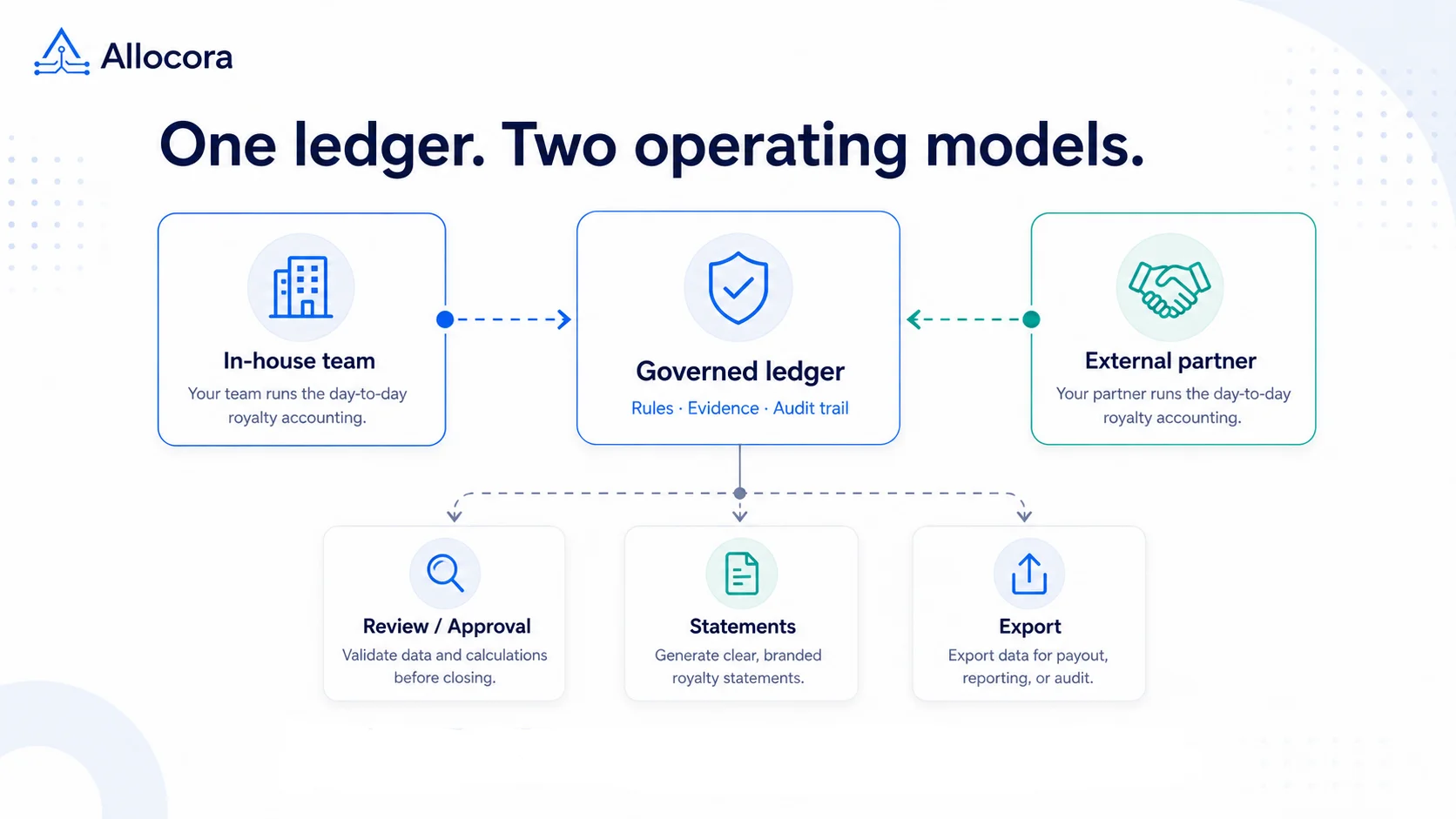 Outsourcing Royalty Accounting vs In-House: A Practical Guide for Growing Teams
A decision guide for labels, publishers, and platforms comparing outsourced royalty accounting, spreadsheet workflows, software-led operations, and hybrid models.
Sep 03, 2026 - 8 min read
Outsourcing Royalty Accounting vs In-House: A Practical Guide for Growing Teams
A decision guide for labels, publishers, and platforms comparing outsourced royalty accounting, spreadsheet workflows, software-led operations, and hybrid models.
Sep 03, 2026 - 8 min read
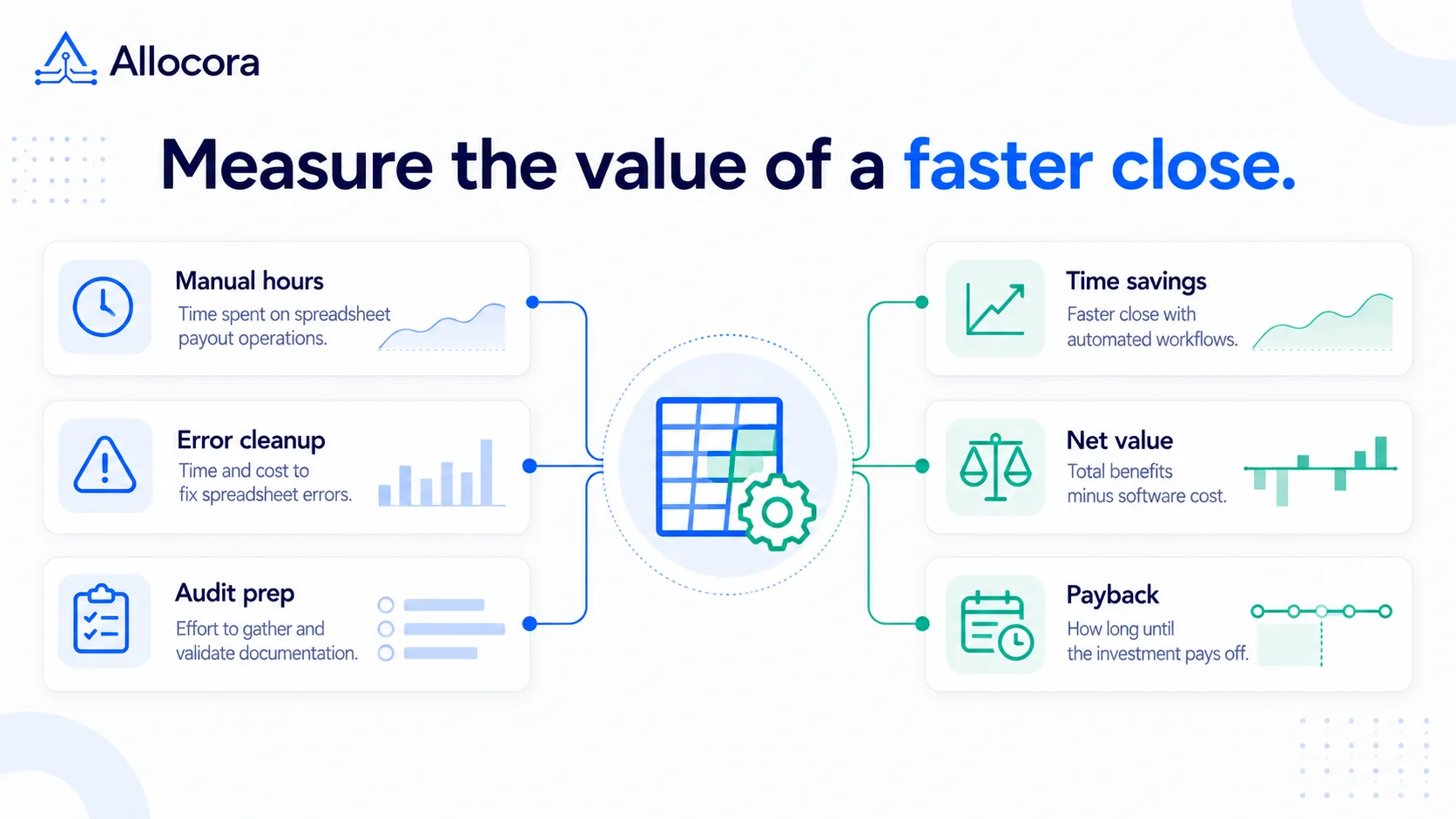 Royalty Ledger Automation ROI: When Spreadsheet Payout Operations Pay for Software
A practical before-and-after ROI model for evaluating royalty-ledger automation using close-time savings, avoided error costs, audit cleanup, and software cost.
Aug 27, 2026 - 11 min read
Royalty Ledger Automation ROI: When Spreadsheet Payout Operations Pay for Software
A practical before-and-after ROI model for evaluating royalty-ledger automation using close-time savings, avoided error costs, audit cleanup, and software cost.
Aug 27, 2026 - 11 min read
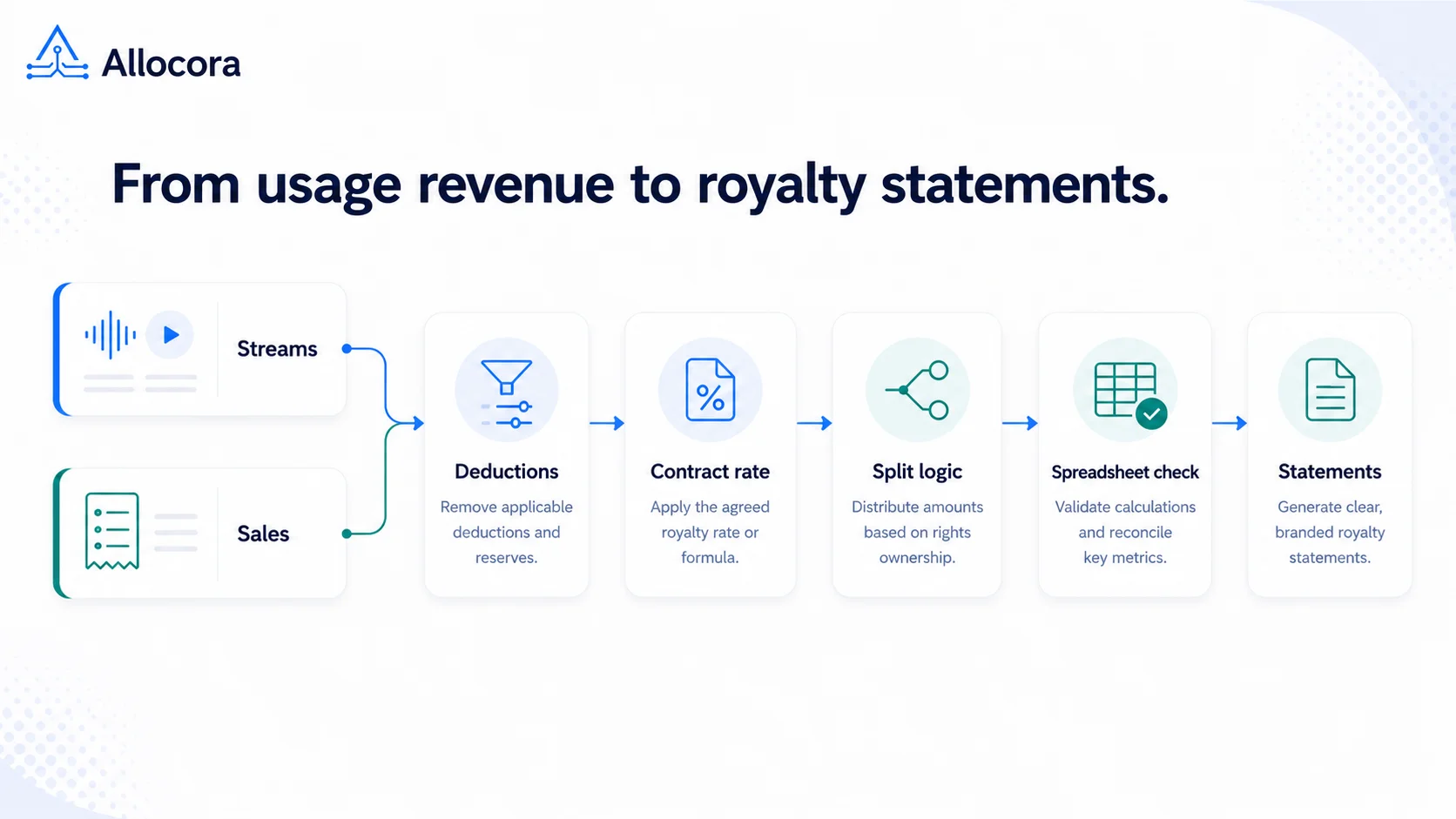 How to Calculate Music Royalties: Formula, Examples, and Spreadsheet Checks
A plain-language guide to calculating music royalties from gross revenue, deductions, splits, recoupment, statements, and audit notes.
Aug 21, 2026 - 8 min read
How to Calculate Music Royalties: Formula, Examples, and Spreadsheet Checks
A plain-language guide to calculating music royalties from gross revenue, deductions, splits, recoupment, statements, and audit notes.
Aug 21, 2026 - 8 min read