
Rights Management vs Royalty Accounting: Which Process Gap Are You Actually Solving?
Rights management and royalty accounting solve different process gaps. Learn when you need rights software, when royalty accounting is enough, and how to connect rights data to statements, exports, and reconciliation.
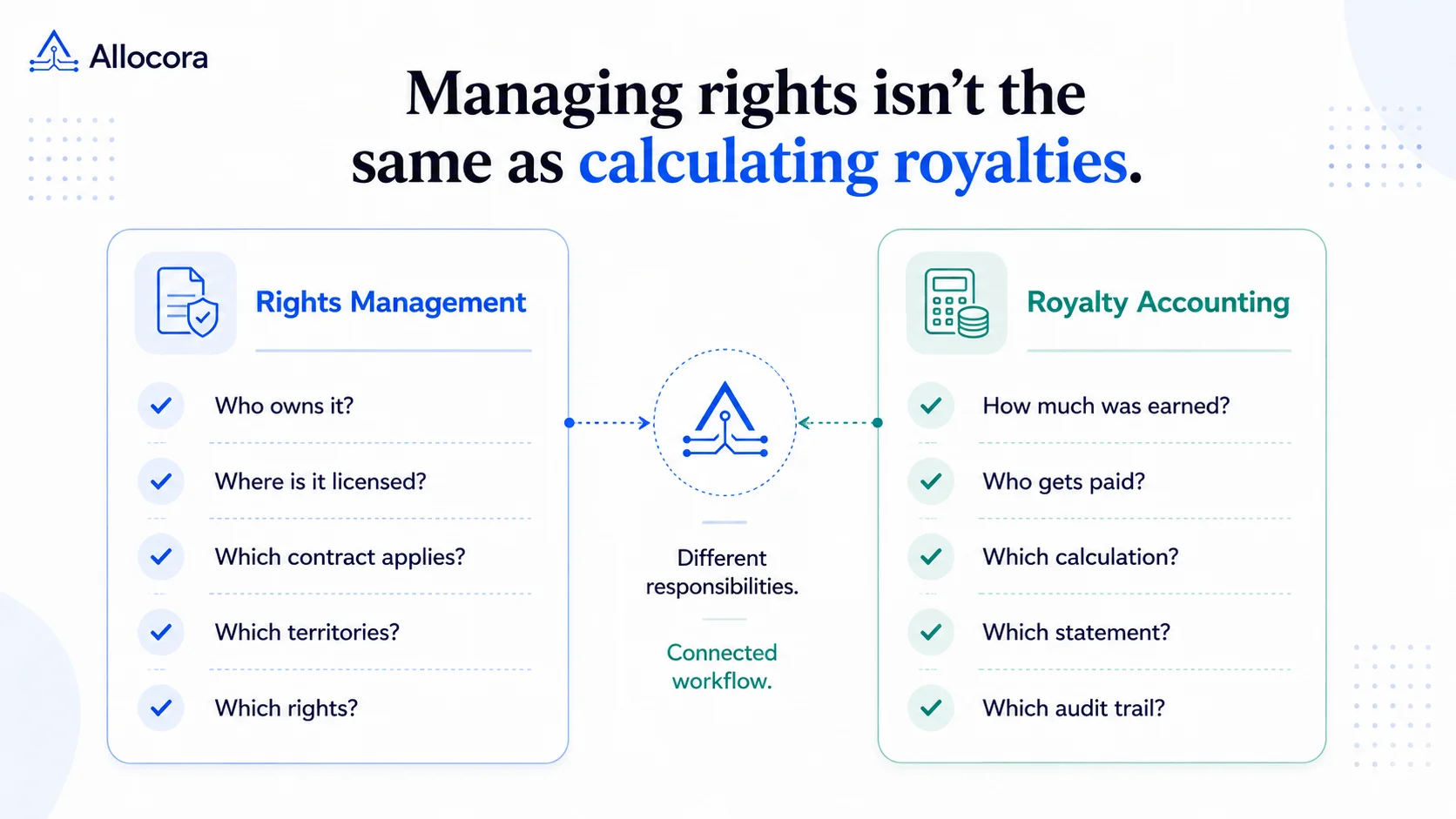
Rights management and royalty accounting are related, but they solve different operational problems. Rights management helps a team understand what can be licensed, where it can be used, who controls it, and which restrictions apply. Royalty accounting starts after revenue or usage data exists: it applies contract rules, calculates who is owed what, generates statements, creates export files, and preserves evidence for review.
If your team is comparing software categories, start with the process that is failing today.
The Short Version
A rights management system is usually the system of record for ownership, licenses, territories, restrictions, approvals, and availability. A royalty accounting system is usually the system of record for revenue imports, payee rules, calculation runs, statements, exports, and reconciliation evidence.
Many larger platforms combine parts of both. Smaller teams often do not need the full rights-management layer on day one. They need a reliable way to turn distributor reports, sync fees, marketplace revenue, affiliate commissions, or catalog income into explainable obligations.
Process Map: From Rights To Royalty Close
A complete rights-to-royalty workflow usually moves through these stages:
- Contract terms are agreed or imported.
- Rights and catalog data identify who controls what.
- Revenue or usage data arrives from a distributor, platform, licensee, storefront, or internal system.
- External identifiers are mapped to internal catalog records.
- Rules decide which payees participate and under what terms.
- A calculation run creates payee-level obligations.
- Statements explain the totals.
- Export files support accounting or downstream payout handoff.
- Reconciliation compares expected obligations against payment evidence later.
- Audit history explains which source rows, rules, and versions produced the result.
Rights management is strongest near the beginning of that chain. Royalty accounting is strongest in the middle and end of the chain, where money, statements, exports, and evidence need to line up.
Rights Management vs Royalty Accounting
| Question | Rights management | Royalty accounting |
|---|---|---|
| Main question | What rights exist, who controls them, and where can they be used? | What revenue came in, which rules apply, and who is owed what? |
| Typical records | Works, recordings, contracts, licenses, territories, rights holders, restrictions, availability | Revenue rows, products, payees, rule versions, calculation runs, statements, exports, reconciliation evidence |
| Common users | Legal, licensing, catalog, rights administration, sync teams | Finance, operations, royalty admins, label managers, publisher operations, accounting support |
| Timing | Before licensing, sale, usage, or exploitation decisions | After revenue, usage, fee, or sales data is available |
| Output | Rights availability, license context, restriction checks, approval support | Payee totals, statements, payment-ready exports, close packages, audit trails |
| Failure mode | The team licenses or uses something without the right permission or restriction context | The team cannot explain, repeat, export, or reconcile what each payee is owed |
The overlap is real. A royalty calculation often depends on rights, splits, contract terms, and catalog identifiers. But the systems do not have to be the same system if the boundaries are clear.
What Rights Management Software Does
Rights management software helps a team track control and permission. In music, publishing, media, licensing, and IP-heavy businesses, that can include ownership, publishing shares, territory restrictions, exclusivity, approvals, and usage limits.
A rights system becomes important when the operational question is: can we license, distribute, monetize, approve, or exploit this asset in this context?
For example, a production library may need to know whether a track is cleared for worldwide advertising use, whether a composer retained approval rights, whether the master and publishing shares are both controlled, and whether a territory restriction blocks a particular placement. A full rights-management system is built for that kind of decision.
It may also support contract storage, asset relationships, licensing approvals, and availability searches. Those capabilities sit before the royalty close. They help prevent mistakes before revenue exists.
What Royalty Accounting Software Does
Royalty accounting software focuses on financial allocation and evidence. It starts with revenue, usage, or fee data and answers a different set of questions:
- Which source rows are included in this period?
- Which catalog identifiers need mapping?
- Which payees are active for this product, source, territory, or condition?
- Which rule version applied at calculation time?
- What deductions, advances, reserves, thresholds, refunds, or adjustments affect net payable?
- Which royalty statement explains the payee's total?
- Which export supports the next accounting or payout step, and how will it connect to payout confirmation reconciliation?
- Can the team reconcile paid evidence against expected obligations later?
Spreadsheet workflows become fragile once the same close has to preserve source rows, rule history, statements, and reconciliation evidence across multiple periods.
Teams often reach this point after outgrowing spreadsheet-based payout operations. We covered those transition signs in Replace Spreadsheet Commission Tracking Before Month-End Breaks.
Royalty accounting software is useful when the core pain is repeatability: the same team has to close every month or quarter, explain results to payees, make corrections without rewriting history, and preserve enough audit-ready settlement evidence for future review.
For a practical close workflow, see the Royalty Audit Checklist, which walks through statements, exports, reconciliation, and review evidence.
Where The Two Systems Overlap
The overlap usually happens around contracts, splits, payees, catalog identifiers, and reporting. A rights system may know that a writer controls 25 percent of a composition in a territory. A royalty accounting workflow may need that same percentage to calculate statement amounts for a revenue file.
The overlap is usually a data-integration problem rather than a reason to collapse both workflows into one system.
The cleaner model is to decide the source of truth for each type of data:
- Rights ownership and availability can live in the rights system.
- Revenue rows can live in the royalty accounting or ledger workflow.
- Product and catalog identifiers need a shared mapping strategy.
- Payee records need stable identifiers across systems.
- Rule versions need a traceable connection to contract terms.
- Statements, exports, and reconciliation evidence should be tied to the calculation system that produced them.
When these boundaries are explicit, teams can connect systems through CSV imports, API syncs, shared identifiers, or periodic exports without pretending every workflow belongs in one database.
When Rights Management Is The Real Need
You probably need rights management first if the risk is permission, licensing, or exploitation control.
Common signs include:
- The team cannot tell which assets are cleared for a use case.
- Territory, term, channel, or exclusivity restrictions drive daily decisions.
- Sync licensing, publishing administration, or media licensing approvals are the bottleneck.
- Legal and licensing teams need a searchable system of record before deals are approved.
- Multiple parties control different rights in the same asset.
- Availability checks are slowing down sales, licensing, or distribution.
In that situation, buying a royalty accounting workflow alone will not solve the root problem. You may calculate royalties more cleanly later, but you will still lack the rights context needed before the revenue event.
When Royalty Accounting Is Enough
Royalty accounting may be enough when the rights picture is already known or simple, but the close process is messy.
That is common for smaller labels, catalog owners, production libraries, publishers, creator platforms, marketplaces, and finance teams that already know the relevant split rules but still rely on spreadsheet workbooks to calculate and explain recurring obligations.
Common signs include:
- Revenue files arrive from distributors, stores, licensees, Stripe, marketplaces, or internal exports.
- The team needs to map external product IDs, ISRCs, SKUs, ISBNs, ASINs, or catalog keys.
- Payee rules, splits, advances, reserves, or thresholds must be applied consistently.
- Statements need to be generated from locked calculation results.
- Export files are needed for accounting or payout handoff.
- Payment evidence needs to be reconciled later against expected obligations.
- The team needs an audit trail more than a licensing CRM.
This is the kind of workflow Allocora is designed to support: imports, mappings, versioned rules, deterministic calculation runs, statements, exports, close evidence, and reconciliation support.
If those exports later feed a payment provider, it also helps to separate payout calculation from payment execution. See Payout Rails vs Payout Calculation Software: Why Teams Need Both.
How To Connect Rights Data To Royalty Accounting
If your team uses both categories, the integration does not need to be complicated at first. What matters is stable identity and a clear handoff.
Start with these fields:
| Data | Why it matters |
|---|---|
| Product or catalog identifier | Connects revenue rows to the correct work, recording, product, SKU, or title. |
| Payee identifier | Keeps recipient records stable across systems. |
| Rule or contract reference | Lets finance trace a calculation back to the commercial basis. |
| Effective dates | Prevents old terms from being applied to new revenue periods. |
| Territory or source metadata | Supports scoped rules when different sources or markets use different terms. |
| Revenue external ID | Prevents duplicate imports and supports later reconciliation. |
CSV can be enough for an early process if the column names and identifiers are stable. API integration becomes more useful when the workflow is recurring, high-volume, or shared across multiple systems.
The most important control is duplicate prevention. Every imported row should have an external identifier, every mapped product should have a durable catalog key, and every calculation should preserve which source rows and rule versions were used.
A Small-Team Decision Checklist
Use this checklist before buying or implementing either category:
- Are we blocked before revenue exists, or after revenue arrives?
- Do we need to decide whether an asset can be licensed, or calculate what a payee is owed?
- Are legal restrictions and availability checks the bottleneck?
- Are imports, calculations, statements, exports, and reconciliation the bottleneck?
- Do we need a rights system of record, a royalty ledger, or a connection between the two?
- Which system owns catalog identifiers?
- Which system owns payee identifiers?
- Which system preserves calculation evidence?
- Which workflow must be self-serve for finance or operations users?
- What can be validated with one sample period before migrating the full catalog?
If most answers point to permissions, restrictions, licensing, and ownership, start with rights management. If most answers point to revenue files, payee rules, statements, exports, and reconciliation, start with royalty accounting.
Some teams eventually need both systems. The important decision is which operational problem to solve first.
Where Allocora Fits
Allocora fits the royalty accounting and settlement-evidence side of the workflow.
Teams can use Allocora to import source revenue data, map external product or catalog identifiers, model payees and versioned rules, run deterministic calculations, generate statements, create exports, and support reconciliation against downstream payment evidence.
Allocora does not clear rights, replace legal systems, execute payouts, handle KYC/AML, or file taxes. Banks, payout rails, accounting systems, and legal tools remain separate parts of the operating model.
That separation keeps the system focused on producing explainable calculation evidence instead of trying to own every upstream and downstream process.
For teams still working in spreadsheets, the best next step is usually a sample workflow: import a representative revenue file, map products, model a few payees and rules, run a calculation, generate statements, export the close evidence, and review how reconciliation would work after payment evidence exists.
FAQ
Is rights management the same as royalty accounting?
No. Rights management tracks ownership, licensing, restrictions, and availability. Royalty accounting calculates payee obligations from revenue or usage data and produces statements, exports, and evidence.
When do I need rights management software?
You need rights management software when the team must answer permission and availability questions before licensing, distributing, approving, or monetizing an asset. Complex territories, exclusivity, approvals, and multi-party ownership usually point to a rights-management need.
When is royalty accounting software enough?
Royalty accounting may be enough when rights and split terms are already known, but revenue imports, calculations, statements, exports, and reconciliation are hard to repeat accurately in spreadsheets.
Can a royalty accounting system use rights data from another platform?
Yes. Many teams connect rights data to royalty accounting through stable catalog IDs, payee IDs, contract references, effective dates, CSV exports, or APIs. The key is deciding which system owns each source of truth.
Does Allocora manage rights or execute payouts?
No. Allocora helps with royalty and payout calculation workflows: imports, mapping, rules, statements, exports, audit evidence, and reconciliation support. It does not clear rights, execute payments, store bank credentials, perform KYC or AML, file taxes, or replace legal review.
Next Steps
- Use the music royalty calculator to model a simple royalty calculation before importing real data.
- Review the import template library to see how source files should identify transactions, products, and revenue amounts.
- Try the music royalty sample data workflow to inspect a calculation run, statements, exports, and reconciliation evidence in a self-serve workspace.
Related Articles
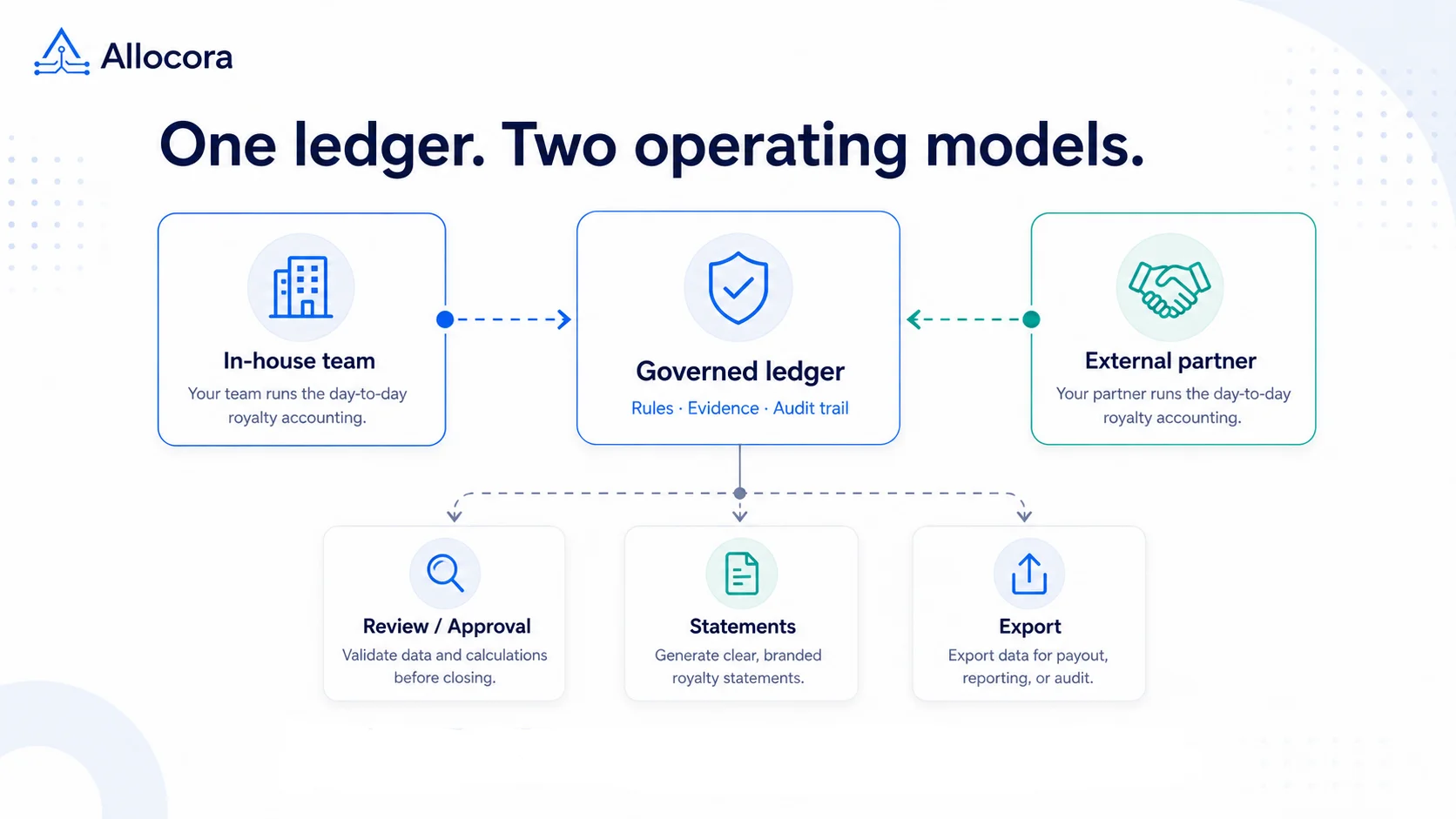 Outsourcing Royalty Accounting vs In-House: A Practical Guide for Growing Teams
A decision guide for labels, publishers, and platforms comparing outsourced royalty accounting, spreadsheet workflows, software-led operations, and hybrid models.
Sep 03, 2026 - 8 min read
Outsourcing Royalty Accounting vs In-House: A Practical Guide for Growing Teams
A decision guide for labels, publishers, and platforms comparing outsourced royalty accounting, spreadsheet workflows, software-led operations, and hybrid models.
Sep 03, 2026 - 8 min read
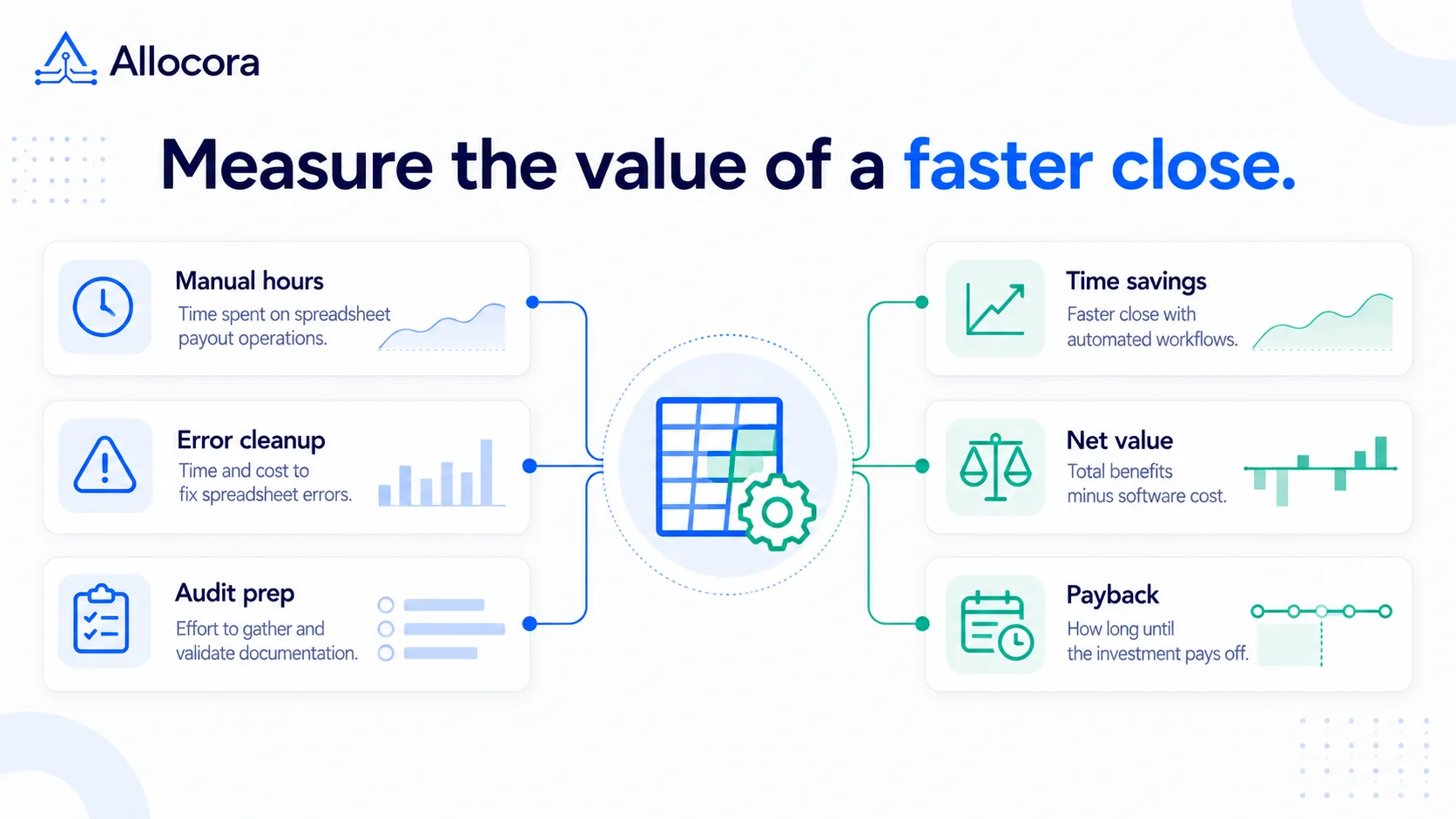 Royalty Ledger Automation ROI: When Spreadsheet Payout Operations Pay for Software
A practical before-and-after ROI model for evaluating royalty-ledger automation using close-time savings, avoided error costs, audit cleanup, and software cost.
Aug 27, 2026 - 11 min read
Royalty Ledger Automation ROI: When Spreadsheet Payout Operations Pay for Software
A practical before-and-after ROI model for evaluating royalty-ledger automation using close-time savings, avoided error costs, audit cleanup, and software cost.
Aug 27, 2026 - 11 min read
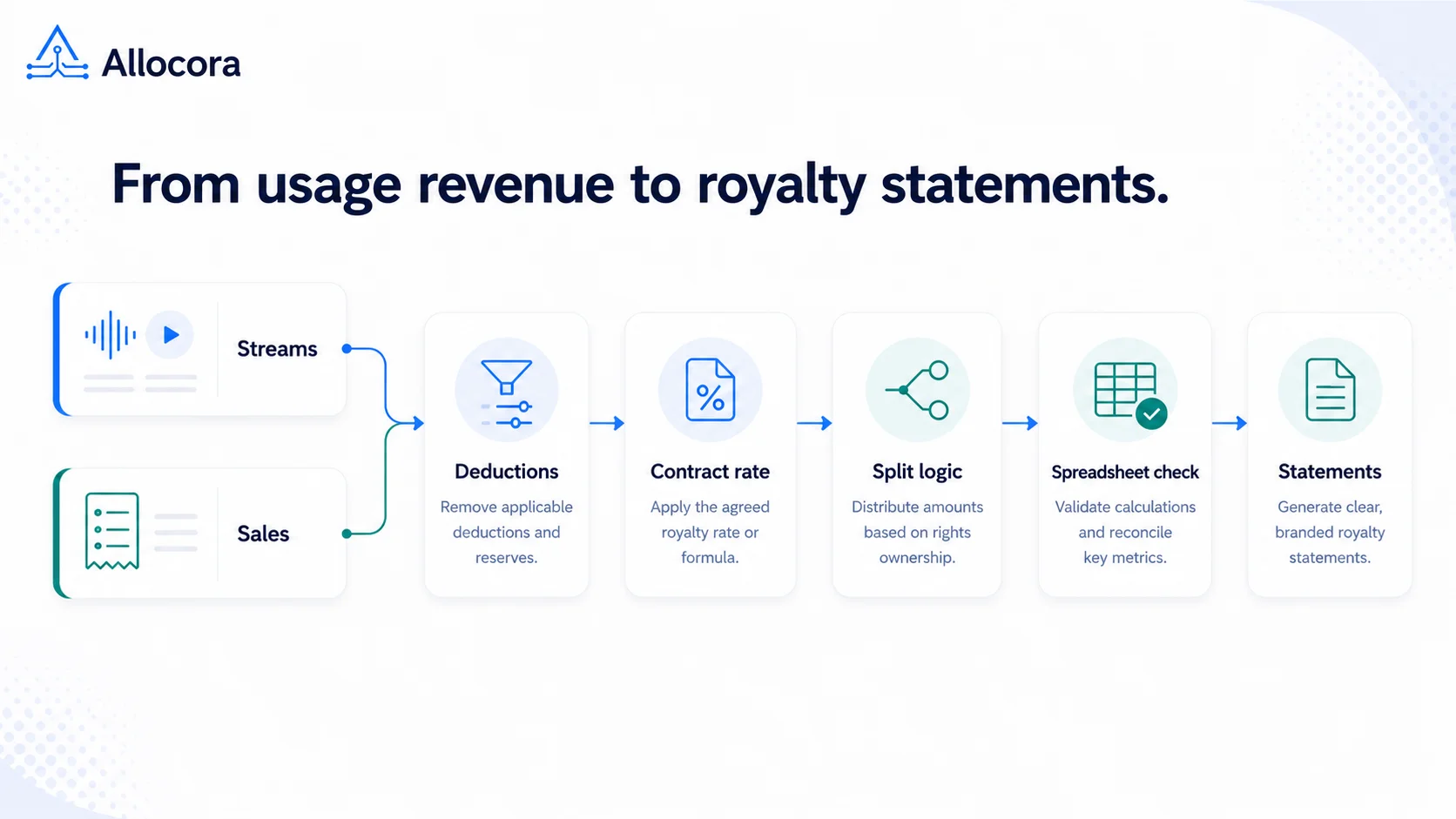 How to Calculate Music Royalties: Formula, Examples, and Spreadsheet Checks
A plain-language guide to calculating music royalties from gross revenue, deductions, splits, recoupment, statements, and audit notes.
Aug 21, 2026 - 8 min read
How to Calculate Music Royalties: Formula, Examples, and Spreadsheet Checks
A plain-language guide to calculating music royalties from gross revenue, deductions, splits, recoupment, statements, and audit notes.
Aug 21, 2026 - 8 min read